

A technology roadmap template is a ready-made visual plan for sequencing IT initiatives against time, ownership, and business goals. Start with a timeline template when you need to show dates and dependencies, a swimlane template when multiple teams need cross-functional alignment, or a one-page strategy view when you're presenting to executives. Open an editable version in whichever tool your team already lives in, and adjust from there.
TL;DR:
- Use a timeline template for showing project dates and dependencies when tracking delivery milestones and deadlines.
- Choose a swimlane format for cross-team alignment over a longer horizon where sequencing and ownership are the primary focus.
- Develop a strategy-on-a-page after detailed roadmaps are in place to quickly communicate IT goals to executives within ten minutes.
- Assign clear owners, dependencies, and success metrics to each initiative to prevent roadmaps from becoming static documents that nobody updates.
- Conduct quarterly reviews involving IT and business stakeholders to keep the roadmap current, actionable, and aligned with evolving priorities.
Table of Contents
- Where to Find Editable Technology Roadmap Templates
- Timeline, Swimlane, or Strategy-on-a-Page: Which Format Fits?
- How to Fill Out a Technology Roadmap Template Step by Step
- Customizing Your Roadmap Without Breaking It
- Turning a Template Into a Funded, Prioritized Plan
- What Actually Happens After the Roadmap Gets Built
- Get a Prioritized Plan Instead of Just a Template
- Sources
- FAQ
Where to Find Editable Technology Roadmap Templates
The right source depends on who has to open the file and how often it changes. File-based templates in PowerPoint and Excel remain the default for board decks and quarterly business reviews, largely because Office Timeline's free roadmap templates work offline, print cleanly, and don't require anyone outside your company to create an account.
Collaborative boards solve a different problem: real-time input from a distributed team. Miro and FigJam both handle live roadmap workshops well, letting product leads, engineers, and stakeholders drag initiatives around a shared canvas during a planning session instead of emailing slide decks back and forth. If your roadmap needs sign-off from people in different time zones, a board beats a static file every time.
Canva fills a narrower but real gap: polished, branded visuals for a roadmap that's going in front of a client, board, or investor. It's not built for heavy dependency mapping, but it wins on visual quality with minimal design effort.
ProductPlan sits between the two categories. It's purpose-built roadmap software rather than a general design or whiteboard tool, so it handles recurring updates, initiative tracking, and stakeholder views more natively than a slide deck ever will.
A few practical notes on picking among them:
- Use PowerPoint or Excel when the audience is executives who want to review offline or annotate a printed copy.
- Use Miro or FigJam when the roadmap gets built collaboratively, in real time, with more than three contributors.
- Use Canva when the output needs to look finished for an external audience, not just internal planning.
- Whichever format you pick, keep one master version and export snapshots for distribution. Editable-by-everyone files drift fast, and nobody notices until two versions disagree.
Timeline, Swimlane, or Strategy-on-a-Page: Which Format Fits?
Pick the format based on the decision you're trying to enable, not personal preference. Two visualization styles dominate technology roadmaps: timeline views for connecting technical work to delivery dates, and swimlane views for organizing work by theme or team.
- Timeline view. Use this when the audience needs to see dates, milestones, and dependencies at a glance, such as a migration cutover or a compliance deadline. Include start and end dates, blocking dependencies, and a visible "today" marker so viewers instantly see what's on track.
- Swimlane view. Use this for cross-team alignment over a longer horizon, where hard deadlines matter less than sequencing and ownership. ProductPlan's examples often separate lanes by People, Technology, and Security, which keeps a busy roadmap scannable even when a dozen initiatives run in parallel.
- Strategy-on-a-page. This is the format for a board or C-suite audience that has ten minutes and needs to see how IT spending maps to business goals. Gartner's guidance on one-page strategic summaries notes that executives respond better to concise goal-to-initiative mapping than to a detailed project list, and Info-Tech's Strategy-on-a-Page template is built around exactly that structure.
A CTO evaluating vendor coordination needs a timeline. A VP overseeing three product teams needs swimlanes. A CFO signing off on next year's budget needs the one-pager.
Pro Tip: Build the strategy-on-a-page version last, after the timeline or swimlane detail exists. Distilling from detail down to a one-pager is far faster than trying to expand a vague summary into a real plan.
How to Fill Out a Technology Roadmap Template Step by Step
A template is just a container. The value comes from the sequence you use to fill it, and skipping steps here is the single biggest reason roadmaps get built once and never touched again.
- Define the purpose and the decision it needs to enable. Are you seeking budget approval, aligning three teams on a migration, or reporting progress to a board? The audience determines the format you picked above.
- Assemble stakeholders and audit the current stack. Pull in IT leads and at least one business stakeholder, then inventory what's running today and where the visible gaps are.
- Prioritize initiatives by business impact and feasibility. Not every gap deserves a slot this quarter. Rank by what moves revenue, reduces risk, or unblocks other work, and be honest about what your team can actually deliver.
- Map initiatives into the template with owners and milestones. Every initiative needs a named owner, not a team name, plus a milestone date and any hard dependencies that could block it.
- Add a short narrative and success metrics, then schedule recurring reviews. A roadmap without metrics is a wish list. A roadmap without a review date is already stale.
This sequence follows a standard six-step lifecycle: define objectives, audit the stack, identify gaps, prioritize by impact, select a visualization, and maintain through recurring reviews.
Before you call it done, check for these gaps:
- Every initiative has a single named owner, not "the platform team."
- Dependencies between initiatives are marked, not implied.
- At least one success metric exists per initiative, even a rough one.
- A review date is on the calendar, not just intended.
Customizing Your Roadmap Without Breaking It
Templates fail when teams treat them as static art instead of a working document. A few adjustments make the difference between a roadmap people actually check and one that gets built once and forgotten.
Translate technical work into terms a non-technical stakeholder will fund. Framing technical debt in business outcomes instead of engineering jargon, such as showing that a refactor cuts deployment time by a measurable amount rather than just calling it "infrastructure cleanup," makes the difference between a line item that gets approved and one that gets cut.
- Set consistent status labels and colors ("On Track," "At Risk," "Blocked") and use them the same way across every lane.
- Assign one roadmap owner by name. Shared ownership is the fastest path to a roadmap nobody maintains.
- Set a quarterly review cadence with IT leads and at least one business stakeholder present, a pattern Tempo's roadmap guidance recommends specifically to keep roadmaps from calcifying.
- Keep the executive view and the delivery view separate. Overloading a board deck with sprint-level detail buries the decision you actually need approved.
- Flag critical integrations and third-party dependencies explicitly, especially where a vendor or partner controls a delivery date you don't.
A quarterly cadence isn't a suggestion. Roadmaps reviewed only annually tend to drift so far from reality that teams quietly stop referencing them, which defeats the purpose of building one at all.
Turning a Template Into a Funded, Prioritized Plan
Filling in a template is the easy part. Getting it funded and staffed is where most roadmaps stall, and that gap is exactly what a short technology assessment is designed to close.
- Start with an assessment: a real inventory of your current stack plus a rough three to five year total cost of ownership picture, not just a list of what's running today.
- Rank initiatives by ROI and risk together, not by whichever team lobbies loudest for budget.
- For any initiative involving automation or AI, build in human-in-the-loop checkpoints and monitoring before it reaches production, not after something breaks. A practical AI governance framework helps set those guardrails early.
- End with a short, plain-language, client-owned plan and one named roadmap owner, not a slide deck that gets filed and forgotten.
Pro Tip: If a cloud migration or cost-cutting initiative shows up on your roadmap, price it before you schedule it. A FinOps-driven cloud cost review upfront often reshuffles what gets prioritized this quarter versus next.
This is the same assessment-to-plan sequence followed by technology advisory services, and it maps directly onto the steps above.
What Actually Happens After the Roadmap Gets Built
Most roadmaps get built by whoever feels the pain first, usually a fractional CTO, an ops lead, or a founder tired of ad hoc IT decisions. Adoption stalls for one predictable reason: nobody assigned an owner, so the document sits untouched until the next crisis forces a rebuild from scratch.
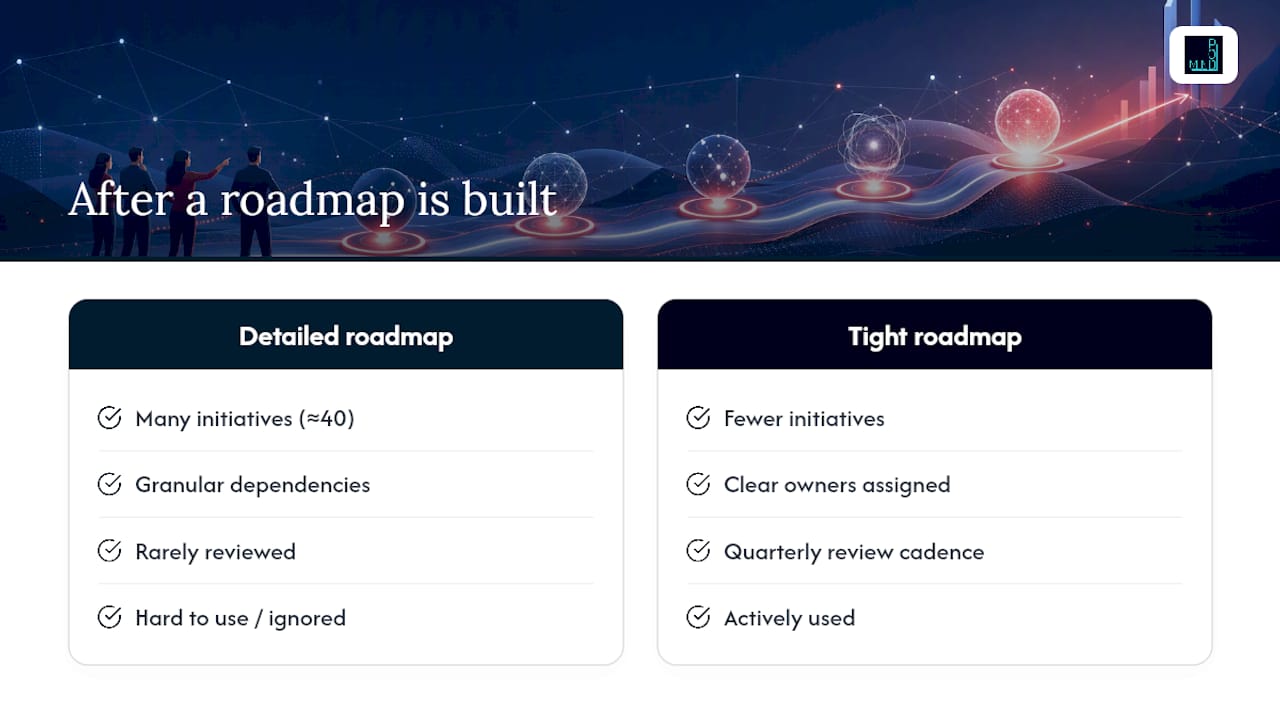
The tradeoff that trips up most teams is detail versus adoption. A roadmap with forty initiatives and granular dependencies looks thorough, but nobody reviews it because it's exhausting to open. A tighter roadmap with fewer initiatives, clear owners, and a quarterly review actually gets used.
If you track one metric first, track initiative completion rate against the quarter's plan. It exposes over-scheduling faster than any other number, and it tells you immediately whether your prioritization step was honest or aspirational.
— jaras
Get a Prioritized Plan Instead of Just a Template
A blank roadmap template answers the "what should we build" question. It doesn't answer "what can we actually afford, staff, and finish this year," which is where most SMB technology plans quietly fall apart. Some firms start every engagement with a free technology assessment that inventories your stack, sizes the cost picture, and ranks initiatives by ROI and risk, the same prioritization logic covered above, applied to your actual environment instead of a generic template.

That assessment turns into a prioritized, plain-language plan you own, whether the next step is fractional technology leadership, a cloud cost review, a security hardening pass, or a specific initiative like tariff and supplier risk work through SupplyMind.ei. From there, Mindpodtech can assign an owner and deliver the work directly instead of leaving it as a slide deck. Explore the full range of advisory and technology services or request a free assessment to see what a prioritized version of your roadmap actually looks like.
Sources
- How to create a technology roadmap: A step-by-step guide | Tempo
- Three Example Technology Roadmaps | ProductPlan
- IT Strategy Template for a Successful Strategic Plan | Gartner
- Free roadmap templates for Excel & PowerPoint - Office Timeline
- Working with engineering teams on technical debt roadmapping | AgileSeekers
FAQ
How do you create a technology roadmap?
Define the decision the roadmap needs to enable, audit your current stack, prioritize gaps by business impact, pick a visualization format, then map initiatives in with owners and milestones before setting a quarterly review cadence.
What is the technology roadmap model?
There's no single required model. Most teams choose between a timeline view for dates and dependencies, a swimlane view for cross-team themes, and a strategy-on-a-page for executive summaries, depending on the audience and decision at hand.
Does Excel have a roadmap template?
Excel doesn't ship with a built-in roadmap template, but free downloadable templates for Excel and PowerPoint are widely available and remain a common choice for offline review and executive decks.
What should be included in a roadmap?
A usable roadmap includes clear goals, named initiatives with a single owner each, dates or sequencing, dependencies between initiatives, and at least one success metric per item so progress can actually be measured.
Where can I get a free, editable technology roadmap template?
Free editable templates are available as PowerPoint and Excel downloads, as collaborative boards in Miro or FigJam, and as design-forward layouts in Canva, with ProductPlan offering a purpose-built option for teams managing recurring updates.