

Tariff engineering is the legal practice of adjusting a product's design, materials, or assembly so it lands in a lower-duty classification under the Harmonized Tariff Schedule, and it holds up only when the changed product has a genuine commercial identity buyers actually want. Converse's felt-bottomed sneakers, Columbia's tiny waist pockets, and Ford's ill-fated Transit Connect seats all sit on different sides of that line. The rest of this guide walks through what worked, what didn't, and how to tell the difference before you commit engineering dollars to a duty play.
TL;DR:
- Tariff engineering is only legal if the product retains a genuine commercial identity through functional and permanent design changes, not if features are immediately removed post-import.
- Changes like adding functional pockets, modifying material content, or unassembling components must be supported by documentation and, when possible, verified through CBP binding rulings.
- Mechanical levers such as assembly state, material thresholds, use classification, and country of origin determine the actual duty savings achievable from engineering adjustments.
- Small-volume importers often find little benefit due to upfront tooling and testing costs, whereas high-volume imports with significant duty rates can justify the effort with proper planning.
- Red flags for enforcement include post-shipment feature removal, internal documents referencing duty avoidance, or inconsistent classifications across similar SKUs.
Table of Contents
- What Counts as Legal Tariff Engineering Versus Illegal Misclassification
- Real Companies That Changed Products to Change Duty Rates
- The Four Levers That Actually Shift HTS Classification
- Where Tariff Engineering Crosses Into Enforcement Risk
- A 6-Step Process for Finding Tariff Engineering Opportunities
- Quantifying the Opportunity Before You Commit Engineering Dollars
- When Tariff Engineering Is Worth the Effort (And When It Isn't)
- Get a Clear Number on What Tariff Engineering Could Save You
- Where to Verify Classifications and Precedent Yourself
- Sources
- FAQ
What Counts as Legal Tariff Engineering Versus Illegal Misclassification
Courts and U.S. Customs and Border Protection (CBP) draw the line at commercial reality. If a design change produces a product with a real, marketable identity, including features a customer would actually use, it's legitimate engineering. If the change exists only on paper, or gets reversed the moment the shipment clears port, it's misclassification, and CBP treats it as fraud rather than planning.
The LII/Wex explainer on tariff engineering frames this as a long-recognized legal doctrine: importers may structure goods to minimize duty as long as the resulting product is what it claims to be at the border and afterward. Thomson Reuters' overview of the practice adds that common tactics fall into a handful of buckets: changing the assembly state, shifting material composition past a classification threshold, altering the functional use, or restructuring where substantial transformation occurs.
Before acting on any of these, check the primary sources yourself rather than relying on a blog post or a competitor's supply chain rumor:
- HTS.USITC.GOV for the current Harmonized Tariff Schedule and Most Favored Nation duty rates on the exact heading you're targeting.
- rulings.cbp.gov to search CBP's binding ruling database for prior decisions on similar products.
- Federal Register notices via govinfo.gov for policy changes, Section 301 actions, or trade remedy updates that could override a standard rate.
If your classification depends on a narrow technical fact, such as fabric weight percentage or whether a component is "essential" to a kit, request a CBP binding ruling before you commit to tooling or a production run. A ruling costs time up front but removes the guesswork that gets companies audited later.
Real Companies That Changed Products to Change Duty Rates
These aren't hypotheticals. Each case below is documented, and each shows a different mechanism for shifting HTS classification.
-
Converse's felt-soled sneakers. Adding a layer of felt to the sole of certain sneaker styles has historically pushed the shoe out of the standard rubber/plastic-soled footwear category and toward classifications associated with slippers or house shoes, which can carry different duty treatment. The felt has to serve a real function and stay on the shoe. A sole that's felt in the catalog photo but stripped off before retail defeats the purpose and invites an audit.
-
Columbia Sportswear's waist pocket. Columbia added a small pocket, sometimes called a chapstick or zip pocket, near the waistline of certain women's shirts. According to CNBC's reporting on the practice, that pocket can shift the garment's classification into a lower-duty apparel category than an equivalent shirt without one. The pocket has to be a usable feature integrated into the design, not a decorative afterthought, and Columbia's design and trade compliance teams reportedly coordinate on this from the product's inception.
-
Ford's Transit Connect "passenger vehicle." This is the cautionary tale every trade compliance officer cites. Ford imported the Transit Connect with rear seats installed, classifying it as a passenger vehicle to avoid the high tariff known as the "chicken tax" that applies to light trucks. Once the vans cleared customs, workers stripped out the seats and installed cargo flooring. Authorities concluded the seats had no genuine commercial purpose and existed solely to defeat the tariff. Ford ultimately agreed to a $365 million settlement with the Department of Justice, one of the largest customs penalty resolutions on record.
-
Toys versus dolls. U.S. tariff schedules have historically distinguished "dolls" representing human figures from other "toys," with different duty rates attached. Action figure makers have adjusted proportions and features so certain products fall under the toy heading rather than the doll heading, since the two carry different rate structures despite looking nearly identical on a shelf.
-
Textile blends and beanies. Apparel classification often hinges on fiber content by weight. A knit hat that's 51% cotton and 49% acrylic can fall into a different heading, and a different rate, than the same hat with the ratio flipped. Manufacturers who track fabric sourcing closely can hit a target blend percentage without changing how the garment looks or performs.
-
Kits versus finished goods. When a product ships as a kit of components rather than a fully assembled item, classification can depend on which single component gives the set its "essential character," a standard explained in Commerce Department guidance on substantial transformation. Shipping certain items unassembled, with final assembly happening domestically or at a different origin point, can change both the classification and the country-of-origin determination.
The pattern across every legitimate example: the design change is real, functional, and permanent. Converse's felt stays on the shoe. Columbia's pocket holds a chapstick. Ford's seats got ripped out within days of import, which is exactly what made the difference between engineering and evasion, and cost the company nine figures.
The Four Levers That Actually Shift HTS Classification
Most tariff engineering strategies boil down to four mechanical levers, and understanding which one you're pulling determines how much documentation and testing you'll need.
- Assembly state. Unassembled or partially assembled goods sometimes classify differently than finished products. Furniture shipped "knocked down" for domestic assembly is the classic case, and it can carry a different rate than the same piece shipped fully built.
- Material composition thresholds. Textiles are the most common example. Crossing a fiber-content percentage, like the cotton/acrylic split in the beanie example above, can move a garment into an entirely different tariff line.
- Functional or end-use classification. The same physical object can classify differently depending on its stated and demonstrable use. A furniture caster sold as a replacement part classifies differently than one sold pre-installed on a chair.
- Country of origin and substantial transformation. When a product undergoes enough processing in a given country to change its fundamental character, name, or use, that processing can shift the declared country of origin, which changes which trade agreements and Section 301 exclusions apply.
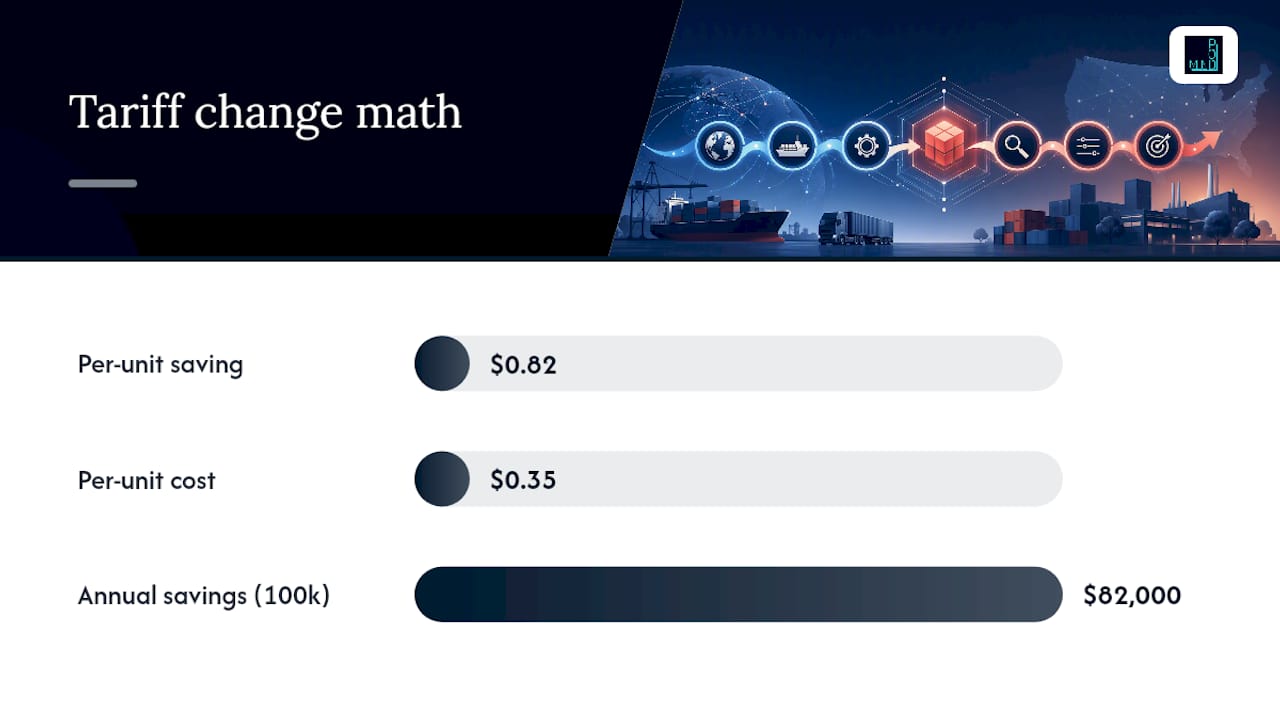
Here's a simplified version of how the math plays out when a company evaluates whether a change is worth making:
On 100,000 units a year, that $0.82 difference is $82,000 in annual duty savings against a one-time or recurring $0.35 cost increase, which nets out fast. The Thomson Reuters guidance on modeling these changes recommends running the math over a multi-year window, since tooling, lab testing, relabeling, and requalification costs often front-load in year one and shrink afterward. A change that looks marginal on a single year's savings can look very different across three years of volume.
Where Tariff Engineering Crosses Into Enforcement Risk
CBP doesn't need to catch you mid-shipment to build a case. Investigators routinely go back through internal emails, engineering change orders, and post-import handling records to figure out whether a design change had a genuine commercial purpose or existed only to dodge duty.
Common red flags that trigger audits or deeper review include:
- A design feature that gets removed, modified, or ignored immediately after customs clearance.
- Internal documents (emails, meeting notes) that explicitly reference tariff avoidance as the goal, rather than product function.
- A sudden classification change on an otherwise identical product with no corresponding change in how it's marketed or sold.
- Inconsistent classification across similar SKUs from the same importer.
The Ford case remains the reference point here. Investigators reportedly found that the passenger seats served no purpose beyond satisfying the classification test, and that the company's own internal handling, stripping them out almost immediately, undercut any claim of genuine commercial use. The penalties involved duty back-assessments, civil fines, and lasting reputational damage that outlasted the settlement itself.
The mitigation playbook is straightforward, even if executing it takes discipline: document the legitimate design rationale for every change before you make it, keep that documentation independent of any tariff discussion, and route borderline decisions through both engineering and trade compliance before production starts, not after.
Pro Tip: Write your design justification memo before you file for classification, not after CBP asks for one. A rationale drafted in real time, describing the functional purpose of the change, reads very differently to an auditor than one reconstructed under pressure two years later.
A 6-Step Process for Finding Tariff Engineering Opportunities
- Screen your SKUs by duty spend and volume. Pull your last 12 months of import data and rank products by total duty paid, not unit count. A handful of high-volume, high-rate SKUs usually account for most of your exposure.
- Run a cross-functional workshop. Bring design, product management, sourcing, and trade compliance into the same room. Classification changes that look easy from an engineering perspective often aren't from a compliance one, and vice versa.
- Model the savings against the cost. Use a duty-rate delta times annual volume, minus tooling, labor, and testing cost increases, the same way shown in the table above. Include a multi-year view if tooling costs are significant.
- Prototype and lab-test the change. If classification depends on a measurable fact, fiber percentage, weight, material composition, get it independently verified before you commit to a production run.
- Document everything. Keep design rationale, test results, and internal approvals in a file separate from any duty-savings discussion, ready to hand to a CBP officer on request.
- Request a binding ruling for borderline cases. If your classification hinges on a fact CBP could interpret differently, file for a binding ruling or consult customs counsel before scaling production.
Pro Tip: Treat step 6 as insurance, not bureaucracy. A binding ruling takes weeks, but a wrong classification found in a post-entry audit can trigger duty back-assessment across every shipment you've made since the change, plus penalties.
Quantifying the Opportunity Before You Commit Engineering Dollars
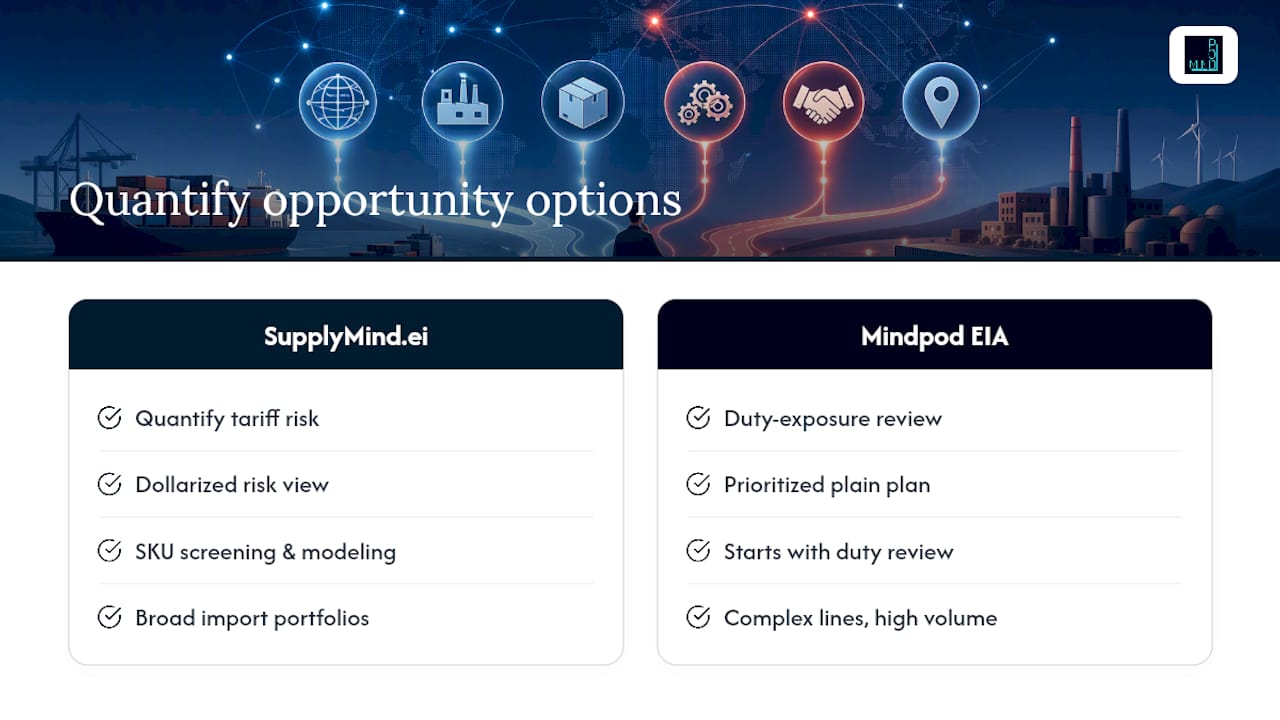
Most SMBs don't have a trade compliance department that can run the SKU screening and cost modeling described above across a full product catalog. That's the gap a tool like SupplyMind.ei is built to close: it quantifies tariff and supplier risk in dollar terms across your import portfolio, rather than leaving you to guess which SKUs are worth the engineering effort.
For companies with complex product lines, borderline classifications, or import volume that makes a wrong call expensive, Mindpod Technologies' Enterprise Intelligence Assessment starts with a duty-exposure review and produces a prioritized, plain-language plan you can act on or hand to customs counsel.
When Tariff Engineering Is Worth the Effort (And When It Isn't)
Tariff engineering earns its keep at volume. If you're importing a few hundred units a year, the tooling, testing, and compliance overhead usually eats the savings before you see them. Once you're moving tens of thousands of units annually at a meaningful rate spread, the math in the table above starts working hard for you.
Brand risk matters too. A shoe brand that adds felt to a sole risks nothing reputationally. A vehicle importer restructuring seats to dodge a truck tariff risks a $365 million lesson. Know which category your change falls into before your engineering team starts cutting prototypes.
— jaras
Get a Clear Number on What Tariff Engineering Could Save You
You've seen what Converse, Columbia, and Ford did, and you've seen where Ford's version blew up into a nine-figure settlement. The harder part for most SMB importers isn't finding one clever example to copy. It's knowing which of your own SKUs actually have enough duty spend and volume to justify the engineering, testing, and documentation work in the first place.

That's the specific gap SupplyMind.ei is built to close: it quantifies your tariff and supplier risk in dollar terms across your actual import portfolio, so you're prioritizing SKUs by real savings potential instead of running the workshop in Section 6 on a hunch. If you'd rather start with a broader look at where your IT and trade operations create hidden cost, Mindpod Technologies' Enterprise Intelligence Assessment begins with a free assessment and produces a prioritized, plain-language plan you own outright, no obligation to hire us to execute it. Book that assessment before your next production run locks in a classification you haven't stress-tested.
Where to Verify Classifications and Precedent Yourself
- HTS lookup: Hts for current duty rates and headings.
- CBP rulings: Rulings for binding-ruling precedent.
- Policy notices: Govinfo.
- Legal definition: LII/Wex on tariff engineering.
Sources
- Tariff engineering 101 (Thomson Reuters)
- DOJ — Ford Motor Company settlement (archive)
- HTS Search (USITC)
- CBP binding ruling (example)
FAQ
What Are Some Real Examples of Tariff Engineering?
Converse adding felt to sneaker soles, Columbia Sportswear adding a small waist pocket to certain shirts, and unassembled furniture shipped "knocked down" are documented examples. Each works because the design change is functional and permanent, unlike Ford's Transit Connect seats, which were removed right after import and triggered a $365 million settlement.
What Exactly Is a Tariff Example?
A tariff is a tax a government charges on imported goods, typically calculated as a percentage of the good's value under a specific Harmonized Tariff Schedule heading. A men's cotton shirt and a women's cotton shirt with a small pocket can carry different tariff rates under HTS even though both are cotton shirts.
What Are the Four Main Types of Tariffs?
Tariffs are generally grouped as ad valorem (a percentage of the good's value), specific (a fixed amount per unit), compound (a combination of both), and tariff-rate quotas (a lower rate up to a volume threshold, then a higher rate afterward). Which type applies depends on the HTS heading and any trade remedy actions layered on top, which you can check through Federal Register notices.
How Is Tariff Engineering Different From Misclassification?
Legal tariff engineering changes a product's actual design, materials, or assembly so the resulting good has a genuine commercial identity in its new classification. Misclassification declares a product as something it isn't, or reverses the change right after customs clearance, which is what turned Ford's case into a federal settlement rather than a legitimate cost-saving strategy.
When Should a Business Request a CBP Binding Ruling?
Request a binding ruling whenever your classification depends on a narrow technical fact, such as fiber percentage or which component gives a kit its essential character. A ruling from rulings.cbp.gov gives you documented precedent before you commit to production, rather than finding out during a post-entry audit.