

Selectively diversify the inputs that would actually shut you down if a single supplier failed, and fold every alternate into your existing vendor risk management program instead of running it as a side project. Don't try to diversify everything. Start with a quick supplier concentration check: pull your top three suppliers by spend in each critical category, see where 60% or more of a category sits with one vendor, and treat that as your priority list. NIST SP 800-161 and tools like SupplyMind.ei give you the structure and the math to act on what you find.
TL;DR:
- Focus on diversifying only high-criticality, upstream inputs with high concentration, lead-time sensitivity, and regulatory risk, rather than all suppliers equally.
- Use scoring criteria such as criticality, lead-time sensitivity, concentration, regulatory exposure, and financial health to prioritize supplier categories for diversification efforts.
- Implement a structured, phased approach involving evaluation, design, qualification, testing, and ongoing governance, integrating new suppliers into existing vendor risk management frameworks.
- Track key KPIs like single-source dependency, supplier concentration, geographic diversity, activation success, and recovery times to measure diversification effectiveness.
- Avoid common pitfalls like unmanaged overhead, testing without real activation, ignoring sub-tier risks, and neglecting contractual protections to ensure a sustainable, resilient supplier base.
Table of Contents
- What Is a Supplier Diversification Strategy, and Why Does It Matter?
- How Do You Decide What to Diversify First?
- How Do You Actually Implement a Diversification Plan?
- How Does This Fit Into Vendor Risk Management?
- What KPIs Prove Your Diversification Strategy Is Working?
- What Are the Biggest Mistakes Companies Make When Diversifying?
- What Mindpodtech Offers Beyond Advice
- Does Diversification Help With Sustainability and Ethical Sourcing?
- What Role Does Technology Play in Managing Multiple Suppliers?
- How Do You Manage Relationships With Suppliers During a Diversification Push?
- What Legal and Contractual Terms Matter Most?
- Three Rules That Actually Make Diversification Work
- Get a Clear Picture of Your Supplier Risk
- Primary Resources Worth Bookmarking
- Sources
- FAQ
What Is a Supplier Diversification Strategy, and Why Does It Matter?
A supplier diversification strategy means deliberately spreading procurement across multiple qualified vendors, regions, or transport modes for the inputs that matter most, so no single disruption can stop production. It's the practical cousin of vendor risk management (VRM): where VRM asks "how risky is this vendor?", diversification asks "what happens if this vendor disappears tomorrow, and do I have a working alternative?"
The case for it isn't theoretical. Harvard Business Review's analysis of early pandemic supply failures found that companies optimized for cost concentration got hit hardest, and argued firms need to rebuild for redundancy and visibility rather than pure efficiency going forward, per Harvard Business Review. That's the resilience side of the ledger.
But diversification isn't free, and pretending otherwise is how programs fail. Splitting volume across three vendors instead of one usually means:
- Higher procurement overhead: more contracts, more audits, more relationships to manage.
- Reduced volume leverage: your biggest supplier gave you better pricing because you gave them all your business.
- Longer lead times in some cases, since a newly qualified backup supplier rarely matches your incumbent's throughput on day one.
An IMF working paper on supply chain diversification models this trade-off directly: diversifying sources helps resilience mainly when the probability of a serious trade shock is high enough to justify the efficiency cost, and the benefit concentrates in upstream, rigid inputs that are expensive to reconfigure on short notice. That's the core decision trigger. If a category has low switching cost, low criticality, and multiple readily available vendors, diversifying it barely moves your risk number. If it's a single-source, long-lead-time, geographically concentrated input feeding a core product line, that's where the trade-off tips toward action.
How Do You Decide What to Diversify First?
Not every purchase order deserves a backup supplier. Start by splitting your supplier base into two buckets: critical items, where a stockout stops production or breaches a customer contract, and non-critical items, where a delay is an annoyance, not a crisis. Most SMB procurement teams find that a minority of their SKUs or service categories account for nearly all their real disruption exposure, so resist the urge to run every vendor through the same rigorous process.
For the items that land in the critical bucket, score each one across five dimensions:
- Criticality: Does this input stop a production line, a client deliverable, or a regulatory filing if it's unavailable?
- Lead-time sensitivity: How long would it take to qualify and ramp a replacement vendor from zero?
- Concentration: What percentage of spend or volume in this category sits with a single supplier?
- Regulatory exposure: Is this input subject to tariffs, export controls, or country-specific compliance rules that could change overnight?
- Supplier financial health: Is the vendor showing signs of financial strain that could turn a supply gap into a sudden one?
Rank categories by combined score and work down the list, not across every vendor at once. The IMF research backs this targeting approach directly: diversification pays off most on upstream, rigid inputs where reconfiguration is genuinely costly, not on commodity items with five interchangeable suppliers.
Pro Tip: Start upstream. The raw materials and sub-components three tiers back in your supply chain are usually where rigidity and concentration are worse, and where your own team has the least visibility. That's exactly why they get overlooked until they cause a shutdown.
How Do You Actually Implement a Diversification Plan?
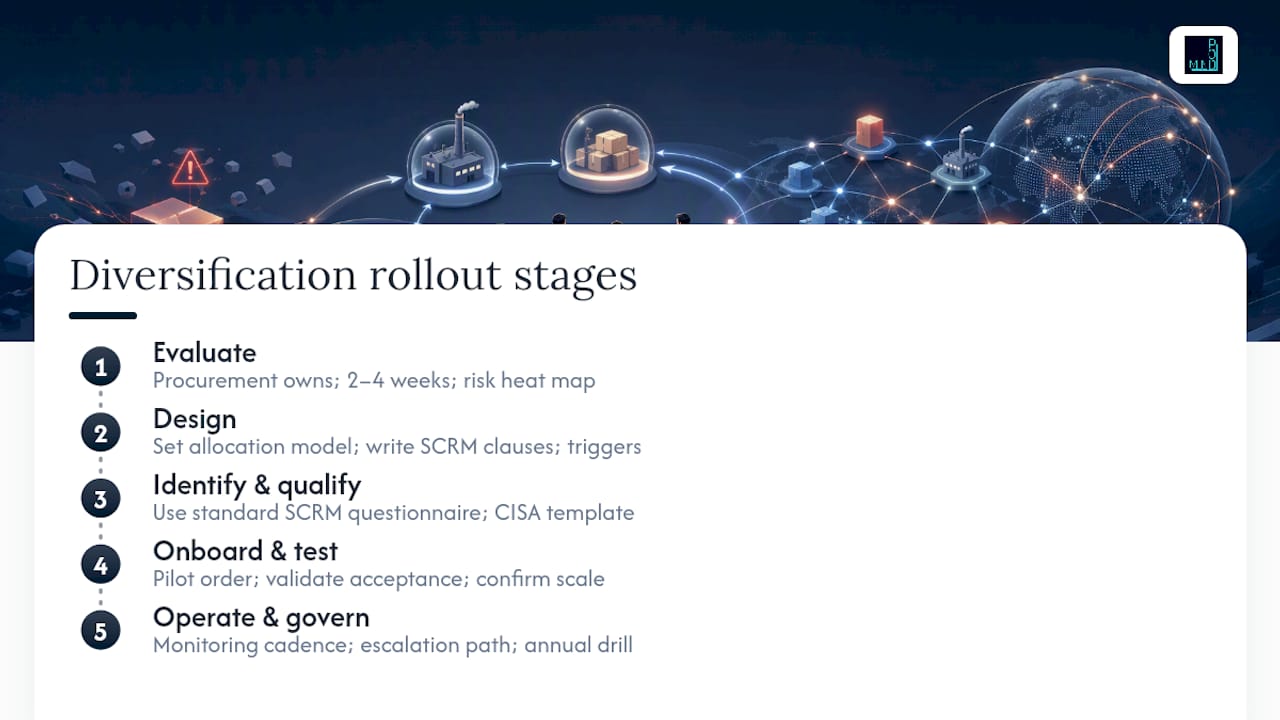
Diversifying suppliers without a sequence turns into scattered pilot orders that never scale and never get folded into your real procurement process. Treat it as a five-stage rollout with named owners and a defined cadence, not a one-time project.
1. Evaluate. Run a spend concentration analysis across your top 50 to 100 suppliers by category, map each critical input to its full upstream chain where you can, and build a simple risk heat map plotting criticality against concentration. Procurement leadership owns this stage, and it should take two to four weeks for a mid-sized operation.
2. Design. Before you go looking for new vendors, decide your target allocation model. A common structure is a primary supplier carrying the majority of volume, a qualified secondary at a smaller portion, and a tertiary or emergency-only vendor held in reserve. Write supply chain risk management (SCRM) clauses into every new contract, including notification requirements if a supplier subcontracts or relocates production, and set a requalification cadence (annually for critical vendors, every two to three years for the rest). Define activation triggers now, not during a crisis: a missed delivery window, a quality failure rate above a set threshold, or a credit downgrade should automatically kick off the secondary vendor's activation process.
3. Identify and qualify. Source candidates through industry associations, trade shows, or sourcing platforms, and run every candidate through a standardized SCRM questionnaire rather than an improvised email chain. CISA's ICT SCRM Task Force publishes a free vendor assessment template built for exactly this, covering quality management, contractual SCRM terms, and supply-chain change notification. Using a shared template also speeds up qualification because you're not reinventing the question set for every new vendor.
4. Onboard and test. Never move volume to a new supplier cold. Run a small pilot order first, validate it against your existing acceptance criteria, and confirm the vendor can actually hit your forecasted volume before you count them as a real secondary source. This step catches the gap between "this vendor passed qualification" and "this vendor can deliver at scale" before it costs you a missed shipment.
5. Operate and govern. Set a monitoring cadence (monthly for critical vendors, quarterly for the rest), define an escalation path when a metric breaches threshold, and run a tabletop activation drill at least once a year, actually routing a real order through your secondary supplier to confirm the failover works when nobody is testing it under real pressure.
How Does This Fit Into Vendor Risk Management?
Diversification without governance just gives you more vendors to lose sleep over. The fix is to fold every new supplier into the same VRM structure you already use for your primary vendors, not run a separate spreadsheet for "backups."
NIST SP 800-161 lays out the lifecycle approach worth copying: a centralized vendor inventory, tiering by criticality, continuous monitoring rather than point-in-time reviews, and written SCRM requirements baked into every contract. That last piece matters more than it sounds. Without it, your secondary supplier can quietly replicate your primary supplier's exact geographic or sub-tier risk, and you find out only after both go down in the same event.
Practical steps for integration:
- Add every alternate supplier to your central vendor inventory the moment they pass qualification, tagged by criticality tier, not just tracked informally by the sourcing team.
- Run alternates through the same CISA vendor SCRM questions you use for incumbents, covering security posture, financial stability, and sub-tier transparency.
- Require supply-chain change notification clauses in every contract, so you learn about a subcontractor swap or facility relocation before it becomes a surprise.
- Set continuous monitoring alerts for financial health, delivery performance, and compliance status, rather than relying on an annual review.
CISA built its template specifically to normalize these questions across organizations, which cuts real time out of qualification when you're vetting several alternates at once instead of writing a fresh questionnaire for each. That standardization is the difference between diversification that scales and diversification that collapses under its own administrative weight.
What KPIs Prove Your Diversification Strategy Is Working?
You can't defend a diversification budget to leadership with a vague sense that things feel safer. You need numbers that move, and a way to show what the movement is worth.
Track these on a recurring basis, ideally monthly for critical categories:
- Single-source dependency rate: percentage of critical spend categories with only one qualified supplier. This metric should trend downward as your program matures.
- Supplier concentration index: share of category spend held by your top supplier. Watch for categories still showing high concentration percentages.
- Geographic diversification ratio: percentage of critical suppliers concentrated in a single region or country.
- Alternative activation rate: how often, and how successfully, your secondary suppliers actually get tested or activated in a real order.
- Supplier financial health average: a composite score across your critical vendor base, tracked over time rather than checked once at onboarding.
- Recovery time objective (RTO): how long it would take to shift meaningful volume to an alternate if your primary supplier failed today.
For ROI, a defensible formula looks like this: avoided-loss value equals estimated lost revenue per day of an outage, multiplied by the number of downtime days your diversification plan actually shaves off, based on your measured RTO improvement. If a category outage would cost a substantial amount per day and your secondary supplier cuts recovery time significantly, that's notable days of avoided exposure, a number your CFO can actually work with.
| Scorecard component | What it measures | Healthy signal |
|---|---|---|
| Concentration index | Share of spend with top supplier | Trending below 60% for critical categories |
| Activation rate | Frequency of tested backup usage | At least one real or drill activation per year per critical category |
| RTO | Days to shift volume to an alternate | Shortening year over year |
| Financial health average | Composite vendor stability score | Stable or improving, not just at onboarding |
What Are the Biggest Mistakes Companies Make When Diversifying?
The most common failure isn't picking the wrong vendor. It's diversifying without discipline and letting the hidden costs pile up unmanaged.
Watch for these pitfalls:
- Diluting volume leverage without a plan to recover it. Splitting orders across three vendors can quietly raise your per-unit cost by more than the resilience is worth if nobody's tracking the pricing gap.
- Adding overhead nobody owns. Every new supplier is another contract, another audit cycle, another point of contact. Without a named owner, alternates get onboarded and then forgotten.
- Never actually testing the alternate. A secondary supplier that's never received a real order isn't a backup. It's a hope.
- Ignoring sub-tier risk. Your primary and secondary suppliers can both source the same rare component from the same overseas factory, and you'd never know unless your SCRM questions asked.
Budget for the real costs up front: qualification effort, contract renegotiation, extra tooling or admin to manage more relationships, and a dual-sourcing price premium that rarely disappears entirely.
Pro Tip: Treat opaque sub-tier information as an automatic red flag. If a supplier can't or won't tell you where their own inputs come from, declining financial indicators or a non-answer to your SCRM questionnaire should stop qualification, not just slow it down.
What Mindpodtech Offers Beyond Advice
Building this program manually across dozens of suppliers is where most SMB teams stall out, not because the framework is unclear, but because quantifying risk in dollars and keeping a live vendor inventory is genuinely time-consuming. Mindpodtech's advisory work covers fractional CTO support and cybersecurity assessments that map directly onto the VRM steps above, and SupplyMind.ei is built specifically to quantify tariff and supplier risk in dollar terms, so a concentration problem shows up as an actual number instead of a hunch.
A typical assessment surfaces where your concentration and SCRM gaps actually sit, then produces a prioritized, plain-language action plan you keep regardless of what you do next. If you're staring at a spreadsheet of suppliers and don't know where to start, the free technology assessment is built for exactly that starting point.
Does Diversification Help With Sustainability and Ethical Sourcing?
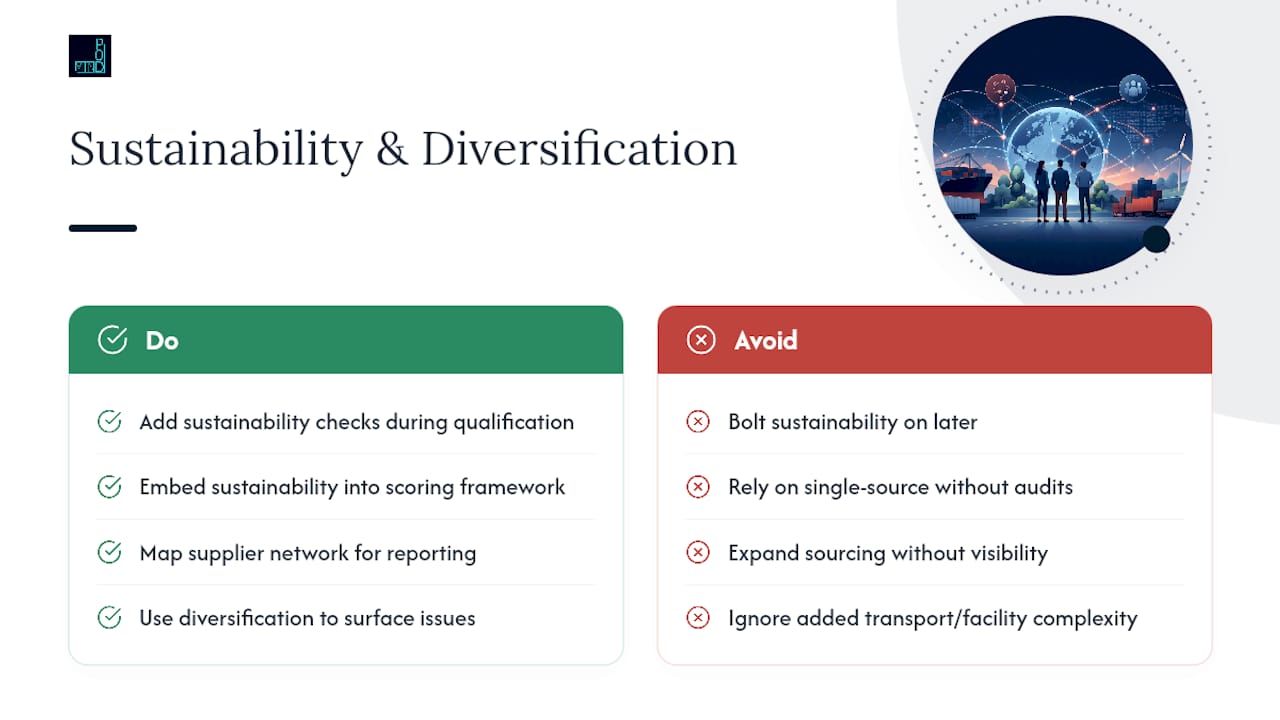
Diversification and ethical sourcing pull in the same direction more often than procurement teams expect, mainly because vetting a new supplier is the moment you have the most leverage to ask hard questions. When you're qualifying an alternate anyway, adding labor practice and environmental compliance checks to that questionnaire costs little marginal effort, and it closes a gap most single-source relationships never get audited for.
There's a real trade-off to manage, though. Adding suppliers usually means adding transport legs, additional facilities to track, and more variation in labor and environmental standards across regions, particularly when diversification pushes sourcing into new countries. DHL's supply chain diversification framework treats this directly, noting that spreading sourcing across new regions and transport modes raises visibility requirements even as it reduces single-point failure, according to DHL's practitioner guidance.
The practical fix is to build sustainability criteria into your qualification scoring from the start rather than bolting it on later. If your five-dimension scoring framework already includes regulatory exposure, extending that same review to cover labor standards, emissions reporting, or conflict-minerals sourcing barely adds process overhead. Mapping your supplier network with this lens also feeds directly into sustainability reporting requirements many mid-sized companies now face from customers or investors, a task covered in more depth by supply chain mapping guidance for sustainability reporting. Diversification done well doesn't just reduce disruption risk. It gives you more chances to catch an ethical sourcing problem before a customer or regulator finds it first.
What Role Does Technology Play in Managing Multiple Suppliers?
Manual diversification tops out fast. Spreadsheets can track five suppliers across two categories, but once you're monitoring dozens of vendors across a dozen critical inputs, tracked manually, someone inevitably misses a renewal date, a financial health flag, or a compliance deadline until it's already a problem.
Procurement platforms and monitoring tools lower the marginal cost of adding each new supplier, which is precisely why practitioner guidance from Maersk pairs diversification advice with a call for better governance tooling, not just more vendors. Without automated tracking, the administrative overhead of a diversified base outpaces its resilience benefit before you even notice.
The technology stack for this doesn't need to be exotic. At minimum, you need a centralized vendor database with automated alerts for contract renewals, financial health changes, and requalification deadlines. Beyond that, dashboard tools that pull concentration ratios and geographic distribution automatically save real analyst hours every quarter compared to rebuilding the same report by hand. Tools purpose-built for supplier and tariff risk quantification, like SupplyMind.ei, take this further by turning concentration data directly into a dollar exposure figure, which is the number that actually gets budget approved. The point isn't chasing the newest platform. It's making sure your monitoring cadence, the one you already committed to in your governance stage, actually happens without depending on someone remembering to check a spreadsheet.
How Do You Manage Relationships With Suppliers During a Diversification Push?
Telling your incumbent supplier you're bringing in a second source is an uncomfortable conversation, and skipping it usually backfires worse than having it. Vendors who find out through a shrinking purchase order, rather than a direct conversation, tend to respond defensively: tightening terms, deprioritizing your account, or becoming less transparent about their own sub-tier risk exactly when you need more visibility, not less.
Frame the conversation around resilience, not dissatisfaction. Most established suppliers understand that single-source dependency is a risk to them too. Being your only source means a supply hiccup on their end becomes a crisis for you, and a reasonable buyer relationship acknowledges that a qualified backup protects the relationship rather than threatens it.
Segment your relationship intensity to match supplier tier. Strategic, high-volume suppliers get regular business reviews, joint planning conversations, and early notice of any allocation changes. Secondary and tertiary suppliers can be managed with lighter-touch, mostly automated check-ins, periodic performance reviews, and SCRM monitoring alerts, without the same relationship investment. Trying to give every vendor the white-glove treatment is exactly the overhead problem that sinks diversification budgets.
Set clear volume-allocation expectations with every vendor up front, in writing, including what triggers a shift in allocation between primary, secondary, and tertiary status. Ambiguity here is where relationships sour. A supplier who agreed to 20% of volume and then watched it silently drop to 5% without explanation has a legitimate grievance, and a defensive vendor is a worse source of supply chain intelligence than a candid one.
What Legal and Contractual Terms Matter Most?
Every new supplier contract is a chance to build in protections that your original single-source agreement probably never had. Skipping this step means you've diversified your vendor list without diversifying your actual protection against risk.
Prioritize these clauses in every new and renewed supplier agreement:
- Supply-chain change notification: require written notice if a supplier changes subcontractors, relocates production, or shifts a material sourcing location, which is exactly the kind of change that can quietly recreate concentration risk you thought you'd eliminated.
- SCRM compliance requirements: bake NIST or CISA-aligned security and continuity questions directly into contract terms, not just into a onetime qualification questionnaire that never gets revisited.
- Volume and allocation flexibility: define minimum and maximum order commitments clearly enough that shifting volume toward or away from a supplier isn't a breach dispute waiting to happen.
- Termination and transition assistance: specify a reasonable transition period and cooperation requirement if a contract ends, so you're not left qualifying an emergency replacement with zero runway.
- Data and IP protection: especially relevant if the new supplier touches your product specifications, proprietary processes, or customer data.
Regulatory exposure varies by industry and by whether a supplier is domestic or international, and tariff classifications, export control rules, and data residency requirements differ meaningfully depending on where a vendor operates. Legal review from someone familiar with your specific sector's compliance requirements is worth the cost before signing, not after a dispute starts.
Three Rules That Actually Make Diversification Work
Most diversification advice tells you to spread risk broadly. That's backwards for a resource-constrained SMB. The programs that survive contact with a real budget follow three rules instead.
First, diversify what actually matters. If a category isn't upstream, rigid, or genuinely single-source dependent, leave it alone and spend your qualification hours where they count. Second, test before you shift real volume. A supplier that passed a questionnaire but never filled a real order is a paper backup, not a working one. Third, automate the triggers. Deciding in the moment of a crisis whether to activate your secondary supplier is how good plans fail under pressure. Decide the threshold now, while you're calm and have the data in front of you.
None of this requires diversifying everything at once. It requires knowing exactly which twenty percent of your supplier base would actually hurt if it failed, and building real, tested coverage for that twenty percent first.
— jaras
Get a Clear Picture of Your Supplier Risk
Most of the framework above depends on knowing your actual exposure in dollars, not just gut feel about which vendor "feels risky." That's the piece SupplyMind.ei is built for: it quantifies tariff and supplier concentration risk in dollar terms and helps you rank which categories to fix first, which is exactly the prioritization step this whole strategy runs on. Pair that with Mindpodtech's advisory work on VRM and security assessments and you've got the quantification and the governance structure in one place instead of two disconnected efforts.

If you're not sure where your concentration risk actually sits, start with a technology assessment. It surfaces your real gaps and hands you a prioritized plan you keep, whichever advisory or software provider you decide to work with. Check out the enterprise intelligence platform to see how SupplyMind.ei fits into that first conversation.
Primary Resources Worth Bookmarking
- NIST SP 800-161: the federal lifecycle framework for vendor risk controls and continuous monitoring.
- CISA's vendor SCRM assessment template: a ready-to-use question set for qualifying suppliers.
- IMF working paper on supply chain diversification: the economic case for targeted, not blanket, diversification.
- Harvard Business Review on resilient supply chains: case-based lessons from real pandemic supply failures.
- Maersk's practitioner framework: operational steps for multi-sourcing and multi-shoring at scale.
Sources
- NIST Special Publication 800-161 Revision 1 (Supply Chain Risk Management Practices for Federal Information Systems and Organizations)
- Vendor supply chain risk management template — CISA ICT SCRM Task Force
- Supply-chain diversification and resilience — IMF working paper
- Coronavirus is proving that we need more resilient supply chains — Harvard Business Review
FAQ
Is There an Actual Strategy for Supplier Diversification?
Yes. The core approach is to segment suppliers by criticality, score critical categories against concentration and lead-time risk, then diversify only those categories and embed the alternates into your existing vendor risk management program rather than managing them separately.
What Are the 5 C's of Supply Chain Management?
Definitions vary across sources, and there's no single agreed-upon list. Rather than force a canonical framework, focus on the scoring dimensions this article covers directly: criticality, concentration, lead-time sensitivity, regulatory exposure, and supplier financial health.
What Are the Four Main Types of Diversification Strategies?
In a supply chain context, the most commonly cited dimensions are multi-sourcing (multiple suppliers per input), multi-shoring (spreading production across regions), transport mode diversification, and diversified logistics operations, a framework detailed in DHL's supply chain diversification guidance.
What Is Supplier Diversification, Exactly?
Supplier diversification is the deliberate practice of sourcing critical inputs from multiple qualified vendors, regions, or transport channels instead of relying on a single supplier, reducing the odds that one disruption halts production.
Does Diversifying Suppliers Always Cost More?
Usually, yes, at least initially. You lose some volume-based pricing leverage and add qualification and monitoring overhead, but that cost buys down the risk of a shutdown, which is why the decision should hinge on whether an input is critical enough to justify the trade-off, not applied universally.