

SIEM is your audit grade log backbone: it collects, normalizes, and retains records across the organization for compliance and forensic reconstruction. XDR is a detection and response layer that correlates endpoint, network, cloud, identity, and email telemetry into structured incidents and triggers automated containment. Most organizations with real compliance obligations need both, or a converged platform, chosen based on regulatory exposure, staffing depth, and where visibility gaps actually sit.
TL;DR:
- Most organizations will require both SIEM and XDR platforms, or a converged solution, depending on their compliance needs and staffing capacity.
- SIEM excels in broad log retention, compliance reporting, and forensic investigations across heterogeneous environments, but demands continuous tuning and engineering effort.
- XDR offers faster threat detection, automated responses, and simplified alert management through curated telemetry and vendor-managed analytics.
- Cost considerations include SIEM's volume-based licensing with rising storage costs and XDR's per-endpoint pricing, with hidden expenses in data egress and integration.
- A phased, tailored approach starting with a basic SIEM, then layering XDR where detection gaps exist, helps small and medium teams optimize resources and reduce operational risk.
Table of Contents
- SIEM vs XDR at a Glance
- How SIEM Works: Architecture, Detection Mechanics, and Forensic Value
- How XDR Works: Telemetry, Analytics, and Automated Response
- Operational Tradeoffs: Alert Quality, Tuning Burden, and SOC Impact
- Deployment, Cost, and Scaling Considerations
- Compliance, Retention, and Forensics: Why SIEM Still Matters
- Integration Patterns: Practical Architectures for SIEM Plus XDR
- Checklist: Evaluating SIEM, XDR, or a Converged Approach
- Mindpod's Take: A Phased Path for SMBs and Mid-Market Teams
- Get a Free Security Assessment From Mindpod Technologies
- Sources
- FAQ
SIEM vs XDR at a Glance
Before diving into architecture, here's how the two categories stack up on the factors that actually drive a buying decision.
- Primary function: SIEM centralizes and retains logs for compliance and investigation; XDR detects and contains threats across a curated set of security telemetry.
- Data inputs: SIEM ingests almost anything with a log format, from firewalls to HR systems; XDR typically ingests endpoint, network, cloud, identity, and email telemetry from a defined set of integrated sources.
- Detection approach: SIEM relies on correlation rules and behavioral baselines you tune yourself; XDR leans on vendor-managed analytics and machine learning models updated centrally.
- Response model: SIEM generates alerts for a human or a SOAR playbook to act on; XDR can trigger automated isolation, process termination, or account lockout natively.
- Compliance and retention role: SIEM is generally the system of record auditors expect; XDR retention windows are often shorter and scoped to its own telemetry.
- Typical strengths: SIEM wins on breadth, historical search, and audit defensibility. XDR wins on speed to detection and lower day-to-day tuning load.
- Typical weaknesses: SIEM demands ongoing engineering and generates alert noise if under tuned. XDR's visibility stops at the edge of what the vendor supports.
- Best team fit: SIEM suits organizations with dedicated detection engineering or an MSSP relationship. XDR suits lean teams that need strong out of box detection without a full engineering buildout.
Neither model is inherently better. They answer different questions: SIEM answers "what happened across our entire environment, and can we prove it?" XDR answers "what's happening right now, and can we stop it automatically?"
How SIEM Works: Architecture, Detection Mechanics, and Forensic Value
A SIEM starts with ingestion. Log forwarders, syslog feeds, API connectors, and agents pull events from firewalls, servers, identity providers, SaaS applications, and network devices into a central pipeline. That raw data rarely arrives in a consistent shape, so the platform normalizes it, mapping vendor-specific fields into a common schema so different security events can sit in the same searchable index.
Once normalized, the SIEM indexes events for search and applies correlation rules: for example, login failures exceeding a threshold from a new geography within a short time of a password reset may trigger an alert. More mature deployments layer in behavioral baselines that flag deviation from a user's or asset's normal pattern rather than relying purely on static thresholds. SIEM centralizes logs from across the organization, normalizes events, applies correlation rules, and functions as the backbone for compliance, retention, and forensic reconstruction, which is precisely why regulated organizations keep one running even after adopting other detection tools.
That correlation engine is also SIEM's biggest operational cost. Rules need continuous tuning. A new application onboarded without a parser update creates a blind spot; a rule written too broadly buries analysts in false positives. Teams that treat SIEM as "install and forget" typically end up with either a flood of low-value alerts or, worse, a quiet dashboard that isn't actually watching anything meaningful. Getting this right takes a detection engineer's ongoing attention, not a one-time configuration project. Organizations that skip this step often discover the gap during an incident, when they realize a critical log source was never onboarded in the first place, a problem closely related to the shadow IT visibility gaps that plague fast-growing companies.
Retention is where SIEM earns its keep for compliance and legal teams. Storing normalized logs for extended periods lets investigators reconstruct a full timeline of an incident long after the event, correlating suspicious activities over time. That kind of retrospective forensic search, across arbitrary time windows and arbitrary data sources, is something most XDR platforms are not built to do at scale, since their storage and indexing model is optimized for recent, high-fidelity telemetry rather than years of archived logs.
SIEM should be your foundation when you run a heterogeneous technology estate spanning legacy on-prem systems, multiple clouds, and a mix of vendor tools, or when a regulator, auditor, or cyber insurance policy requires demonstrable log retention. If your environment is simple and mostly cloud-native, that same breadth can become overhead you don't need yet.
How XDR Works: Telemetry, Analytics, and Automated Response
XDR starts from a narrower, more curated telemetry set including endpoint activity, network traffic, cloud workload events, identity signals, and email. Rather than treating each source as independent, the platform stitches related events together automatically. A phishing email, a malicious macro execution on the endpoint, and an unusual outbound connection from that same machine get merged into one structured incident narrative instead of three unrelated alerts an analyst has to manually connect.
That stitching is the core value proposition. XDR unifies telemetry across endpoints, network, cloud, identity, and email, applies analytics and machine learning to cut false positives, and enables automated response actions directly from the console. Instead of a raw alert that says "suspicious process spawned," you get a timeline showing the initial access vector, lateral movement attempt, and the process tree, already correlated.
The detection models themselves are largely vendor-managed. Where a SIEM's correlation rules are yours to write and maintain, an XDR platform's detection logic gets updated centrally by the vendor's threat research team, based on telemetry pooled across their entire customer base. That's a real advantage for teams without dedicated detection engineers, since you inherit improvements without writing a single rule. It's also a real constraint: you're limited to the detection logic and integrations the vendor has chosen to build, and tuning options are typically narrower than what a SIEM offers.
Automated response is where XDR distinguishes itself operationally. Native playbooks can isolate an endpoint, kill a malicious process, disable a compromised account, or block a malicious domain across integrated tools, often within seconds of detection, without waiting on an analyst to act. Forrester frames XDR as an evolution toward cross-domain detection and response, though it's worth being direct about the caveat buried in that framing: implementations vary widely between vendors, and "automated response" in one platform can mean a handful of native containment actions, while in another it means deep orchestration across dozens of third-party tools.
That variance points to the real tradeoff: vendor integration model and lock-in. XDR's cross-domain magic depends heavily on how well it talks to your existing endpoint, identity, and cloud stack. A platform built around a single vendor's ecosystem will correlate beautifully within that ecosystem and poorly outside it, which matters a lot if your environment is multi-cloud or runs a mix of security tools from different vendors.
Operational Tradeoffs: Alert Quality, Tuning Burden, and SOC Impact
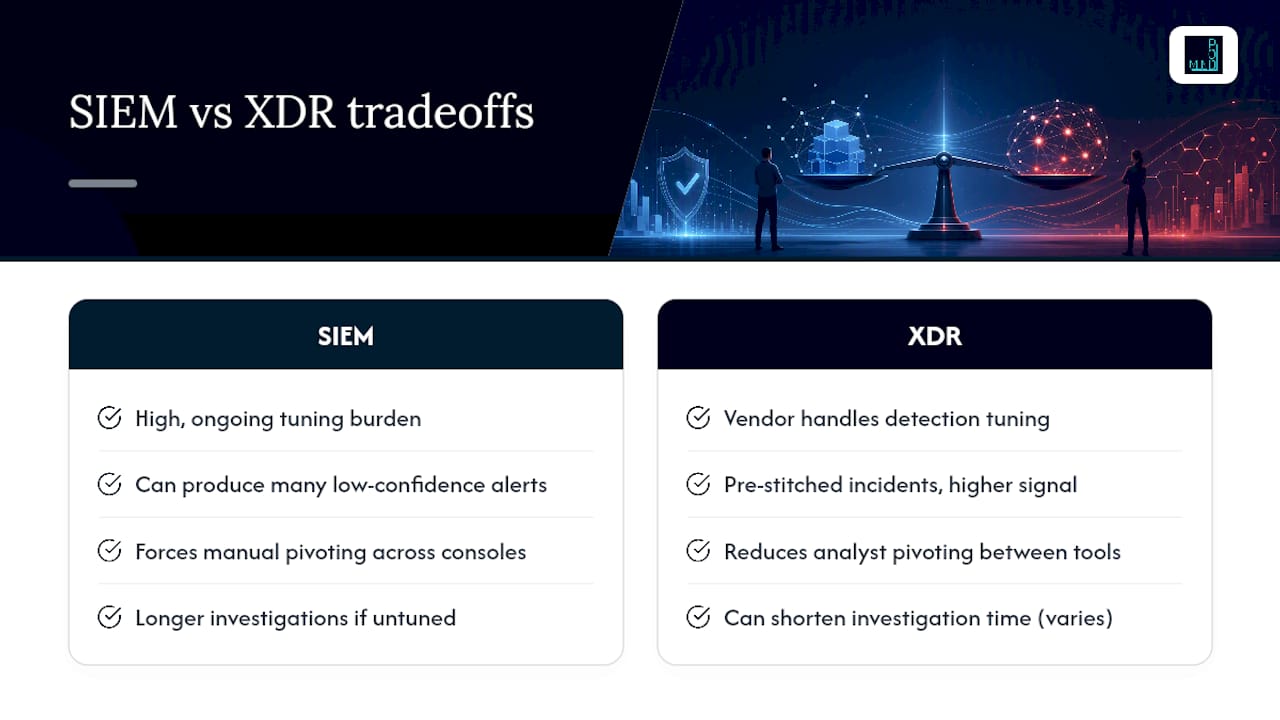
The technical differences above translate directly into how your analysts spend their day. SIEM's tuning burden is real and ongoing: someone has to write, test, and refine correlation rules, or the tool either misses real threats or drowns the team in noise. XDR shifts that burden to the vendor, whose data science and threat research teams update detection models across their customer base, which is a meaningful relief for a five-person SOC without a dedicated detection engineer.
Alert quality is the more visible impact. A poorly tuned SIEM can generate hundreds of low-confidence alerts a day, forcing analysts to manually pivot between an EDR console, a network monitoring tool, and the SIEM itself to piece together what actually happened. XDR's pre-stitched incidents cut that pivoting dramatically, since related events already arrive bundled into one narrative. Reducing analyst pivoting between consoles is one of the largest measurable operational gains teams report after adopting XDR, though realizing it depends on having clear playbooks and defined ownership for who acts on which incident type. Without that clarity, you just end up with two tools generating separate alert queues instead of one.
Vendor research indicates XDR adoption can shorten investigation time and reduce analyst fatigue when cross-domain correlation and automated actions work as designed, though actual gains vary by deployment and by how much of your environment the platform actually covers natively. Staffing follows from all this: a lean team leans toward XDR or a managed detection and response (MDR) service layered on top of it; a team supporting strict compliance mandates usually needs SIEM expertise in-house or via a managed SOC provider, regardless of which detection layer sits on top.
Pro Tip: If you're a small team choosing where to spend your first telemetry budget, prioritize endpoint and identity data before network logs. Those two sources catch the largest share of real-world intrusion techniques, and they're the fastest to deploy without heavy engineering.
Deployment, Cost, and Scaling Considerations
SIEM cost scales primarily with ingest volume and retention window. Most pricing models charge by the gigabyte ingested per day or indexed per month, so adding new log sources, extending retention from ninety days to seven years for compliance, or onboarding a noisy application can quietly multiply your bill. On top of licensing, budget for the engineering time to build and maintain parsers, correlation rules, and dashboards. That labor cost is frequently the larger line item over a multi-year horizon, not the software itself.
XDR cost typically follows a per-endpoint or per-seat licensing model, sometimes with tiers based on which telemetry sources (network, cloud, identity) you add beyond core endpoint coverage. Cloud processing for the analytics layer is usually bundled into the license rather than billed separately, which makes forecasting easier than SIEM's consumption-based pricing. The tradeoff is breadth versus price: broader coverage across cloud and identity sources generally means moving up a pricing tier.
Hidden costs show up in both models. Data egress fees from cloud providers add up fast if you're shipping large log volumes to a SIEM hosted outside your cloud environment. Third-party telemetry connectors, the integrations that let either platform ingest data from a tool the vendor doesn't support natively, often carry separate licensing or professional services fees. Scaling a SIEM from one hundred to one thousand employees can multiply storage costs faster than headcount grows, since log volume tends to scale with device and application count, not just people.
When budgeting, ask vendors for a twelve-month total cost projection based on your actual current log volume and expected growth, not a list price per gigabyte. Ask specifically what counts toward ingest for pricing purposes, since some platforms charge for raw data before normalization and others charge after, which can produce very different bills for identical environments.
Compliance, Retention, and Forensics: Why SIEM Still Matters
Frameworks like SOC 2, PCI-DSS, HIPAA, and the NIST Cybersecurity Framework generally expect demonstrable log retention and the ability to reconstruct events well after they occur, not just real-time detection. SIEM remains necessary for compliance and long-term retention, and organizations that try to replace it outright risk failing regulatory and forensic requirements when an auditor asks for evidence spanning a retention window their detection tool was never built to hold.
Forensic reconstruction is the practical reason this matters beyond a checkbox audit. When an incident surfaces months after the initial compromise, which happens often with slow-moving data exfiltration or dormant malware, investigators need to search back through historical logs across every affected system to build an accurate timeline. That's SIEM's specialty: broad historical search across normalized data from disparate sources.
XDR's telemetry is often sufficient for investigating the incident itself, tracing exactly what happened on the endpoint or in the cloud workload during the active attack window. Where it typically falls short is retention depth and breadth outside its supported telemetry sources. If your compliance obligations require years of retained logs across systems XDR doesn't natively monitor, HR platforms, legacy on-prem applications, network devices from a vendor outside the XDR's integration list, you still need a SIEM or an equivalent long-term log repository to close that gap.
Integration Patterns: Practical Architectures for SIEM Plus XDR
Three patterns cover most real-world deployments. Pattern A puts XDR on the front line for detection and automated response, then forwards its incident data into SIEM for archival, compliance retention, and cross-referencing against other log sources. This suits teams that want fast detection with an audit trail behind it. Pattern B runs SIEM-first, using it as the primary detection and search platform, with XDR layered in specifically to accelerate endpoint and cloud investigations where its automated correlation saves analyst time. This suits teams with existing SIEM investment and detection engineering maturity who want targeted relief, not a wholesale platform swap.
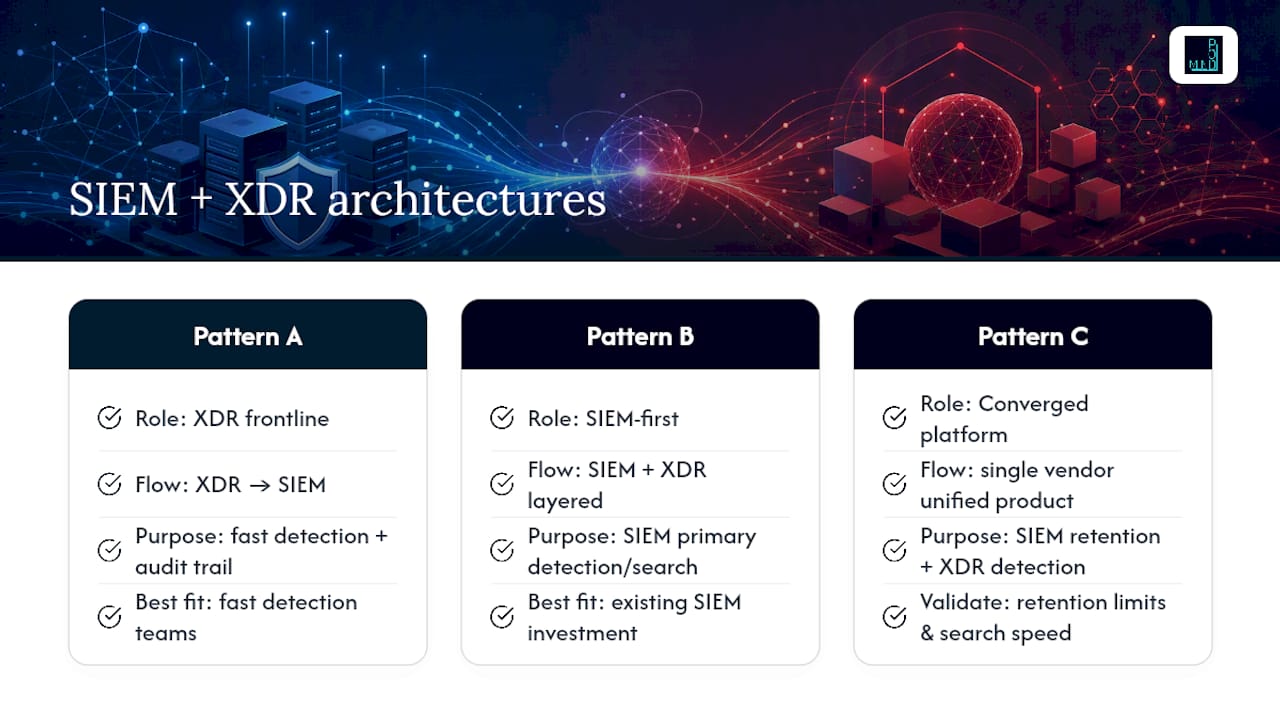
Pattern C is the converged platform, where a single vendor offers both SIEM-grade retention and XDR-style detection in one product. Platform convergence is a real and growing trend: some SIEM vendors now bundle XDR-like detection, and some XDR vendors extend retention windows to compete on compliance use cases. If evaluating a converged platform, validate retention limits, forensic search speed against your actual data volume, and whether the "unified" pricing still spikes when you add non-native telemetry sources.
Whichever pattern you choose, define alert ownership and escalation rules explicitly. Decide in writing which tool an analyst checks first for a given alert type, who owns exporting data for compliance requests, and how incidents get handed off between platforms, before an actual incident forces you to figure it out live.
Checklist: Evaluating SIEM, XDR, or a Converged Approach
Work through these questions before signing a contract with either category of vendor:
- Map your compliance obligations first. List every framework you must satisfy (SOC 2, PCI-DSS, HIPAA, or industry-specific rules) and their minimum retention windows.
- Inventory your telemetry sources. Identify every log source you currently have and confirm which ones each candidate platform actually ingests natively versus through a paid connector.
- Test forensic search speed. Ask for a proof of concept searching a realistic volume of historical data, not a canned demo with a small dataset.
- Ask for detection efficacy evidence. Request detection rate and false-positive data from a comparable customer environment, not marketing benchmarks.
- Confirm automation scope. Get a specific list of native automated response actions versus ones requiring a third-party integration or professional services engagement.
- Evaluate export formats. Confirm the platform can export data in formats your legal and compliance teams can actually use during an investigation or audit.
- Match the platform to your team's capacity. Security maturity should drive the choice: SIEM-first for large, heterogeneous, compliance-heavy estates; XDR-first for small teams needing fast detection without a full engineering buildout.
Whatever you choose, treat the first ninety days as a tuning period, not a finished deployment. XDR platforms that provide genuine cross-domain correlation and automated response have been associated with faster investigation times in vendor-reported deployments, but that outcome depends on proper telemetry onboarding and clear playbooks, not the software alone.
Mindpod's Take: A Phased Path for SMBs and Mid-Market Teams
Most SMBs don't need to solve SIEM versus XDR as an either/or decision on day one. Start with a lean SIEM baseline for the log sources compliance actually requires, then layer in XDR where it closes a real detection gap or takes tuning work off an overstretched analyst's plate. That sequencing avoids paying for retention you don't need yet, or detection breadth you can't operationally support.
Mindpod Technologies runs this as a phased engagement: a free technology assessment identifies your actual compliance and coverage gaps, a prioritized plan you own sequences the fixes by risk and cost, and implementation includes monitoring, rollback, and human-in-the-loop checkpoints, particularly where agentic AI touches detection or response workflows, which is where measurable ROI actually shows up: fewer manual pivots, faster containment, less wasted engineering time.
— jaras
Get a Free Security Assessment From Mindpod Technologies
Mindpod Technologies is the practical alternative to guessing your way through a SIEM or XDR purchase: instead of buying first and tuning later, you get an assessment that maps your actual compliance obligations and telemetry gaps before a dollar is spent on licensing.

Our security assessment and hardening service produces a prioritized, plain-language plan covering exactly which log sources need to be onboarded, where automated detection would relieve your team, and whether a converged platform makes sense for your size. If autonomous monitoring across your Microsoft and Azure environment is part of the gap, our MITB platform extends that same phased, human-in-the-loop approach into day-to-day operations. Request a free technology assessment and get a plan you own before you commit to either category of tool.
Sources
FAQ
Will XDR Replace SIEM?
Unlikely for regulated organizations. SIEM remains necessary for compliance and long-term retention, and most security teams run XDR for faster detection alongside SIEM for audit and forensic requirements rather than dropping one for the other.
Is Microsoft Sentinel a SIEM or an XDR?
Microsoft Sentinel is built and marketed as a cloud-native SIEM, though it integrates closely with Microsoft's XDR product (Microsoft Defender) for endpoint and cross-domain detection, reflecting the broader trend of SIEM and XDR platforms converging.
Is CrowdStrike a SIEM or EDR?
CrowdStrike's core Falcon platform started as EDR and has expanded into full XDR, correlating endpoint data with network, cloud, and identity telemetry; it is not a traditional SIEM and doesn't offer the same long-term log retention model.
What Is Replacing SIEM?
Nothing fully replaces SIEM's compliance and retention role today. The more accurate trend is convergence, where some SIEM platforms add XDR-like detection and some XDR platforms extend retention, blurring the line rather than eliminating either category.
How Do I Know If My Organization Needs Both?
If you face compliance retention requirements and lack in-house detection engineering capacity, you likely need both: a phased assessment can identify exactly where each tool should sit in your environment before you commit budget to either one.