

Shadow IT discovery is the ongoing process of finding, inventorying, and assessing every app, cloud service, endpoint, or API connection running inside your organization without formal IT approval. Start now with three moves: run a cloud discovery scan against your proxy or firewall logs, pull 30 days of SSO and identity provider logs to see which apps users authenticate into, and begin a 72-hour DNS sweep on your network traffic. Record two numbers immediately: the total count of unknown apps surfaced and the percentage of users touching at least one non-catalog app. Those two figures become your baseline for every decision that follows.
- Run a cloud/network discovery scan (proxy, firewall, or CASB logs).
- Pull SSO and identity provider logs for the same period.
- Start a 72-hour DNS/network sweep to catch what identity logs miss.
Key Takeaways
Shadow IT discovery works only when layered telemetry (network, identity, endpoint) feeds a continuous discover, evaluate, manage, monitor cycle instead of a one-time audit.
| Point | Details |
|---|---|
| Start with identity logs | SSO/IdP data gives the fastest, broadest visibility into unsanctioned app usage. |
| Layer, don't rely on one source | Combine network, endpoint, and expense data since no single method catches everything. |
| Score risk consistently | Use a weighted rubric (data sensitivity, user count, compliance flags) to triage remediation. |
| Communicate before enforcing | Explain monitoring scope and business reasoning before restricting any tool. |
| Track mean time to remediation | This KPI shows whether your triage process actually closes the loop, not just finds risk. |
| Get expert help scoping the stack | Mindpodtech's free technology assessment maps discovery gaps and delivers a prioritized plan. |
Table of Contents
- What Does Shadow IT Discovery Actually Cover?
- Which Telemetry Sources Actually Find Shadow IT?
- How Does the Discover-Evaluate-Manage-Monitor Process Work?
- How Do You Build an Integrated Detection Stack?
- How Should You Prioritize Discovered Apps?
- What Belongs in a Shadow IT Discovery Pilot Checklist?
- Where Do Shadow IT Discovery Methods Fall Short?
- Why Identity-Centric Controls Matter More Than Ever
- How Do You Manage Change Without Triggering a Backlash?
- What KPIs Actually Prove Your Program Is Working?
- What SMB Deployments Actually Teach You
- How Mindpodtech Helps You Get From Discovery to Governance
- Sources
- FAQ
What Does Shadow IT Discovery Actually Cover?
Shadow IT discovery spans more ground than most teams assume. It includes unsanctioned SaaS and cloud apps, unmanaged endpoints (laptops, personal phones, IoT devices), orphaned API keys and service accounts, unauthorized browser extensions, and increasingly, Shadow AI: employees feeding company data into public chatbots or embedding third-party AI agents into workflows nobody vetted.
Before you build a program, define its edges:
- Which departments are in scope for the initial sweep (start with finance, sales, and marketing; they buy the most SaaS).
- Which data classes matter most (customer PII, financial records, health data).
- Which networks and device types count (corporate VPN only, or personal devices too).
The biggest blind spots: devices that never touch the VPN, browser-based AI tools with no install footprint, and SaaS subscriptions employees expense on personal cards.
Which Telemetry Sources Actually Find Shadow IT?
No single signal catches everything. Effective shadow IT detection blends several data streams, each with real tradeoffs.
- CASB/cloud discovery tools: strong at cataloging known SaaS with risk scores attached, weaker on brand-new or niche apps not yet in the catalog. Microsoft's Defender for Cloud Apps scores against a catalog of over 31,000 apps using more than 90 risk factors, then layers in Defender for Endpoint and proxy log collectors for continuous visibility.
- Expense and credit-card mining: surfaces subscriptions technical telemetry never sees, since finance records often reveal SaaS purchases that network monitoring misses entirely.
- Email/invoice scanning: catches sign-up confirmations and renewal notices as a secondary signal, per vendor discovery guidance.
For most SMBs, the minimum viable stack is network monitoring plus IdP logs plus one endpoint signal. That combination catches the majority of unsanctioned activity without a heavy deployment lift.
Pro Tip: Run your first expense-report audit before you buy any discovery tool. It costs nothing, takes an afternoon, and usually turns up more surprises than a month of log analysis.
How Does the Discover-Evaluate-Manage-Monitor Process Work?
Shadow IT management follows a repeatable lifecycle, and skipping a phase is how programs stall out after the first inventory.
- Discover: aggregate telemetry from network, identity, and endpoint sources into a single inventory of apps, devices, and accounts. Output: a raw asset list with usage counts.
- Evaluate/Analyze: apply risk scoring and compliance flags to each item. A useful filter: usage exceeding 5 users AND risk score below 40 gets prioritized for sanctioning; usage under 5 users with a high risk score gets flagged for immediate review.
- Manage/Remediate: sanction apps that pass review (route through SSO, add to the approved catalog), block or migrate off apps that fail, and negotiate contracts where consolidation makes sense.
- Monitor: set continuous alerts for new app sign-ups, unusual data transfer volumes, and license creep, feeding results back into the discovery phase.
This mirrors the workflow Microsoft recommends for cloud app discovery: discover, evaluate, manage, on a continuous loop rather than a one-time audit.
How Do You Build an Integrated Detection Stack?
Think of the architecture in five layers: telemetry sources feed an ingestion layer, which populates a catalog and risk engine, which triggers enforcement through proxy, SSO, or MDM controls, which reports out to your ITSM or ticketing system.
Integration priorities, in rough order:
- IdP connectors first (Entra, Okta): identity is the fastest path to broad visibility and the backbone of every later enforcement step.
- Proxy/firewall log collectors: catch traffic that never touches SSO.
- EDR/MDM integration: adds device-level context, especially useful for catching locally installed software.
- CASB/API integrations: automate catalog matching and risk scoring instead of manual spreadsheet work.
- Expense and email connectors: lower priority technically, but high value for catching financial blind spots.
Lightweight approaches, like a browser extension that flags AI tool usage, deploy in days but only cover browser activity. Heavier agent-based EDR deployments take longer to roll out but give you process-level visibility. Most SMBs should sequence lightweight signals first, then layer in agent-based tools as budget and IT bandwidth allow.
How Should You Prioritize Discovered Apps?
Not every unsanctioned app deserves the same urgency. A weighted rubric keeps triage decisions consistent instead of ad hoc.
- Data sensitivity (customer PII, financial, health records carry the heaviest weight).
- User count (an app used by 50 people is a bigger governance gap than one used by two).
- Integration depth (does it connect to your core systems via API or OAuth token).
- Vendor risk and compliance posture (does the vendor carry SOC 2, and does the app touch HIPAA-regulated data).
A simple three-band scoring model works well in practice: a score of 0 to 30 means tolerate and monitor, 31 to 70 means recertify with the business owner within 30 days, and 71 to 100 triggers immediate remediation. If your organization handles HIPAA or SOC 2-scoped data, weight compliance flags higher regardless of user count. A niche app with two users but direct access to patient records should score in the immediate-remediation band every time.
What Belongs in a Shadow IT Discovery Pilot Checklist?
Run your pilot narrow and fast. Scope it to one or two departments, pick two or three data sources (start with IdP logs and proxy logs), define success metrics up front (number of apps cataloged, percentage sanctioned within 30 days), and set a hard timeline of four to six weeks.
Map stakeholders before you start: IT owns the technical discovery and tooling, security owns risk scoring and remediation calls, procurement owns vendor negotiation once an app gets sanctioned, legal reviews data processing terms, and business unit owners weigh in on whether a flagged app is actually mission-critical.
- Define monitoring boundaries in writing before you start collecting data.
- Use privacy-preserving language in policy documents (monitor app usage patterns, not individual browsing history).
- Set classification tiers (sanctioned, tolerated, prohibited) and a review cadence, typically quarterly.
Pro Tip: Draft your employee communication before your pilot launches, not after someone finds out their expensed project management tool got flagged. A short, plain-language memo explaining what's being monitored and why heads off most of the pushback.
Where Do Shadow IT Discovery Methods Fall Short?
Every method has gaps. Browser-only AI tools and freemium apps often generate no network signature IT recognizes. Ephemeral API keys and service accounts get created and abandoned faster than most audit cycles catch them. Personal devices off the corporate network stay invisible to proxy logs entirely, and reimbursed purchases on personal cards bypass procurement controls completely.
Practical mitigations exist for most of these. Tie access to sensitive data stores to SSO requirements so even ungoverned apps need an identity check to reach anything valuable. Deploy browser monitoring specifically for Shadow AI usage, since AI agents increasingly interact through browser UIs and APIs that traditional installation-based detection never sees. Loop in legal before deploying any monitoring that touches personal devices or off-hours activity.
Why Identity-Centric Controls Matter More Than Ever
Shadow AI has quietly broken the assumptions most discovery programs were built on. A generative AI tool doesn't need an installer, doesn't touch your endpoint agent, and often runs entirely inside a browser tab or through an API call. Perimeter-based detection simply doesn't see it.
Security researchers argue the fix is identity-centric controls paired with transaction-level monitoring rather than another network appliance. Gartner's guidance on generative AI points the same direction: protect the data flows to and from external AI services, not just the endpoint. Three moves matter most right now: prioritize SSO/IdP integration as your primary detection lever, instrument API and browser telemetry specifically for AI endpoints, and apply per-transaction monitoring for AI agents rather than one-time approval checks. This lines up with the continuous verification model in NIST's zero trust architecture, which treats every access decision as a fresh evaluation rather than a standing permission.
How Do You Manage Change Without Triggering a Backlash?
Shadow IT mitigation fails more often from poor communication than from weak technology. Employees adopt unsanctioned tools because the sanctioned alternative is slower, clunkier, or doesn't exist yet. Rip out an app without addressing that gap and you'll just push the behavior further underground, often to a tool with even less oversight.

Start every remediation conversation with the business reason for the tool, not the security violation. If marketing has been using an unapproved design tool for eight months, find out what it does that your approved stack doesn't before you talk about shutting it down. That conversation usually surfaces a legitimate need you can fold into your sanctioned catalog instead of fighting.
Communicate in tiers. A prohibited app with active data exposure needs an immediate, direct message from security leadership with a clear deadline. A tolerated app under review can wait for the quarterly governance update. Sending every finding with the same urgency trains employees to ignore all of them.
Give business owners a say in the recertification process outlined earlier. When a department head signs off on keeping a tool (or agrees to migrate off it), you get buy-in instead of resentment. ISACA's guidance on shadow IT makes the same point: pairing technical detection with genuine stakeholder coordination is what makes remediation stick instead of bouncing back six months later.
Publish a short, recurring update, monthly or quarterly, showing what got sanctioned, what got migrated, and what's still under review. Transparency here does more to reduce future shadow purchases than any policy memo.
What KPIs Actually Prove Your Program Is Working?
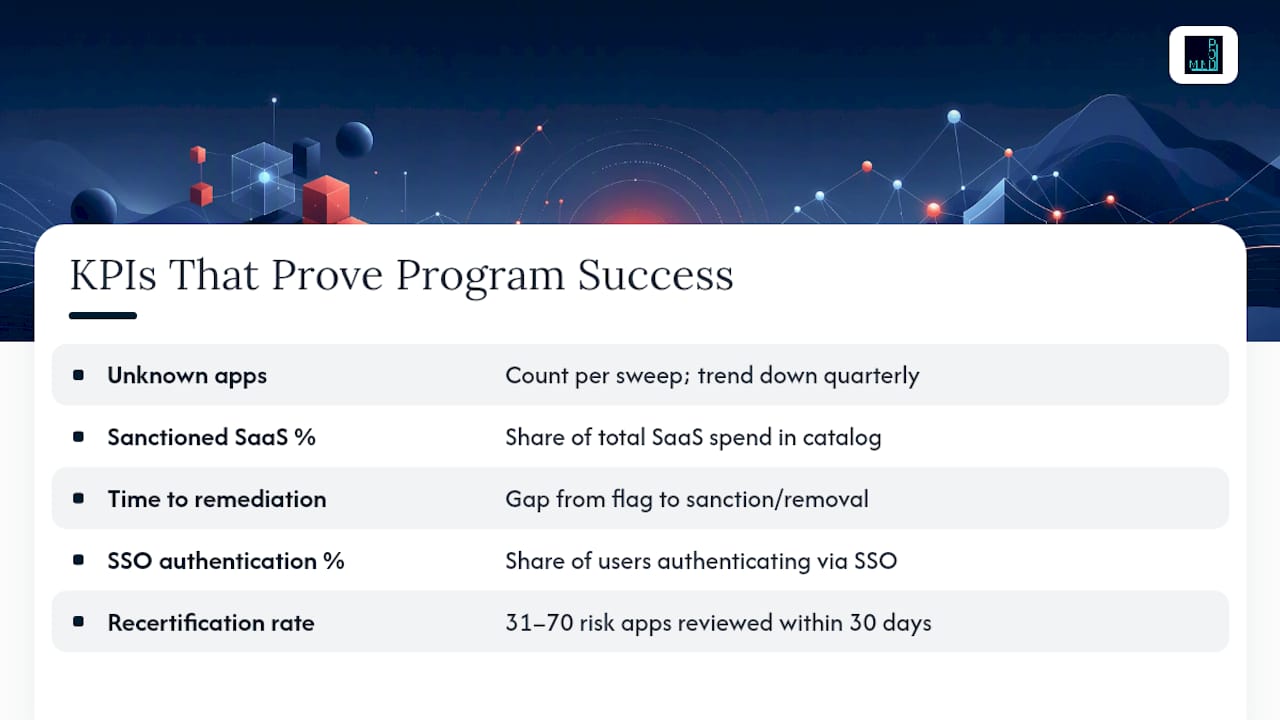
Track a small set of numbers consistently rather than a sprawling dashboard nobody reads. The count of unknown apps discovered per sweep is your starting baseline; watch it trend down over successive quarters, not just in the first month. The percentage of total SaaS spend running through your sanctioned catalog versus outside it tells you whether procurement controls are actually working.
Mean time to remediation, the gap between when you flag a high-risk app and when it's sanctioned or removed, is one of the sharper signals of program maturity. A shrinking number here means your triage rubric and stakeholder process are working together instead of creating bottlenecks. Also track the share of users authenticating through SSO versus standalone credentials; a rising SSO percentage means your identity-first strategy is closing blind spots.
Finally, measure recertification completion rate: what percentage of apps flagged for the 31 to 70 risk band actually get reviewed within your stated 30-day window. A program that finds risk but never closes the loop on review isn't managing shadow IT, it's just cataloging it. Report these four numbers together, quarterly, to whoever owns budget for the program. Isolated metrics tell a partial story; together they show whether unauthorized technology is actually shrinking or just getting better documented.
What SMB Deployments Actually Teach You
The programs that stick are the narrow ones. Teams that try to discover, score, and remediate everything in month one usually stall by month three because there's no bandwidth to act on the findings. Scope your pilot to one high-spend department, pick low-friction wins first (an app with three users and no sensitive data access isn't worth a fight), and set KPIs you can actually hit with the headcount you have.
Not every discovered app needs to disappear. A tolerated app with limited data exposure and a small user base is often better left alone than forced through a disruptive migration that burns political capital you'll need later for the apps that actually matter.
How Mindpodtech Helps You Get From Discovery to Governance
Building the stack described above, network telemetry, identity logs, a risk-scoring rubric, and a governance cadence, takes real engineering time most SMB IT teams don't have sitting idle. Mindpodtech starts every engagement with a free technology assessment that maps your current visibility gaps against the discovery methods covered in this guide, then hands you a prioritized, plain-language plan you own outright, whether you implement it in-house or bring Mindpodtech in to execute it.

That assessment typically surfaces where your identity and endpoint telemetry already overlap, where your Shadow AI exposure sits relative to your data sensitivity profile, and which quick wins (SSO enforcement, proxy log integration) will move your risk score fastest. From there, Mindpodtech's security assessment and hardening service line can build out the ingestion, scoring, and enforcement layers directly, or support your internal team through the rollout. If your organization runs primarily on Microsoft infrastructure, MITB extends that visibility into autonomous IT operations across Entra and Azure. Start with the free assessment and get a plan you can act on within weeks, not quarters.
Sources
- Tutorial: Discover and manage shadow IT — Microsoft Learn
- NIST SP 800-207: Zero Trust Architecture
- Navigating the shadows — ISACA Journal
FAQ
How do you discover shadow IT?
Combine network or proxy log analysis, SSO/identity provider logs, and at least one endpoint signal (EDR or MDM), then feed the results into a risk-scoring rubric to prioritize what gets reviewed first.
What is shadow IT in Microsoft's framework?
Microsoft defines shadow IT as any cloud app or service used without IT approval, and its Defender for Cloud Apps platform structures discovery into discover, evaluate, and manage phases using a catalog of over 31,000 apps scored against 90-plus risk factors.
Is shadow IT an insider threat?
Shadow IT isn't inherently malicious, most employees adopt unsanctioned tools to work faster, but it creates the same exposure as an insider threat: ungoverned access to company data outside your security controls and audit trail.
What is shadow IT in simple terms?
Shadow IT is any app, device, or cloud service employees use for work without IT's knowledge or approval, from a marketing team's unapproved design tool to a personal AI chatbot handling company data.
How does Mindpodtech help with shadow IT discovery?
Mindpodtech's free technology assessment identifies visibility gaps across identity, endpoint, and network telemetry, then delivers a prioritized remediation plan the client owns, with security hardening and MITB support available for Microsoft-based environments.