

If you import goods, the immediate task is running an HTSUS line-item check against those annexes before your next entry filing, not after a broker flags a discrepancy.
TL;DR:
- Importers must run an HTSUS line-item check against annexes before the next entry, not after a broker flags discrepancies.
- Duties are applied per HTS subheading and must be sequenced correctly, with Section 301 duties reported first in the entry process.
- Exemptions and TRQs depend on specific annexes and may change over time due to updates in federal notices, requiring ongoing monitoring.
- Effective duty rates may be lower for certain partners through netting, and textile TRQs are tied to U.S. input share, not a fixed tariff.
- Automated supply-chain intelligence tools can provide real-time dollar exposure by SKU and supplier, helping prioritize risk mitigation.
Table of Contents
- What Are Section 301 Tariffs and Who Enforces Them?
- What USTR Announced in July 2026
- How Section 301 Duties Get Applied at the Border
- Your Import Team's Action Checklist
- Exemptions, TRQs, and How to Track Relief Options
- Reducing Dollar Exposure With Better Supply-Chain Intelligence
- Where SMBs Should Focus Their Effort First
- Get a Clear Picture of Your Tariff Exposure
- Primary Sources Worth Bookmarking
- Sources
- FAQ
What Are Section 301 Tariffs and Who Enforces Them?
Section 301 gives the Office of the U.S. Trade Representative authority to investigate foreign trade practices that burden American commerce and to impose remedies, including tariffs, once it finds a violation. The statute lives in 19 U.S.C. §§2411 through 2420, and it works through a specific sequence: investigation, determination, then remedy.
USTR opens an investigation, either on its own initiative or after a petition. It gathers evidence, holds public comment periods, and eventually issues a finding. If the finding supports action, USTR has broad discretion to select the remedy. That discretion is the part most importers underestimate.
- Tariffs on goods from the offending country or countries, set at whatever rate USTR determines fits the violation.
- Suspension of trade concessions previously granted under existing agreements.
- Negotiated settlements or agreements that resolve the underlying practice without tariffs.
One detail trips up a lot of compliance teams: Section 301 does not itself create a standing exclusion process. Earlier tariff actions, like the 2018 to 2019 China lists, included exclusion mechanisms because USTR built them in as a matter of policy, not because the statute requires them. Whatever exclusion or exemption process exists for the current 2026 actions comes from the specific Federal Register notice implementing them, not from the underlying law.
The statute also operates alongside other trade authorities. Congressional Research Service analysis of U.S.-China tariff actions since 2018 shows Section 301 has repeatedly worked in parallel with national security tariffs under Section 232 and, at times, emergency economic powers. Courts and Congress retain oversight roles, but in practice USTR's determinations have held up as the primary lever for tariff policy against specific countries.
What USTR Announced in July 2026
The White House presidential memorandum issued on July 23, 2026 directed USTR to impose Section 301 tariffs on economies found to have failed to adequately address forced labor in their supply chains. The Federal Register notice published five days later set the official rate structure.
Rate structure at a glance: Economies that met specified forced-labor enforcement benchmarks face a 10% ad valorem rate. Economies that did not meet those benchmarks, based on USTR's investigation findings, face a 12.5% rate.
A few mechanics matter more than the headline numbers:
- MFN netting. For certain trading partners, including the EU, Taiwan, Japan, Korea, and Switzerland, the new duty is netted against existing Most Favored Nation rates rather than stacked fully on top of them. That means the effective new cost on some product lines is lower than the headline 10% or 12.5% suggests, but only where the annex specifies netting applies.
- Textile and apparel TRQs. Bangladesh, Cambodia, Indonesia, and Malaysia received tariff-rate quota treatment instead of a flat rate on qualifying textile and apparel categories, with eligibility tied to the share of U.S.-origin inputs in the finished product.
- Annex exemptions. Both the White House memorandum and the Federal Register notice reference annexes that exempt specific HTS lines, generally products unavailable from domestic U.S. production or products where tariffs would not accomplish the policy's forced-labor objective.
The effective dates run on a staggered schedule tied to each economy's specific determination, so the annex language for your supplier's country is the document that controls your entry date, not a single blanket date across all 60-plus economies covered by the investigations.
Pro Tip: Don't assume your customs broker has already mapped your SKUs against the annex. Ask for a written confirmation, by HTS line, that shows which of your active purchase orders fall inside an exemption and which do not.
How Section 301 Duties Get Applied at the Border
Section 301 duties attach to specific HTSUS subheadings, not to a country as a whole. Your compliance team needs the line-by-line HTS mapping, because two products from the same country, in the same shipment, can land in completely different duty positions depending on classification.
CBP's operational guidance issued via CSMS bulletin in July 2026 spells out exactly how brokers must sequence multiple Chapter 99 duties on a single entry. The order matters for accurate reporting:
- Section 301 duties get reported first in the Chapter 99 sequence for goods subject to the forced-labor determinations.
- Section 122 duties, where applicable, follow.
- Section 232 duties on steel, aluminum, or other covered materials come next.
- Antidumping and countervailing duties are reported last in the stack.
This is what trade professionals call "stacking," and it is the single most common source of underestimated landed costs. Brookings analysis of tariff leverage points out that many import teams model only the headline Section 301 rate and miss that a product can simultaneously carry Section 232 duties and AD/CVD margins. A landed-cost model built on one duty line instead of the full stack will consistently understate true cost, sometimes by a wide margin on steel-adjacent or apparel categories.
Foreign Trade Zones add another wrinkle. Goods admitted to an FTZ underprivileged foreign status lock in the duty rate at the time of admission, which historically let importers defer or manage tariff exposure. The CBP bulletin clarifies that Section 301 forced-labor duties can still apply to FTZ-admitted goods, and electing privileged foreign status forfeits certain deferral advantages that FTZ operators previously relied on. If your FTZ standard operating procedure predates July 2026, it needs a rewrite before your next admission.
Your Import Team's Action Checklist
Waiting for a supplier invoice to reveal your new duty exposure is the expensive way to find out. Here is the sequence that actually limits damage:
- Run a full HTSUS exposure report. Pull every active SKU and supplier, match each to its HTSUS subheading, and cross-reference against the annex exemption lists. Do this before your next purchase order, not after.
- Rebuild your landed-cost model for both rates. Model the 10% and 12.5% scenarios separately, and stack them against any existing Section 232 or AD/CVD duties already applying to the same product. A single-rate spreadsheet will mislead your pricing team.
- Review supplier contracts and Incoterms. Figure out who absorbs a tariff increase under your current terms, and decide now whether you renegotiate cost-sharing or start passing costs to customers, and how you communicate that change.
- Give brokers explicit Chapter 99 sequencing instructions. Confirm they are filing Section 301, then 122, then 232, then AD/CVD in the correct order, and ask whether contesting a classification is worth requesting a liquidation extension while you gather documentation.
- Loop in finance and treasury early. Higher duty rates mean higher bond requirements and tighter cashflow around entry. Treasury needs the exposure numbers weeks before the first affected shipment clears, not the day it arrives.
Pro Tip: Treat step one as a recurring task, not a one-time audit. Annex lists and TRQ eligibility get amended, and a supplier that was exempt in August can lose that status in a later Federal Register update.
Exemptions, TRQs, and How to Track Relief Options
The annexes attached to the White House memorandum and Federal Register notice carve out specific relief categories. Two show up most often: products the United States cannot practically source domestically, and products where USTR determined a tariff would not meaningfully advance the forced-labor enforcement goal behind the action.
Textile and apparel importers get a different mechanism entirely. Bangladesh, Cambodia, Indonesia, and Malaysia qualify for tariff-rate quotas rather than a flat duty rate, and eligibility depends on how much of the finished product's input value originates in the United States. The current TRQ structure runs on an initial three-year basis, which means the relief is temporary by design and worth flagging on any multi-year sourcing contract.
There is no single, permanent Section 301 exclusion portal the way there was during parts of the 2018 to 2019 China tariff rounds. Instead, monitor three channels:
- The Federal Register for annex amendments and new exemption windows.
- USTR's Section 301 tariff actions page for docket updates and historical precedent on how prior exclusion requests were handled.
- CBP CSMS bulletins for entry-level operational changes that affect how you file, even when the underlying rate hasn't moved.
Reducing Dollar Exposure With Better Supply-Chain Intelligence
Manual spreadsheets are the weak link in most tariff response plans. Country-of-origin thresholds, assembly-value calculations, and annex exemption lists change often enough that a static file goes stale within weeks, and stale data means someone discovers the real exposure number at the worst possible time, when an entry is already at the port.
Automated HTSUS scrubbing paired with supplier-level exposure dashboards solves the timing problem. Instead of a quarterly spot check, a proper intelligence assessment should hand your leadership team three things:
- Dollar exposure broken out by SKU and by supplier, not just a blended country-level estimate.
- A supplier risk score that accounts for forced-labor determination status and TRQ eligibility, not just current duty rate.
- A prioritized remediation roadmap ranked by dollar impact, so the first fix targets the highest-cost exposure, not the easiest one.
CSIS analysis of Section 301 tariff strategy warns against reflexive supplier shifting: moving production to dodge one country's tariff can expose you to the next investigation if the new country later shows up on a future determination. Scenario modeling across multiple supplier geographies beats a single reactive move.
This is the exact gap SupplyMind.ei is built to close, quantifying tariff and supplier risk in dollar terms rather than generic risk labels. Pairing that kind of exposure data with fractional technology leadership lets a mid-sized importer prioritize which mitigation to fund first and get the tooling integrated into procurement workflows that already exist, instead of bolting on another disconnected system.

Where SMBs Should Focus Their Effort First
Most SMB importers waste their first response cycle chasing the wrong priority. Classification accuracy comes before contract renegotiation, and cashflow modeling comes before either. If your HTSUS mapping is wrong, everything downstream, pricing decisions, broker instructions, customer communication, inherits that error.
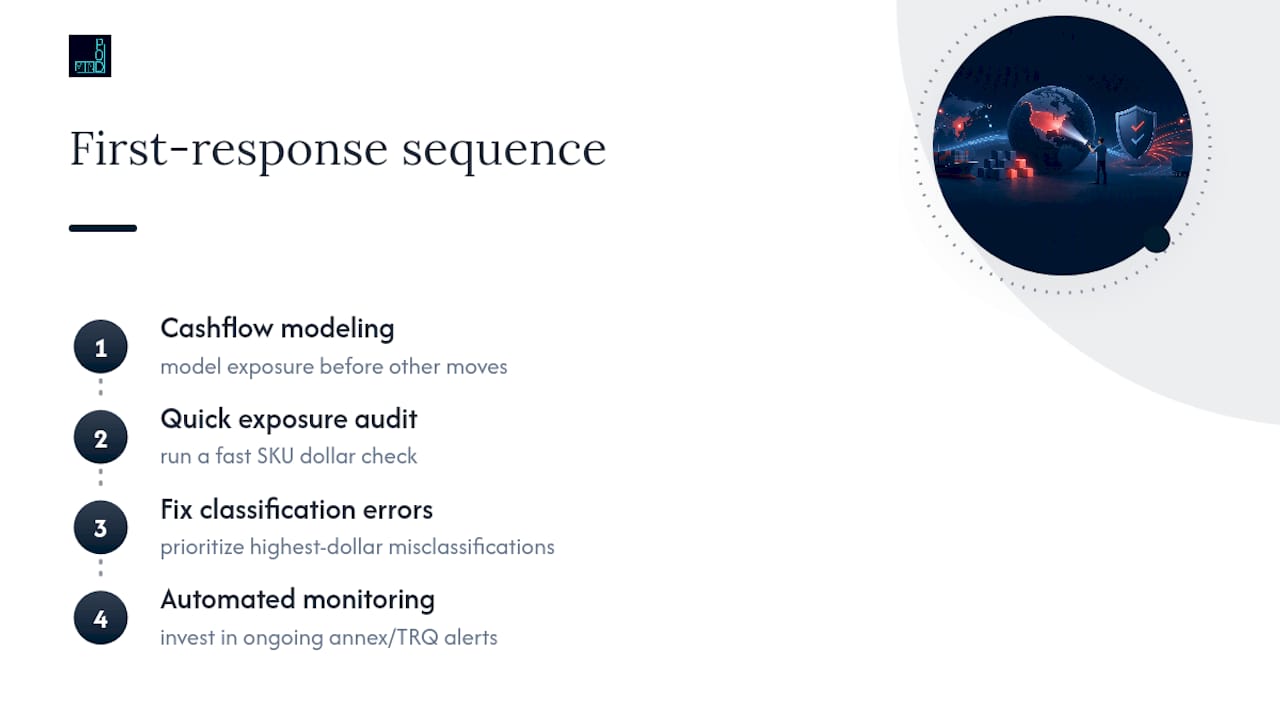
Treat annex and TRQ monitoring as ongoing governance built into procurement and finance calendars, not a one-time reaction to the July 2026 notice. Trade policy under the current administration has moved quickly and repeatedly, and Brookings' tracking of America First trade policy suggests that pace is unlikely to slow. A staged approach works best: run a quick exposure audit first, fix the highest-dollar classification errors next, then invest in automated monitoring so the third round of changes doesn't catch you flat.
The businesses that get hurt worst aren't the ones facing the highest tariff rate. They're the ones that find out about their exposure from a customs bill instead of a spreadsheet.
— jaras
Get a Clear Picture of Your Tariff Exposure
If you've read this far and you're still not sure exactly how many dollars these rates cost your business this quarter, that's the actual problem to solve, not the tariff rate itself. Mindpodtech built SupplyMind.ei specifically to turn scattered HTSUS data, supplier records, and annex exemption lists into a single dollar-exposure number by SKU, so your team stops guessing and starts prioritizing.

We start every engagement with a free technology assessment. If your compliance team is stretched thin managing broker instructions and classification reviews on top of everything else, that's exactly the gap fractional CTO support is meant to fill. Book your assessment with Mindpodtech and get the exposure numbers before your next shipment clears.
Primary Sources Worth Bookmarking
Keep these four documents on hand: the White House memorandum that directed the July 2026 actions, the Federal Register notice that sets the official rates and annexes, USTR's Section 301 tariff actions hub for historical context, and the CBP CSMS bulletin covering entry reporting order and FTZ treatment. If your sourcing team is exploring liquidation or alternative inventory channels to manage short-term exposure, wholesale electronics pallet options illustrate one way businesses diversify procurement outside of standard tariff-affected supply chains.
Sources
- Actions by the United States in the Investigations under Section 301 (White House)
- Notice of Actions in Section 301 investigations (Federal Register)
- Section 301 of the Trade Act of 1974 (CRS)
- USTR section 301 tariff actions (USTR)
FAQ
What Does Section 301 Tariff Mean?
A Section 301 tariff is a duty USTR imposes on imports from a specific country after investigating that country's trade practices under 19 U.S.C. §§2411 through 2420 and finding they unfairly burden U.S. commerce.
What Is the Section 301 Tariff Rate in 2026?
The July 2026 actions set two rates: 10% ad valorem for economies that met specified forced-labor enforcement benchmarks, and 12.5% for economies that did not, per the Federal Register notice.
What Is Section 301 in the USA?
Section 301 is a provision of the Trade Act of 1974 that gives USTR authority to investigate and respond to foreign trade practices that harm U.S. commercial interests, with remedies ranging from negotiated agreements to tariffs.
What Are Section 301 Tariff Exclusions?
Section 301 exclusions are exemptions for specific HTSUS lines listed in annexes to the implementing notices, typically covering products unavailable from U.S. domestic production; the statute itself does not require a standing exclusion process, so each action's own annex controls what qualifies.
How Do Section 301 Duties Combine With Other Tariffs?
Section 301 duties can stack with Section 232, Section 122, and antidumping or countervailing duties on the same entry, and CBP guidance requires brokers to report them in a specific Chapter 99 sequence to avoid misfiling.