

The fastest, highest-confidence wins in SaaS cost optimization come from three moves in sequence: find every contract and active user, reclaim the seats nobody's using, then negotiate renewals from that clean baseline. Do it in that order and you protect the savings instead of watching them evaporate at the next billing cycle.
Programs that run discovery, reclamation, rightsizing, and negotiation together typically recover 20% to 40% of SaaS and data platform spend. You'll see the first hard dollars shortly after starting, usually from canceled or downgraded licenses. Program-level results, the kind that show up in a board deck, take 3 to 12 months because renewal cycles and organizational habits move slower than a spreadsheet cleanup.
Here's where to start this week:
- Pull every SaaS contract, invoice, and card charge into one list, even the ones nobody remembers signing up for
- Cross-reference active users against license counts in your five biggest platforms
- Flag every renewal date in the next 90 days before you do anything else
If you don't have the internal bandwidth to run discovery properly, a free technology assessment from a firm like Mindpodtech can get you a prioritized plan without derailing your team's existing workload.
Key Takeaways
Cutting SaaS spend by 20% to 40% requires discovery, reclamation, and renewal negotiation run in that order, backed by a governance cadence that prevents the savings from reversing.
| Point | Details |
|---|---|
| Start with reclamation | Unused licenses are the fastest, highest-certainty savings and require no vendor negotiation. |
| Reconcile three data feeds | Combine SSO logs, card/AP records, and vendor billing APIs to find shadow IT. |
| Negotiate with benchmarks | Bring market pricing to renewal conversations rather than relying on internal usage data alone. |
| Assign a named owner | Savings reverse without a RACI and a recurring review cadence enforcing them. |
| Consider a managed engagement | Mindpodtech's free technology assessment and prioritized plan suit teams without internal bandwidth to run discovery and renewals consistently. |
Table of Contents
- What Are the Seven Levers of SaaS Cost Optimization?
- How Do You Execute Each Lever in Practice?
- Who Owns SaaS Cost Optimization Inside Your Company?
- What Tools and Data Feeds Do You Actually Need?
- Which Metrics Prove the Program Is Working?
- What Does a 30-90-180 Day Rollout Look Like?
- When Should You Bring in a Managed Partner?
- What the Conventional Advice on SaaS Spend Gets Wrong
- How Mindpodtech Helps You Act on This Playbook
- Sources
- FAQ
What Are the Seven Levers of SaaS Cost Optimization?
Cost optimization isn't one action, it's seven distinct levers, each with its own effort level and payoff speed. Running them out of order is why so many cleanup efforts stall after month one.
- Discovery. Find every contract, subscription, and shadow-IT purchase. Low effort, immediate visibility, and the prerequisite for everything else.
- License reclamation. Cancel or reassign seats tied to inactive or departed users. Industry playbooks consistently rank this as the fastest, highest-certainty win because it requires no vendor negotiation and no workflow change.
- Rightsizing. Move users from premium tiers to standard ones when their usage doesn't justify the cost.
- Consolidation. Eliminate redundant tools doing the same job across departments.
- Renewal leverage. Use benchmark pricing and usage data to negotiate better terms before auto-renewal locks you in.
- Tail spend cleanup. Automate rules for the long list of small, low-visibility subscriptions that add up.
- Prevention. Build governance so savings don't quietly reverse.
Discovery and reclamation can run in parallel almost immediately; they touch the same data and the same stakeholders. Consolidation and rightsizing take longer because they require change management with actual end users, so plan them as a second wave. Renewal leverage works best once you've already reclaimed and rightsized, since a smaller, cleaner license count gives you real numbers to negotiate with.
How Do You Execute Each Lever in Practice?
Each lever has a distinct operational playbook. Skipping steps here is how teams end up with a spreadsheet full of good intentions and no realized savings.
Discovery: reconcile before you cut anything
Single-source discovery misses more than it finds. Effective discovery reconciles at least three feeds: single sign-on (SSO) logs, corporate card and accounts payable records, and vendor billing APIs where available. SSO shows you who's actively logging in. AP and card feeds surface subscriptions that never went through procurement, the ones a marketing manager expensed eighteen months ago and forgot about. Vendor APIs, where offered, give you seat counts and usage stats that self-reported spreadsheets never will.
Reconcile these three sources against your master contract list monthly at first, then quarterly once the list stabilizes. Expect discrepancies of 15% to 30% between what finance thinks you're paying for and what's actually active. That gap is your shadow IT.
Reclamation: notice, reclaim, deprovision
Reclamation needs a workflow, not a one-time sweep. The sequence that works:
- Flag any license with zero logins in 30 to 45 days
- Notify the license owner and their manager with a deadline to justify continued access
- Reclaim the seat automatically if there's no response
- Tie deprovisioning into your HR offboarding process so departed employees lose access the same day, not the same quarter
That last step matters more than people think. Orphaned licenses tied to former employees are one of the most common and most avoidable sources of waste, and they're invisible until someone runs an audit.
Rightsizing: match tier to actual use
Pull feature-level telemetry where the vendor exposes it, not just login counts. A user who logs in daily but never touches the advanced reporting module doesn't need the premium tier. Map roles to feature sets, then decide between downgrading the license or reassigning the user to a cheaper role-based plan. Rightsizing works best as a quarterly exercise tied to the review cadence, not a one-time push.

Consolidation: kill the overlap, carefully
Before you consolidate, map every tool against the workflow it serves. Overlapping project management or communication tools are common, but collaboration tool sprawl and poor process design already erode productivity even before cost enters the conversation. Consolidation done badly adds friction on top of that. Build a migration plan with a named owner, a training window, and a rollback option before you sunset anything people rely on daily.
Renewals: negotiate before the clock runs out
Track termination notice windows the moment a contract is signed, not 30 days before renewal. Most enterprise SaaS contracts require 60 to 90 days' notice to avoid auto-renewal, and missing that window is one of the most common ways companies overpay year after year. Bringing benchmark pricing into the negotiation rather than relying solely on internal usage data produces measurably better outcomes, because vendors price to what they think you know.
Usage-based platforms: guard the meter, not just the seat
Seat-based SaaS and usage-based platforms (compute, data warehouses, observability tools) need different controls entirely. Autosuspend idle compute clusters after a defined inactivity window. Rightsize warehouse and cluster sizing against actual query load rather than peak provisioning. Cap observability and logging ingest volumes, since telemetry costs scale silently and rarely get flagged until the invoice arrives. FinOps-style shared ownership between finance and engineering is the right model here because these costs move daily, not annually.
By the time you hit the ceiling, the overage has already happened.*
| Cost Type | Primary Lever | Review Cadence |
|---|---|---|
| Fixed seat licenses | Reclamation and rightsizing | Monthly |
| Usage-based compute | Autosuspend and rightsizing | Weekly |
| Telemetry and observability | Ingest controls and sampling | Weekly |
Tail spend: automate the small stuff
The long tail of sub-$500 monthly subscriptions rarely gets manual attention, but it adds up. Set automated policy rules: flag any new SaaS charge under a spending threshold for review after 60 days, and auto-cancel any subscription with no login activity for 90 days unless someone actively renews it.
Who Owns SaaS Cost Optimization Inside Your Company?
Savings reverse when nobody owns them. That's not a hypothetical, it's the default outcome without a named owner and a recurring cadence.
A workable RACI splits responsibility three ways: IT owns technical discovery and deprovisioning, finance owns spend visibility and renewal budgeting, and a designated business owner for each tool (usually the department head who requested it) owns usage justification and rightsizing decisions. Procurement sits in as an approver on anything above a defined dollar threshold.
Cadence matters as much as ownership:
- Weekly: automated alerts for unusual usage-based spend spikes and inactive-seat flags
- Monthly: license utilization review by department owners
- Quarterly: consolidation review across overlapping tool categories
- Annual: full strategic renegotiation pass tied to budget planning
Set a policy default that every new SaaS contract requires 90-day termination notice terms unless there's a documented business reason otherwise. That single policy prevents the auto-renewal traps that quietly cost companies the most.
Cost optimization only works as a continuous operating rhythm across design, operation, and governance, not a one-time cleanup. Treat it like patching security vulnerabilities: skip a cycle and the exposure comes back.
AWS's Well-Architected guidance on cost optimization frames this as a lifecycle discipline, and that framing holds for SaaS spend just as much as cloud infrastructure. Allocate a portion of recovered savings back to the requesting department's budget as an incentive to keep reporting waste, rather than letting finance absorb 100% of it silently. Teams that see the benefit of good stewardship keep practicing it.
What Tools and Data Feeds Do You Actually Need?
You don't need an enterprise platform to start. You need four data feeds working together: SSO login logs, corporate card and AP records, vendor billing APIs, and, for usage-based platforms, native usage telemetry from the vendor itself.
- SSO data tells you who's logging in and how often, the backbone of reclamation decisions
- Card and AP feeds surface shadow IT that never touched procurement
- Vendor billing APIs give you real seat counts and consumption data where the vendor exposes them
- Usage telemetry for compute and observability platforms needs near-real-time ingestion, since costs there move daily
If you're managing fewer than 50 SaaS tools, a well-maintained reconciliation spreadsheet pulling from these four feeds monthly will get you most of the way there. Past that scale, or once usage-based platforms make up a meaningful share of spend, a dedicated SaaS management platform earns its cost through automated discovery and alerting that a spreadsheet can't keep pace with. Quality checks matter regardless of tooling: mismatched user identities between SSO and billing records are the single most common reason discovery data goes stale.
Which Metrics Prove the Program Is Working?
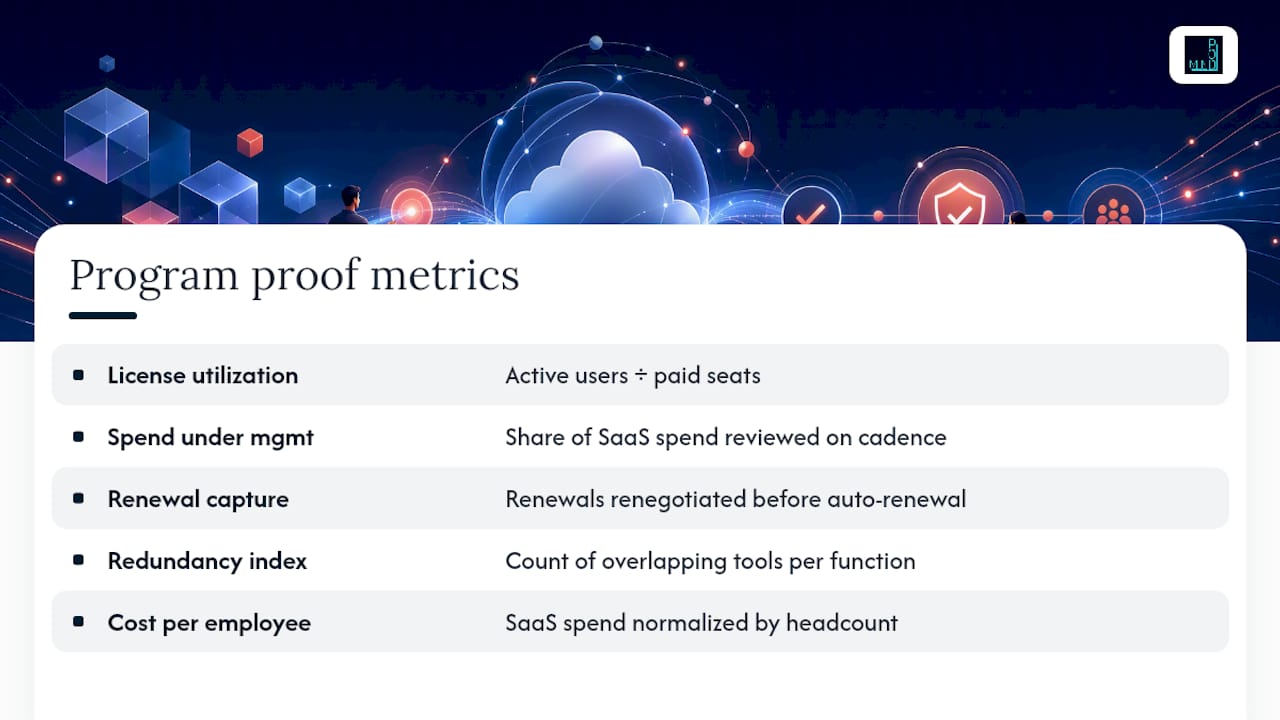
Five metrics tell you whether the program is real or just a slide deck. License utilization rate (active users divided by paid seats) exposes reclamation opportunity. Spend under management tracks what percentage of total SaaS spend is actually being reviewed on a cadence. Renewal capture rate measures how many renewals got renegotiated before auto-renewal versus how many slipped through. Redundancy index counts overlapping tools per function. Cost per employee normalizes spend as headcount changes.
Separate identified savings from realized savings in every report. Identified savings are the opportunity you found; realized savings are the dollars that actually stopped leaving the bank account. Without a named owner enforcing that distinction, a meaningful share of recovered savings creeps back within months as new tools get added without review. Report identified opportunities to IT leadership weekly and realized savings to finance monthly.
What Does a 30-90-180 Day Rollout Look Like?
A phased rollout keeps the effort visible to leadership without demanding a full-time team from day one.
- Days 1 to 30: Complete discovery across SSO, AP, and card feeds. Reclaim every inactive seat you find. Flag every renewal date in the next 180 days so nothing auto-renews by accident.
- Days 31 to 90: Rightsize licenses based on feature usage. Make consolidation decisions on overlapping tools with a documented migration plan. Renegotiate the renewals that fell inside this window using benchmark pricing.
- Days 91 to 180: Lock in governance with a named RACI and review cadence. Automate tail spend rules and inactive-seat alerts. Benchmark every remaining major renewal against market pricing before signing.
Companies without that bandwidth internally often bring in outside help for the discovery and negotiation phases specifically, since those require both tooling and time most operations teams don't have spare.
When Should You Bring in a Managed Partner?
Running this internally works fine if you have someone who can own discovery, sit through renewal negotiations, and enforce the governance cadence quarter after quarter. Most SMBs don't have that person sitting idle.
Mindpodtech's cloud architecture and cost optimization advisory starts with a free technology assessment that maps your current SaaS and cloud spend against actual usage, then hands you a prioritized, plain-language plan you own outright. From there, Mindpodtech sequences discovery, reclamation, and renewal negotiation with human-in-the-loop checkpoints, so nothing gets automated away without someone reviewing the decision.
- DIY makes sense if you already have a designated owner and can commit to the review cadence above
- A managed engagement makes sense if discovery keeps getting deprioritized behind other IT fires, or renewals keep slipping past notice windows
| Scenario | Recommended Path |
|---|---|
| Internal owner available, under 50 tools | Run the playbook in-house with the reconciliation approach above |
| No dedicated owner, renewals frequently missed | Managed engagement to establish discovery and cadence |
| Usage-based platforms are a major cost driver | Managed engagement with FinOps-style shared ownership |
What the Conventional Advice on SaaS Spend Gets Wrong
Most SaaS cost content treats this as a one-time audit: find waste, cut it, move on. That's backwards. The research on this is consistent: without a named owner and a cadence, recovered savings quietly creep back within months as new tools get purchased without review. The audit isn't the program. The governance is the program.
The other overrated idea is that consolidation should happen first. It shouldn't. Consolidation touches workflows people rely on daily, and doing it before you've reclaimed the easy wins burns political capital on the hardest lever before you've built any credibility with quick, visible savings. Reclaim first. Show the number. Then ask departments to give up their favorite redundant tool.
What actually matters, based on everything the evidence here supports, is sequencing: discovery before cuts, reclamation before renegotiation, governance locked in before you declare victory. Teams that skip straight to renewal negotiation without cleaning up their license count first are negotiating from a worse position than they realize.
— jaras
How Mindpodtech Helps You Act on This Playbook
Running the full sequence, discovery, reclamation, rightsizing, and renewal negotiation, takes real hours most operations teams don't have sitting idle between other priorities. That's the gap Mindpodtech's cloud architecture and cost optimization advisory closes: a small team gets enterprise-grade discovery and negotiation support without hiring a dedicated FinOps function.

The engagement starts with a free technology assessment covering your current SaaS contracts, usage data, and upcoming renewal windows. You get a prioritized, plain-language plan you own outright, whether you implement it internally or bring Mindpodtech in to deliver it. For usage-based platforms and cloud spend specifically, Mindpodtech applies the same discovery-to-governance model with human-in-the-loop checkpoints at every automation step, so nothing gets cut or rightsized without a person confirming the call.
If your last SaaS audit produced a spreadsheet nobody followed up on, that's the exact failure mode a managed engagement is built to prevent. Start with a free technology assessment and get a plan you can hand straight to finance.
Sources
FAQ
What Is Replacing SaaS?
Nothing is broadly replacing SaaS today. Usage-based and API-metered pricing models are growing alongside traditional seat-based licensing, which is why cost programs need distinct levers for fixed seats versus consumption-based platforms.
What Are the Four Pillars of Cost Optimization?
Definitions vary by framework, but a common structure covers visibility (discovery), efficiency (rightsizing and consolidation), negotiation (renewal leverage), and governance (ongoing cadence and ownership) to prevent savings from reversing.
Is Netflix a SaaS or PaaS?
Netflix is a consumer streaming service, not a business SaaS or PaaS product. It's sometimes cited in SaaS discussions because of its subscription billing model, but it doesn't fit the B2B software categories this playbook addresses.
Is SaaS a Capex or Opex?
SaaS subscriptions are almost always treated as operating expenses (opex) since companies pay recurring fees rather than purchasing and depreciating a capital asset, which is exactly why governance and renewal cadence matter for controlling recurring spend.
How Long Does It Take to See SaaS Savings?
Expect the first hard savings, typically from reclaimed licenses, within 30 days of starting discovery. Program-level results from renegotiated contracts and consolidation take 3 to 12 months to fully materialize.