
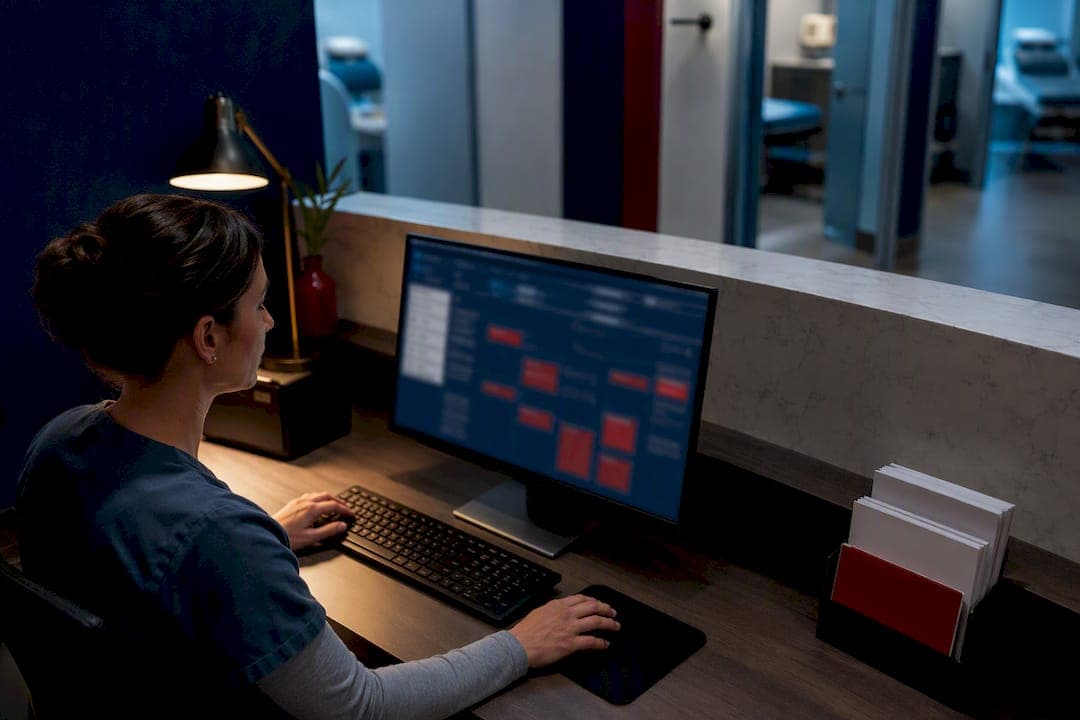
Prioritize two-way confirmations that ask for a reply, shorter lead times with re-confirmation on long-lead bookings, frictionless reschedule and waitlist automation, and targeted phone outreach for high-risk appointments. Stacking three or four of them, sequenced correctly over about 90 days, does.
TL;DR:
- Implement two-way confirmation systems that require patient replies to significantly outperform passive reminders in reducing no-shows.
- Reconfirm appointments scheduled more than three weeks in advance with a second message around one week before the visit to address higher risk periods.
- Automate waitlist backfill and ensure quick, frictionless rescheduling options to recover canceled slots and prevent no-shows from turning into lost revenue.
- Target high-risk patients with personalized phone outreach, rather than spreading scarce staff resources across all appointments, for a more substantial decrease in missed visits.
- Validate risk scoring models locally and ensure HIPAA-compliant, real-time data integration to prevent automation failures and protect patient privacy.
Table of Contents
- What Actually Reduces Patient No Shows?
- How Do You Build a 90-Day No-Show Reduction Plan?
- Which Technology Choices Actually Scale Appointment Adherence?
- How Do You Design a Fair No-Show Policy?
- What Metrics Should You Track to Prove ROI?
- Mindpod Technologies' Approach to Responsible Automation
- Getting Patients Back After a Missed Visit
- Training Your Front Desk to Prevent the Next No-Show
- Understanding Why Patients Miss Appointments in the First Place
- Do Incentives and Engagement Programs Actually Help?
- When Are No-Shows Most Likely to Happen?
- The Real Lesson Buried in the No-Show Data
- How Mindpod Technologies Supports Clinic Scheduling and Automation
- Sources
- FAQ
What Actually Reduces Patient No Shows?
Reminders get too much credit and too little scrutiny. A one-way text that says "You have an appointment Tuesday at 2pm" does something, but it does far less than a message that forces the patient to reply "confirm" or "reschedule." Research on appointment no-show interventions has found that confirmation systems capturing a patient reply outperform passive reminders, largely because they surface the wavering patient three days early instead of leaving an empty chair on the day of.
Here's the ranked list, in the order most clinics should attack it.
- Two-way confirmation over one-way reminder. A reply requirement turns a silent no-show into a visible reschedule opportunity. It costs almost nothing to implement in most scheduling software and should be the first thing you turn on.
- Shorten and re-confirm long lead-time bookings. The gap between booking and visit date is one of the most reliable predictors of a miss. A visit booked six weeks out carries far more risk than one booked six days out, so re-confirm anything scheduled more than three weeks in advance with a second touchpoint roughly a week before the visit.
- Frictionless cancellation and rescheduling. A cancellation is a recovered slot. A no-show is a dead one. If your cancel flow requires a phone call during business hours, you are converting recoverable cancellations into unrecoverable no-shows by accident. One-tap reschedule links change that math immediately.
- Self-scheduling, done the right way. A 2025 study in Frontiers in Digital Health found that online booking reduced no-shows in a direct-booking practice setting but did not move the needle in a referral-based hospital clinic using a request-and-triage model. The lesson: direct patient control over the calendar works, reducing no-show rates in certain practice settings. A workflow where the patient submits a request and waits for staff to confirm reintroduces the friction you were trying to remove.
- Risk segmentation with targeted human outreach. Reserve staff phone calls for your highest-risk slots rather than spreading thin across every booking. Reviews and trials on targeted outreach consistently show live phone calls or patient navigator contact reduce no-show risk substantially compared with generic reminders for the subset of patients flagged as high risk.
- Waitlist and backfill automation, sized to your baseline. If your no-show rate runs 12%, a modest, rules-based overbooking policy tied to an automated waitlist can absorb much of that loss without double-booking chaos.
- Telehealth, selectively. Video visits can lower transportation and time-off-work barriers for follow-ups and behavioral health, but evidence on telehealth and no-shows is mixed, and audio-only visits underperform video. Don't treat it as a universal fix.
- Fees, used narrowly. Reserve deposits or no-show fees for repeat offenders rather than blanket policies. Broad punitive fees tend to punish patients dealing with transportation or childcare problems more than the actual serial no-show risk.
Statistic Callout: Confirmation systems that require a patient reply consistently outperform passive one-way reminders in clinical trial and observational data, and targeted phone outreach to high-risk patients shows some of the largest relative reductions in no-show risk of any single tactic studied.
Pro Tip: Don't roll out self-scheduling and risk-based outreach in the same week. Stagger them by two to three weeks so you can tell which change actually moved your numbers.
How Do You Build a 90-Day No-Show Reduction Plan?
Treat this as a build, not a switch you flip. Clinics that try to launch everything simultaneously usually can't tell which tactic worked, and that makes the second round of investment a guessing game.
- Weeks 0 to 1: Measure the baseline. Pull twelve months of appointment data and build a no-show heatmap by provider, appointment type, day of week, and lead time. You cannot fix what you have not measured, and most clinics are surprised by where their real problem sits.
- Weeks 2 to 4: Discovery and quick pilots. Turn on two-way confirmations for one or two providers or appointment types with the worst rates. Test message timing (48 hours out versus 24 hours) on a concentrated slot before rolling wider.
- Weeks 5 to 8: Deploy automation. Launch self-scheduling with direct booking (not request-and-wait), enable one-tap reschedule links, and turn on waitlist backfill. Route your highest-risk appointments, identified from the Week 0 heatmap, to live staff calls instead of automated messages only.
- Weeks 9 to 12: Scale and refine. Expand automated backfill clinic-wide, run A/B tests on reminder timing and wording, and formalize which risk tier gets a phone call versus a text.
Staff SOPs matter as much as the software. Define who owns escalation when a high-risk patient doesn't respond to a confirmation request within 24 hours, and build a post-miss recovery protocol that puts a person on the phone within 24 to 48 hours of any missed visit, not a form letter a week later.
- Week 30 marker: confirmation reply rate above 70% and a measurable dip in same-day no-shows for pilot slots.
- Week 60 marker: self-scheduling adoption climbing and waitlist fill rate improving on canceled slots.
- Week 90 marker: overall no-show rate trending down across at least two full reporting cycles, not just one good month.
Pro Tip: The most common failure mode isn't bad tactics, it's declaring victory after one good month. No-show rates move with seasons, weather, and local events, so judge your program on a rolling 60 to 90 day trend, not a single reporting period.
Which Technology Choices Actually Scale Appointment Adherence?
The software layer either amplifies your plan or quietly undermines it. A few decisions matter more than the rest.
- Choose closed-loop reminder systems. A confirmation that doesn't sync back into your EHR or scheduling system creates a manual reconciliation task for staff, and manual tasks get skipped during busy weeks. Confirm the vendor writes status changes directly into the patient record in real time.
- Capture two-way SMS and phone responses as early-warning signals. A patient who replies "need to reschedule" three days out is worth more operationally than one who never opens the reminder. Route non-responses to a follow-up queue automatically.
- Default to direct-booking self-scheduling. Request-and-triage models reintroduce the delay and friction that self-scheduling was supposed to remove, which is exactly what the Frontiers in Digital Health hospital-clinic comparison found.
- Understand backfill latency. A freed slot only helps if your waitlist automation can fill it fast enough. Set expectations for how many hours before a slot your system needs to notify waitlisted patients, and tune the trigger accordingly.
- Validate any risk score on your own data before acting on it. Independent evaluations of vendor no-show risk models have found performance that underdelivers on marketed accuracy once tested outside the vendor's own dataset. Run the model against your last twelve months of appointments before you let it drive costly live outreach decisions.
- Build a monitoring and rollback plan before automation goes live. Any system touching scheduling and patient communication needs logging, an alerting threshold for failed messages, and a documented way to pause automation without losing appointment data.
Statistic Callout: Independent testing of vendor no-show risk models has repeatedly found accuracy that falls short of marketing claims once applied outside the original training population, which is why validating a model locally before scaling outreach isn't optional.
Security and privacy checks belong in this list too, not as an afterthought. Any tool sending appointment details by text or email needs a signed business associate agreement and a documented data flow before it touches a single patient record.
How Do You Design a Fair No-Show Policy?
Transparency beats punishment. Patients who understand the cancellation window and any deposit rules before they book are far less likely to feel blindsided by a fee, and far more likely to actually call ahead when something comes up.
- Display cancellation windows and any deposit or fee policy at the moment of booking and again in the reminder message, not buried in a form they signed months earlier.
- Reserve fees for repeat no-shows, not first-time misses. A refundable deposit works better than a punitive flat fee because it rewards the behavior you want instead of just penalizing the behavior you don't.
- Build an exception path for patients dealing with transportation gaps, housing instability, or caregiving conflicts. A blanket fee policy applied without exceptions tends to fall hardest on the patients least able to absorb it.
- Keep your "no-show" notification factual and neutral: state the missed date and time, offer the next available slot, and avoid language that reads as a scolding.
- Check payer and state rules before charging a no-show fee to a workers' compensation patient. Many state workers' comp programs restrict or prohibit billing the patient directly for missed visits, so confirm the specific rule in your state before applying any fee to that population.
Getting this wrong doesn't just cost goodwill. As one industry playbook on no-show reduction points out, financial uncertainty is itself a driver of missed visits, so a policy that adds ambiguity around cost can make your no-show problem worse, not better.
What Metrics Should You Track to Prove ROI?
Define your no-show rate the same way every time: missed appointments divided by total scheduled appointments, segmented by clinic, provider, appointment type, and lead-time bucket. Track confirmation rate (percentage of patients who reply to a two-way message), same-day fill percentage on canceled slots, and recovered visits from your post-miss outreach.
| Metric | Definition | Reporting cadence |
|---|---|---|
| No-show rate | Missed visits ÷ scheduled visits, by provider and lead time | Weekly |
| Confirmation reply rate | Patients replying to two-way confirmation ÷ messages sent | Weekly |
| Same-day fill rate | Canceled slots refilled from waitlist ÷ total cancellations | Weekly |
| Recovered visit rate | Rebooked visits after a no-show ÷ total no-shows | Monthly |
- Run A/B tests on one variable at a time: message timing, wording, or channel, never all three together.
- Test any vendor risk score for discriminative accuracy (AUC) against your own outcome data before trusting it to trigger live outreach, since a model that looks strong in a vendor's marketing deck may perform close to chance on your specific patient mix.
Mindpod Technologies' Approach to Responsible Automation
Mindpodtech treats automation around scheduling and patient outreach the way it treats any workflow touching sensitive data: ranked by ROI and risk, not deployed because it's available. That means starting with the highest-leverage lever, usually two-way confirmations or waitlist backfill, before adding a risk-scoring layer that requires more validation.
Every automated workflow ships with human-in-the-loop checkpoints for edge cases, logging on message delivery and response rates, and a rollback plan if a change underperforms. An engagement typically starts with a free technology assessment of your current scheduling and communication stack, followed by a prioritized plan the clinic owns, then delivery and ongoing operation.
Consent and privacy checks come first when automation touches patient communications. That includes confirming HIPAA-aligned data handling with any messaging vendor and setting alert thresholds before a single automated text goes out to a live patient list.
Getting Patients Back After a Missed Visit
A no-show isn't the end of the interaction, it's a signal that something in the patient's life got in the way. The recovery window matters more than most clinics treat it. A scripted, empathetic call within 24 to 48 hours of a missed visit tends to recover more patients than a form letter sent a week later, because the reason for missing is still fresh and the rebooking friction is lowest right after the miss.
Train front-desk staff on a short script: acknowledge the missed visit without blame, ask if anything came up that the clinic can help address (transportation, timing, cost), and offer the next available slot on the spot. This single habit does more for retention than most reminder systems alone.
On fees, apply the same fairness standard from your written policy. A repeat no-show might warrant a deposit requirement on the next booking. A first miss, especially one tied to a documented barrier like a canceled ride or a work conflict, generally shouldn't. Clinics that charge every no-show the same flat fee regardless of history or circumstance tend to see patients disengage entirely rather than pay and return, which defeats the purpose of the fee in the first place.
Document the outcome of every recovery call, whether the patient rebooked, declined, or needs a different kind of support (financial counseling, transportation assistance, translation services). That data feeds directly back into your risk segmentation model, closing the loop between the miss and the next prevention effort.
Training Your Front Desk to Prevent the Next No-Show
Software catches a lot of no-shows before they happen. Staff catch the rest, provided they're trained to look for the right signals. A scheduler who books a follow-up visit six weeks out without flagging it for re-confirmation is missing the single strongest predictor of a miss.
Train staff to ask about likely barriers at the point of booking, not just at check-in. A simple question, "Is there anything that might make it hard to get here that day?", surfaces transportation gaps or work conflicts early enough to solve them, whether that means offering a telehealth alternative or a different time slot.
Give front-desk teams a clear script for confirmation calls that goes beyond reading the date and time back to the patient. The script should invite a real answer: "Are you still able to make it Tuesday at 2pm?" rather than "This is a reminder about your appointment," which patients tend to tune out the same way they ignore a robocall.
Standardize how staff document a "reschedule needed" versus a true no-show in the system, since inconsistent tagging quietly corrupts your no-show rate data and makes every downstream metric less trustworthy. And make sure whoever answers the phone knows the clinic's actual cancellation window and fee policy cold. Nothing erodes trust faster than a patient getting three different answers from three different staff members about the same policy.
Understanding Why Patients Miss Appointments in the First Place
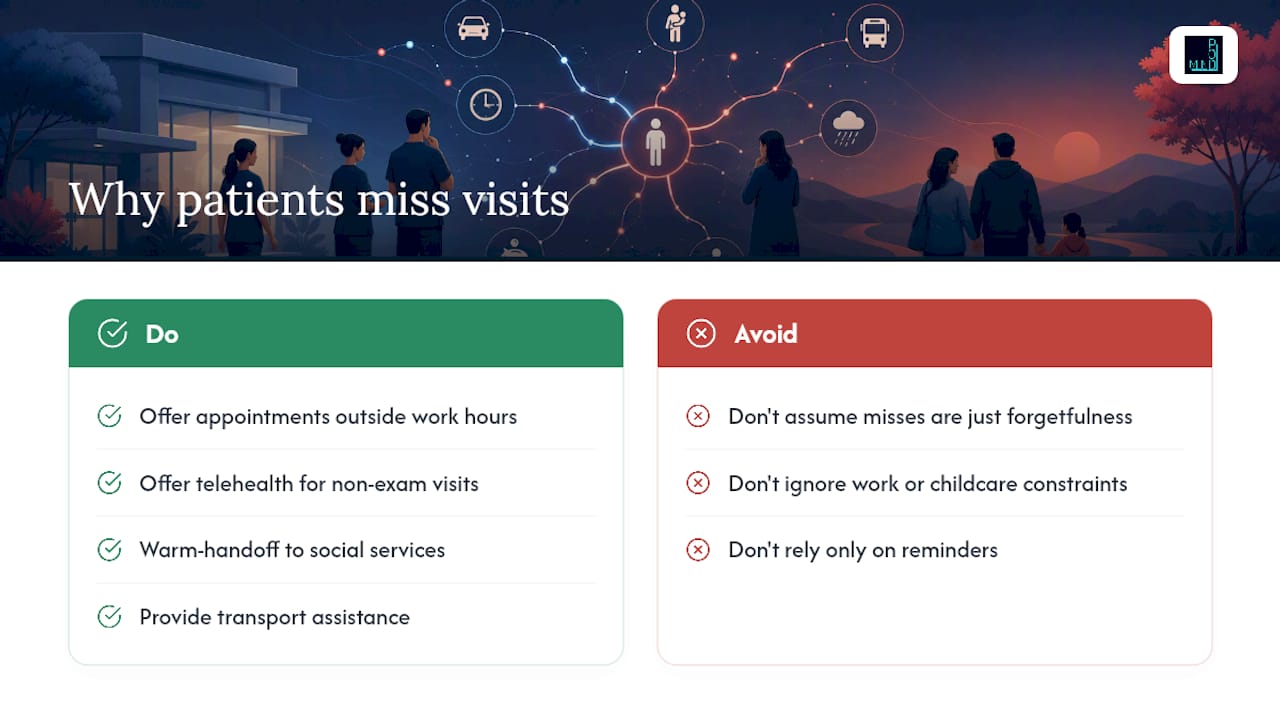
Most no-show interventions treat missed visits as a communication failure. Often they're a resource failure instead. Transportation gaps, unpredictable work schedules, lack of childcare, and housing instability are recurring, well-documented drivers of missed medical visits, and no reminder message fixes any of them.
A patient working an hourly shift job with no paid time off faces a real cost every time they leave work for a midday appointment, regardless of how many texts reminded them it was coming. A patient without reliable transportation may fully intend to show up and still lose that battle to a bus that didn't come. Clinics serving lower-income populations or rural areas typically see higher baseline no-show rates for exactly these structural reasons, not because those patients care less about their health.
This matters for how you interpret your own data. If your heatmap shows certain appointment types or times consistently missing at higher rates, ask whether the pattern maps to a barrier (afternoon slots that conflict with school pickup, appointments that require a second bus transfer) rather than assuming it's simply forgetfulness.
Practical mitigations include offering appointment windows outside standard work hours, telehealth options for visits that don't require a physical exam, and a warm handoff to social services or transportation assistance programs when a patient discloses a barrier during a confirmation call. None of these fixes are free, but they target the actual cause rather than papering over it with another reminder.
Do Incentives and Engagement Programs Actually Help?
Incentives work best as reinforcement, not as the primary fix. A small reward for consistent attendance, like a gift card after a streak of kept appointments in a chronic disease management program, can support behavior you're already reinforcing through good communication and easy scheduling. It rarely moves the needle on its own.
Patient engagement techniques that build a real relationship tend to outperform one-off incentives. Personalizing outreach with the patient's own name and provider (rather than a generic clinic-wide blast), sending appointment purpose reminders ("This visit is for your diabetes follow-up"), and following up after visits to check on outcomes all build the kind of trust that makes a patient prioritize showing up.
Portal engagement matters too. Patients who log into a patient portal to review visit summaries, message their provider, or check lab results tend to stay more engaged with their overall care plan, which correlates with better appointment adherence over time. That's a reason to invest in portal adoption campaigns alongside any no-show-specific tactic.
Loyalty-style programs work better for elective and wellness visits than for urgent or acute care, where the incentive to attend is already high and an added reward adds little. Match the engagement tactic to the visit type instead of applying one program clinic-wide.
When Are No-Shows Most Likely to Happen?
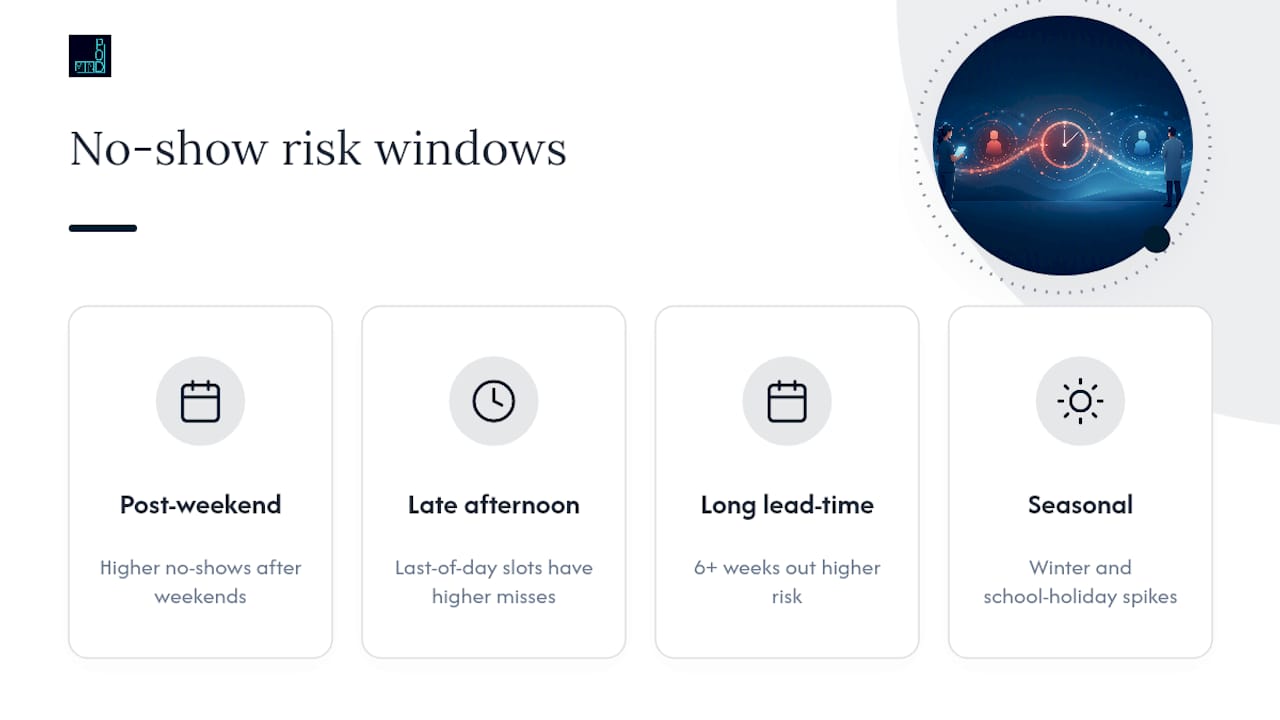
No-show risk isn't evenly distributed across your calendar. Monday appointments and the first slot after a weekend consistently run higher no-show rates in most clinic settings, likely because patients reschedule their week's plans over the weekend and forget commitments made the previous Friday. Late-afternoon slots, especially the last appointment of the day, also tend to run higher misses as patients weigh whether it's worth leaving work early.
Long lead-time bookings compound this risk. A visit scheduled six or more weeks out carries meaningfully higher no-show risk than one scheduled within a week, simply because more can change in a patient's life, and more time passes for the appointment to slip from memory without a strong confirmation touch.
Seasonal patterns matter too. Weather-sensitive appointments in winter months and school-schedule-sensitive pediatric visits around holidays and summer break both show predictable spikes. If your Week 0 to 1 baseline heatmap (from the 90-day plan above) shows these same patterns, that's your signal to concentrate re-confirmation resources and live outreach specifically on Monday mornings, end-of-day slots, and any booking made more than three weeks in advance, rather than spreading effort evenly across every appointment on the books.
The Real Lesson Buried in the No-Show Data
The conventional wisdom on no-shows treats it as a messaging problem: send more reminders, send them earlier, make them friendlier. That advice isn't wrong, it's incomplete. The evidence points somewhere more useful: attendance is a system failure, not a memory failure, and most clinics only fix the memory piece.
What gets underweighted is friction. A patient who wants to cancel but faces a phone tree during business hours doesn't become a no-show by choice, they become one by default. Fix the friction in canceling and rescheduling before you spend another dollar on reminder frequency.
What gets overweighted is fear of overbooking. Clinics that avoid backfill automation because "double-booking feels risky" are leaving recoverable revenue on the table every week their no-show rate sits above single digits. Start with two-way confirmations and frictionless rescheduling. Add targeted outreach for your highest-risk slots next. Everything else is refinement, not foundation.
— jaras
How Mindpod Technologies Supports Clinic Scheduling and Automation
Mindpodtech is the alternative to hiring a full-time scheduling analyst or betting on an unvetted vendor risk score: a fractional advisory relationship that maps the specific tactics in this playbook (two-way confirmations, self-scheduling, waitlist automation, risk-based outreach) to your actual EHR and patient population before anything goes live.
The engagement starts with a free technology assessment of your current scheduling stack and communication workflows, which surfaces where friction and risk actually sit in your data rather than where a generic checklist assumes it does. That assessment produces a prioritized, plain-language plan you own outright, covering which automation to deploy first, how to validate any risk model on your own patient history, and what monitoring and rollback safeguards go in before launch. From there, Mindpodtech can deliver and run the buildout as part of its clinic scheduling and patient operations service line.
If your no-show rate has stalled despite reminders you already send, start with a free assessment at Mindpod Technologies to see where the next 90 days should actually focus.
Sources
- Reducing Appointment No-Shows: Going from Theory to Practice — PMC
- Online appointment scheduling, SMS reminders, and no-show rates — Frontiers in Digital Health
- Reduce No Shows: A Playbook For Clarity, Convenience And Payment Readiness — Forbes
- Systematic review and trials on targeted outreach and no-show reduction — PMC
FAQ
How do you reduce patient no-show rates?
Stack two-way confirmations, shorter lead times with re-confirmation, frictionless rescheduling and waitlist automation, and targeted phone outreach for high-risk appointments. Each tactic alone helps modestly; combined, they address most of the reasons patients miss visits.
What is a good process to reduce no-shows?
Start with a 90-day measured rollout: baseline your no-show rate by provider and lead time in the first two weeks, pilot two-way confirmations, then layer in self-scheduling, waitlist backfill, and risk-based outreach in stages so you can tell what's working. Mindpodtech structures exactly this kind of phased assessment for clinics that need to prove ROI quickly.
How do you professionally notify a patient about a no-show?
State the missed date and time factually, avoid blaming language, and immediately offer the next available slot along with an invitation to share what got in the way. A neutral, helpful tone recovers more patients than a scolding one.
Can you charge a workers' compensation patient a no-show fee?
Check your state's workers' compensation rules before charging that patient directly, since many states restrict or prohibit billing an injured worker for a missed visit under that program. When in doubt, confirm with your state's workers' comp board or the payer before applying any fee.