

LLM data leakage happens when a model outputs sensitive, private, or proprietary information that it absorbed during training or picked up from runtime context. The fix starts before you write a single filter rule: treat every prompt, retrieval document, and piece of conversation history as untrusted input, then layer output filtering and access controls on top. If you haven't run a leakage audit or red-team test against your deployment yet, that's the next move.
TL;DR:
- Training data duplication and poisoned datasets significantly increase the likelihood of sensitive information being memorized and later leaked by the model.
- Prompt injection and prefix exploitation are the most practical attack vectors, enabling malicious users to force the model to reveal internal prompts or system instructions during inference.
- Embedding injection and provenance failures in RAG systems allow unauthorized retrieval of sensitive documents, often surfacing data tied to other users or expired access rights.
- Effective leakage mitigation requires comprehensive controls, including data deduplication, strict input validation, output sanitization, and provenance tagging, especially in RAG pipelines.
- Routine leakage testing with sequence-level analysis and traceability tools is essential, as aggregate metrics tend to underestimate actual exposure by up to 2.14 times.
Table of Contents
- What LLM Data Leakage Actually Means
- How Leakage Happens: Attack Surfaces You Need to Map
- Measuring Leakage: Metrics, Tests, and Where They Fail
- Engineering Controls That Actually Reduce Leakage Risk
- Building the Operational Playbook: Monitoring and Response
- What the Research Says: Standards and Empirical Findings
- Our Take: Prioritize Controls by Business Risk, Not Novelty
- Get a Risk-Ranked Path to Securing Your LLM Deployment
- Sources
- FAQ
What LLM Data Leakage Actually Means
Data leakage in large language models isn't one failure mode. It's a category covering at least three distinct problems, and conflating them is why so many security reviews miss real exposure.
Training-data extraction is the classic case: a model reproduces text it memorized during pretraining, sometimes verbatim, sometimes close enough to violate a license or expose a person's information. This is what researchers mean when they talk about a model "regurgitating" its training set. Prompt leakage is different. It happens at inference time, when a user coaxes the model into revealing its system prompt, hidden instructions, or earlier turns in a conversation it shouldn't be exposing. RAG leakage is the newest variant and arguably the most common in production systems today: a retrieval-augmented generation pipeline pulls a document into context that the requesting user was never authorized to see, and the model dutifully summarizes it.
Each type maps to a different failure and a different fix.
- Training-data extraction surfaces as verbatim PII, reproduced copyrighted passages, or leaked credentials that were scraped into a pretraining corpus.
- Prompt leakage surfaces as a chatbot revealing its system instructions, internal tool names, or a competitor's business logic embedded in a custom prompt.
- RAG leakage surfaces as a support bot answering with details from a document tied to a different customer's account, tenant, or case file.
The business impact scales with the sensitivity of what leaks. A privacy breach involving customer PII triggers notification obligations under state breach laws and, for regulated data, HIPAA or GLBA exposure. An intellectual property leak, such as a model trained on proprietary source code reproducing that code for a competitor's prompt, is a harder loss to quantify but often a bigger one. And for any organization operating in or serving the EU, the EDPB's guidance on AI privacy risks makes clear that lifecycle data flows, including RAG retrieval and retention, fall under the same privacy-by-design expectations as any other personal data processing. Compliance risk isn't hypothetical here. It's a DPIA line item.
How Leakage Happens: Attack Surfaces You Need to Map
Leakage risk isn't a single hole to patch. It's distributed across the model lifecycle, and most teams only defend one or two of the four points where it actually occurs.
- Training-time exposure. Duplicated records in a training corpus dramatically increase memorization, meaning the same sensitive record appearing dozens of times across scraped data makes it far more likely to be reproduced later. Poisoned data introduced during fine-tuning, whether by a malicious contributor or a compromised data pipeline, can also implant extractable secrets or backdoor behaviors that never show up in normal testing.
- Inference-time attacks. Prompt injection remains the most practical attack against production systems: an attacker embeds instructions inside user input or a retrieved document that override the system prompt. Prefix exploitation, where an adversary supplies the start of a memorized sequence and lets the model complete it, is a well-documented extraction technique. Membership inference attacks try to determine whether a specific record was in the training set at all, which matters enormously for anyone with contractual or regulatory duties around specific customer data. Jailbreaks compound all of this by degrading the safety behaviors that would otherwise block a leak.
- RAG and knowledge-base risks. Embedding injection lets an attacker plant a document in a vector store that, once retrieved, hijacks the model's behavior. Provenance failures, where the pipeline can't tell you which source a given chunk of context came from, make it nearly impossible to enforce per-document access control. Vector databases that retrieve user-supplied secrets, like API keys pasted into a support ticket, and later surface them to an unrelated user are a leakage vector most teams don't test for.
- Supply-chain and orchestration risks. Agentic workflows that chain multiple tools and third-party APIs multiply the attack surface. A compromised plugin, a poisoned tool description, or an over-permissioned agent can move sensitive data across trust boundaries without triggering any single alarm.
Research from ICLR 2025 demonstrated that alignment training alone doesn't stop extraction attacks against production-grade aligned models. Attackers found ways to circumvent safety tuning and pull training data out regardless. That finding should reshape how you think about "safety" as a control: it's a layer, not a guarantee.
Pro Tip: Don't assume your vendor's alignment work covers your exposure. If you fine-tune a foundation model on your own data or bolt on a RAG pipeline, you've introduced new attack surfaces that upstream alignment never touched.
Measuring Leakage: Metrics, Tests, and Where They Fail
You can't manage what you can't measure, and leakage measurement has a specific trap: the standard metric most teams reach for tends to undercount the actual risk.
Extraction rate, the percentage of a test set a model reproduces under a fixed prompting strategy, is the default benchmark in most memorization research. It's also incomplete. Sequence-level analysis shows that per-sequence extraction probabilities reveal risk that aggregate extraction-rate metrics miss entirely, with one analysis finding underestimation by up to 2.14 times compared to sequence-level scoring. If your team is reporting a single extraction-rate number to leadership as your leakage risk score, you're likely reporting a number that's meaningfully lower than reality.
The more useful framing splits leakage into capability and propensity. Capability asks: under adversarial, best-effort prompting, can this model be made to leak? Propensity asks: under ordinary, non-adversarial use, how often does it leak anyway? A model can score low on propensity and still carry serious capability risk if a motivated attacker spends time crafting the right prompt sequence. You need both numbers, not one.
Practical tests worth running before deployment:
- Prefix-extraction challenges, where you feed the model the first few tokens of a known sensitive record and check whether it completes the rest.
- Membership inference probes, testing whether the model's output confidence reveals whether a specific record was in its training set.
- Few-shot detection, an approach validated in EMNLP 2025 research showing that supervised few-shot classifiers can catch leaked instances even when such instances are uncommon in the training data.
- Canary token probes, where you plant unique, traceable strings in training data or RAG documents and monitor for their appearance in outputs.
Tracing tools built on ideas like SimpleTrace and PropMe approach this by scoring per-sequence memorization probability rather than relying on a single aggregate pass/fail extraction test, which is closer to how the sequence-level research above recommends evaluating risk. The caveat that trips up most internal audits: a single-query adversary model almost always understates real-world risk. Attackers don't get one shot. They iterate, and a multi-query adversary with unlimited attempts will find leakage paths that your one-pass test suite never surfaces.
Engineering Controls That Actually Reduce Leakage Risk
Mitigation has to span the entire stack, from the data you train on to the API endpoint serving live traffic. No single control closes the gap. Here's where the leverage actually is.
Data hygiene before anything touches a model
Deduplication of training and fine-tuning corpora is one of the highest-leverage, lowest-cost interventions available, because duplicated records are disproportionately responsible for memorization. PII scrubbing pipelines, run before any data enters a fine-tuning job, catch the obvious cases: names, SSNs, account numbers. Retention policies matter just as much on the output side. If your system logs full prompts and completions indefinitely, you've built a second leakage surface sitting right next to the model. Access controls on that log store need to match the access controls on the underlying data itself.
Training-time techniques
Differential privacy during training adds calibrated noise to gradient updates, which measurably reduces memorization of individual records at some cost to model accuracy. That tradeoff is real and worth quantifying before you commit to it. Conservative fine-tuning pipelines, meaning smaller learning rates, fewer epochs, and aggressive early stopping, reduce the model's tendency to overfit to specific sensitive examples in a small fine-tuning set. Curriculum design that limits how many times any single sensitive record appears across a training run does the same job deduplication does, applied continuously rather than once.
Inference-time protections
- Strict input validation on every prompt and every retrieved document, treating both as untrusted regardless of source.
- Output filters and sanitizers that scan completions for PII patterns, known secrets formats, and canary token strings before they reach the user.
- Rate limits on API access, since extraction attacks generally require many queries to succeed.
- Context window management that strips or truncates conversation history containing sensitive data before it's re-fed into subsequent turns.
- Sanitized error handling, since verbose error messages routinely leak internal schema, file paths, or stack traces that attackers use to map your system.
RAG-specific hardening
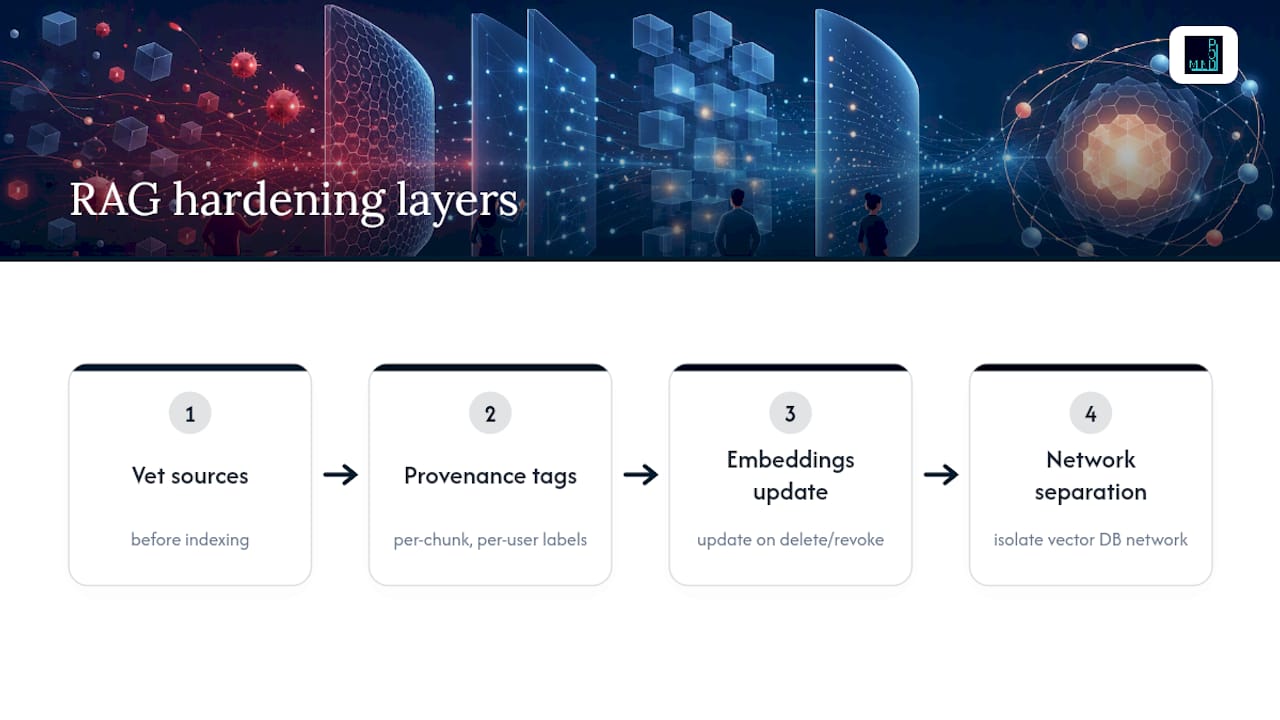
Provenance tagging, attaching a verifiable source and access-control label to every chunk in your vector store, is the single most underused control in RAG deployments. Without it, you can't enforce per-user or per-tenant retrieval boundaries at all. Embedding update policies matter too: stale embeddings from deleted or revoked documents can keep surfacing content that should no longer be retrievable. Vet content sources before they're indexed, and keep your vector database on a separate network segment from user-facing endpoints so a compromised front-end can't query the store directly.
Operational secure-by-default steps
Secrets should never live in prompts, system messages, or fine-tuning data. Least-privilege API keys, scoped to the narrowest permission set a given integration actually needs, limit blast radius when a key does leak. If you're self-hosting a model, network segmentation between the inference service and the rest of your infrastructure keeps a model compromise from becoming a lateral-movement incident.
Pro Tip: Canary tokens and structured logging are the cheapest controls on this entire list and among the highest leverage, since they turn an invisible leak into a detectable event, often within minutes instead of months.
Building the Operational Playbook: Monitoring and Response
Controls without monitoring are a false sense of security. You need to know when something got through, not just hope your filters caught everything.
- Log the right signals. Canary token hits are the clearest positive signal you'll get. Track unusual completion patterns, like outputs that are unusually long, unusually specific, or structurally similar to known sensitive records. Watch abnormal API request rates, since extraction and membership-inference attacks typically require volume.
- Build the incident playbook before you need it. Containment means cutting off the affected endpoint or model version immediately, not after a post-mortem. Evidence capture means preserving the exact prompts, completions, and timestamps involved, since you'll need this for both root-cause analysis and any regulatory notification. Rollback considerations get complicated with LLMs specifically, since "unlearning" a leaked record from a trained model is still an unsolved problem in most production setups. Your realistic rollback path is usually reverting to a prior model version or disabling the feature, not surgically removing the memorized record. Notification pathways need to be pre-mapped to legal and compliance before an incident, not improvised during one.
- Formalize governance. An acceptable-use policy that explicitly defines what data can and can't be sent to which model tier is table stakes. Red-team cadence should be scheduled, not ad hoc. A memorization audit schedule, run quarterly at minimum for any fine-tuned model, catches drift as new data gets incorporated. Reporting and accountability means someone specific owns the leak-risk metric and reports on it regularly, not "the AI team" in the abstract.
Useful KPIs to track over time: leak-test pass rate across your standard test suite, mean time to detection from canary trigger to human review, and number of canary triggers per quarter as a trend line. A flat or rising trigger count with no corresponding fix is a governance failure, not a monitoring success.
What the Research Says: Standards and Empirical Findings
The practitioner literature on LLM leakage has moved fast, and a few findings should directly change how you test and what you adopt as baseline standards.
The sequence-level leakage research is the one to internalize first because it undermines confidence in whatever extraction-rate number your team is currently reporting. If you're only running aggregate extraction tests, you're likely underestimating risk in some cases by more than double.
Separately, LessLeak-Bench's investigation across 83 software engineering benchmarks found that a meaningful share of standard evaluation benchmarks show contamination, meaning benchmark data leaked into pretraining corpora before evaluation even ran. This matters beyond academic scoring: if your vendor's stated safety or accuracy benchmarks were measured against a contaminated test set, those numbers tell you less than they claim to.
Benchmark contamination doesn't just inflate a leaderboard score. It means the evaluation you're relying on to trust a model's behavior may have already been compromised by the same data the model memorized.
On the standards side, OWASP's LLMSVS v2.0 gives you something the research papers don't: a concrete, tiered checklist. It maps specific requirements, covering credential handling, RAG protections, canary token deployment, prompt sanitization, and logging, to verification levels L1 through L3, so you can pick a target maturity level instead of guessing. Paired with OWASP's Top Ten entry on Data Leakage (LLM02), which frames mitigation around the same core controls, that's a defensible baseline to hand to an auditor or a board.
Adopt these checks:
- Run the LLMSVS L1 checklist as a minimum bar before any production deployment.
- Cross-reference vendor-published benchmark scores against known contaminated benchmark lists before trusting them.
- Require provenance documentation for any third-party training or fine-tuning dataset.
Our Take: Prioritize Controls by Business Risk, Not Novelty
Most leakage advice gets written as if every organization has infinite security budget and a dedicated ML security team. Few SMBs do. That changes the right sequence of moves.
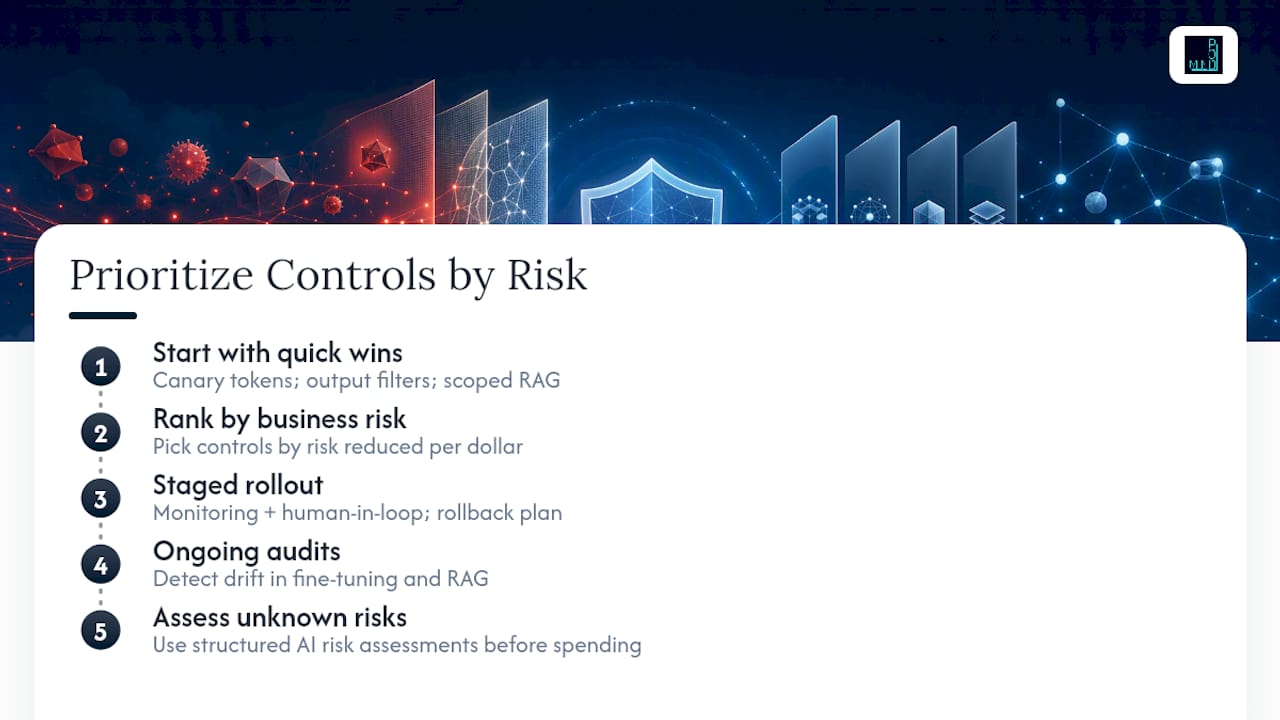
Start with what actually reduces exposure fastest per dollar spent: canary tokens, output filtering, and access-scoped RAG retrieval. These are cheap, fast to deploy, and catch the leakage patterns most likely to actually occur in a mid-market deployment, long before you invest in differential privacy training runs or custom red-team tooling. Rank controls by the business risk they close, not by how sophisticated they sound in a vendor pitch.
Advisory work often leans on staged rollout for exactly this reason. A model or agentic workflow goes into production behind monitoring and a human-in-the-loop checkpoint first, with a clear rollback path defined before launch, not improvised after an incident. Ongoing audits, not one-time assessments, catch the drift that happens as fine-tuning data and RAG sources change over time. If you're staring at a leakage risk you can't yet quantify in dollars, that's the exact gap a structured AI risk assessment is built to close, before you commit budget to controls that may not match your actual exposure.
The organizations that get burned aren't usually the ones with no controls. They're the ones with controls built for last year's threat model, running unmonitored against this year's attack surface.
Get a Risk-Ranked Path to Securing Your LLM Deployment
If your team is running a chatbot, a RAG pipeline, or an agentic workflow without a documented leakage test suite, that's a gap worth closing before an incident forces the issue. Security assessments and governance engagements specifically for AI systems often cover exposure mapping, monitoring design, and the acceptable-use and incident-response policies that turn technical controls into an actual defensible program.

A typical starting point is a free technology assessment: a structured review of your current LLM and AI deployments that produces a prioritized, plain-language plan ranked by business risk and cost to fix. From there, fixes can be executed, from output filtering and canary token deployment to full AI agent governance programs for teams running multi-tool agentic workflows. If you want a concrete plan for reducing leakage exposure across the models you're already running, start with the assessment and see where your actual risk sits before your next audit does.
Sources
- LLMSVS v2.0 — OWASP Large Language Model Security Verification Standard
- Sequence-Level Leakage Risk of Training Data in Large Language Models (arXiv)
- AI privacy risks and mitigations in LLMs — EDPB
FAQ
Will ChatGPT leak my data?
Standard consumer ChatGPT conversations can be used to improve models depending on account settings, and enterprise or API tiers typically offer stricter data-use controls. The realistic risk isn't the vendor selling your data. It's sensitive input ending up in logs, training pipelines, or model outputs shown to someone else, which is why input validation and retention policy review matter more than the platform's brand name.
What is AI data leakage?
AI data leakage is when a model exposes sensitive, private, or proprietary information it learned during training or received as runtime context, whether through verbatim memorization, prompt leakage, or a RAG pipeline surfacing unauthorized documents. It spans training-time and inference-time failure modes, not just one cause.
What do LLMs do with your data?
Data submitted to an LLM is typically used to generate a response and, depending on the provider's terms and your account tier, may also be logged, retained, or used to improve future model versions. Enterprise agreements and self-hosted deployments generally give you direct control over retention and training use; consumer-tier products often don't.
What is the most common cause of data leakage?
In production LLM systems, the most common cause is a combination of retrieval-augmented generation pipelines surfacing documents outside a user's authorization and prompt injection attacks that override intended instructions. Training-data memorization is a real risk too, but RAG misconfiguration and prompt injection account for far more incidents in deployed systems handling live user traffic.