
The fastest, highest-return legal levers are an HTS classification review, duty drawback, Foreign Trade Zones, First Sale valuation, targeted sourcing changes, and tariff-sharing contract clauses. Which one pays off first depends on your product mix, import volume, and whether you export any of what you bring in. Tech-enabled monitoring makes ranking those options a data problem instead of a guessing game.
TL;DR:
- Small-scale fixes like classification audits and First Sale reviews can deliver duty savings within two to eight weeks if properly documented.
- Duty drawback claims require detailed recordkeeping of import and export data and can recover up to 99% of paid duties for exports or destroyed goods.
- Reassessing HTS classifications and unbundling non-dutiable charges may significantly reduce duty costs but need engineering input and thorough documentation to avoid audits.
- Supply diversification and nearshoring decisions should consider total landed costs, including duty, freight, and quality risks, not just tariff savings.
- Building continuous monitoring and cross-team ownership is essential for sustained tariff mitigation, supported by data-driven tools modeling potential impact and ROI.
Table of Contents
- Top Import Tariff Mitigation Strategies: Quick Wins vs. Structural Moves
- How Do Duty Drawback, FTZs, and TIB Actually Work?
- Can HTS Reclassification and First Sale Lower Your Duty Bill?
- Should You Diversify Suppliers, Nearshore, or Reshore?
- What Contract Terms Help Share Tariff Risk With Suppliers?
- How Do You Model and Monitor Tariff Exposure Over Time?
- Where Do You Start: A Rollout Plan That Won't Stall
- Author Perspective: Tariff Mitigation Is a Capability, Not a Project
- How Mindpod Technologies Helps You Cut Duty Costs
- Where to Go for Deeper Research
- Sources
- FAQ
Top Import Tariff Mitigation Strategies: Quick Wins vs. Structural Moves
Not every tactic delivers on the same timeline, and treating them as one bucket wastes months. Sort them by effort and payback before you touch anything.
- Quick wins (2 to 8 weeks): HTS classification audit, First Sale documentation review, unbundling non-dutiable charges like freight or commissions from declared value.
- Medium effort (2 to 6 months): Duty drawback filing setup, FTZ feasibility study, renegotiating tariff clauses into active supplier contracts.
- Long-term structural (6 to 18 months): Sourcing diversification, nearshoring or reshoring, tariff engineering that changes product design or assembly location.
Classification and valuation fixes carry real audit exposure if you cut corners, so document every change with a written rationale, not just a spreadsheet update. A 2025 survey of trade professionals found 46% already use classification engineering and 65% have changed sourcing patterns to manage volatility, which tells you these aren't fringe tactics anymore.
How Do Duty Drawback, FTZs, and TIB Actually Work?
Duty drawback lets you recover up to 99% of duties paid on imported goods that are later exported, destroyed, or used in manufacturing for export, and CBP allows claims going back five years from the date of importation in most cases. The catch is recordkeeping: you need matched import and export records, proof of use, and a compliant drawback program on file before you can claim anything retroactively.
Foreign Trade Zones defer duty payment until goods leave the zone for U.S. consumption, and they can eliminate duty entirely on goods re-exported from the zone. FTZs also solve the "inverted tariff" problem, where a finished product carries a lower duty rate than its imported components, by letting you pay the lower finished-goods rate.
Temporary Importation under Bond avoids duty altogether on goods imported for a limited purpose (repair, testing, trade shows) and re-exported within one year, extendable to three.
- Confirm eligibility: is the good exported, destroyed, or used in export manufacturing?
- Build a compliant recordkeeping system before filing, not after.
- File within the applicable window and track CBP processing timelines.
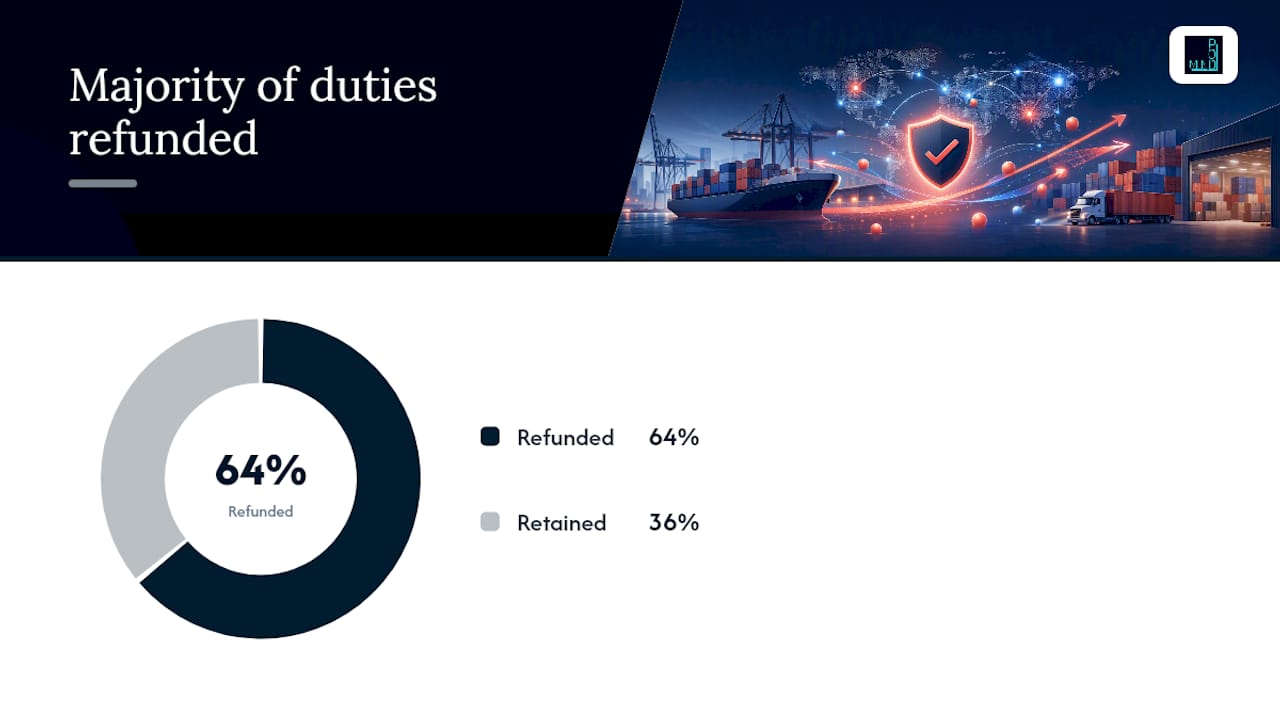
As of July 2026, the average effective U.S. tariff rate stood at 6.7%, and CBP had certified roughly $107 billion in refunds through August 21, 2026, about 64% of the $166 billion collected under the programs generating those claims according to the Wharton Budget Model. That refund volume is the clearest signal yet that drawback and exclusion processes are active and worth pursuing, not theoretical.
Can HTS Reclassification and First Sale Lower Your Duty Bill?
Most companies never revisit their HTS classifications after initial entry, and that's usually where the money sits. An HTS audit starts with pulling every active tariff line, checking each against the current Harmonized Tariff Schedule, and flagging anything classified more than five years ago or by a broker without engineering input.
It requires a documented multi-tiered sale structure and invoices that hold up under CBP scrutiny.
Unbundling separates non-dutiable charges (international freight, insurance, buying commissions) from the merchandise price so you're not paying duty on costs that shouldn't be dutiable in the first place.
- Pull HS4-level volume and duty-paid totals for the last 12 months.
- Cross-check current classifications against CBP rulings and any tariff engineering already applied.
- Confirm First Sale documentation exists for every tier in a multi-party supply chain.
Tariff engineering, changing a product's design, materials, or assembly sequence to land in a lower-duty category, requires proof of "substantial transformation" under CBP standards. Superficial changes invite audits, according to CLA Connect's tariff mitigation primer.
Pro Tip: Keep a paper trail showing the business reason behind any classification or design change, not just the duty savings. CBP auditors weigh intent, and "we changed this to avoid tariffs" without an engineering rationale is a red flag, not a defense.
Should You Diversify Suppliers, Nearshore, or Reshore?
The math starts with landed cost, not sticker price: duty rate, freight, lead time risk, and quality variance all belong in the comparison, not just the invoice total.
- Model total landed cost for your current source and at least two alternatives, including duty, freight, and inventory carrying cost.
- Decide between diversification (adding a second qualified factory) and full relocation based on volume concentration risk, not just tariff exposure.
- Confirm free trade agreement eligibility and rules-of-origin documentation before assuming a "nearshore" move actually qualifies for preferential rates.
- Vet new vendors on capacity, quality history, and financial stability, not price alone.
Academic research on tariff-driven sourcing shifts shows companies often reallocate toward lower-priced product varieties when switching suppliers, which can quietly erode quality even as duty costs drop, per IMF working paper findings. Full relocation makes sense when tariff exposure concentrates in one high-volume category; a second qualified factory makes more sense when you need resilience without abandoning a working relationship. Tools built for supplier discovery and sourcing automation can shorten the vendor search phase considerably when you're evaluating unfamiliar regions.
What Contract Terms Help Share Tariff Risk With Suppliers?
Procurement, legal, and finance need to sit in the same room before a tariff shock, not after. The contracts that survive volatility have specific language built in, and most companies wait until costs spike to add it.
- Change-in-law clauses that trigger price renegotiation when tariff rates shift beyond a defined threshold.
- Tariff pass-through provisions that split new duty costs between buyer and supplier by a set formula.
- Incoterms adjustments, shifting from DDP to FOB or vice versa, depending on who's better positioned to absorb classification risk.
- Short-term accommodations like temporary price holds or volume commitments in exchange for tariff-sharing.
PwC's advisory on tariff response notes that negotiating these clauses into every procurement contract is high-leverage and low-cost, yet most organizations delay it until after a tariff shock instead of building it in upfront.
How Do You Model and Monitor Tariff Exposure Over Time?
A usable scenario model needs four inputs at minimum: current HTS codes and duty rates, import volume by supplier and country, landed cost by SKU, and a probability-weighted view of pending rule changes. Run that against two or three "what-if" scenarios (a 5-point rate increase, an FTZ move, a sourcing shift) and you have a ranked list instead of a hunch.
- Set alerts for HTS rulings, exclusion announcements, and refund program updates tied to your specific product categories.
- Review exposure quarterly at minimum; monthly if your volume is concentrated in a handful of tariff lines.
- Present ROI to finance in dollars recovered or avoided per tactic, not percentage reductions, since CFOs fund concrete numbers.
Fifty-eight percent of trade professionals now use trade-data analytics for these decisions, according to the same Thomson Reuters survey, which tracks with why manual spreadsheet modeling is losing ground fast. A tool like SupplyMind.ei links HS codes directly to contract terms and supplier locations, so a rate change shows up as a dollar figure against a specific line, not a headline you have to translate yourself.
Where Do You Start: A Rollout Plan That Won't Stall
Week one is a diagnostic, not a decision. Pull your HS4-level volume table, your export share (it determines drawback eligibility), and a list of every active duty line over the last year.
- Week 1: Build the diagnostic table above and flag the top three duty-cost categories by dollar volume.
- Weeks 2 to 6: Pilot one tactic, an FTZ feasibility study or a supplier renegotiation, with a defined metric (dollars saved, percent duty reduction) and a hard end date.
- Weeks 6 to 12: Report pilot results to finance with actual recovered or avoided dollars, then decide on scaling.
Quick wins like classification fixes typically cost little beyond staff time and pay back within a quarter. Structural moves like FTZ setup or reshoring run into real capital and take six months or more to show results, so budget and expectations need to match the tactic.
Pro Tip: Run your pilot on the category with the highest duty-dollar exposure, not the easiest one to fix. A clean win on a small line item won't get budget approval for the next phase.

Author Perspective: Tariff Mitigation Is a Capability, Not a Project
Most companies treat tariff mitigation as a one-time scramble after a rate hike, then let it lapse once the news cycle moves on. That's backwards. KPMG's analysis of corporate tariff exposure makes the case that durable resilience comes from continuous monitoring and cross-functional ownership, not a single classification fix filed once and forgotten. Procurement, finance, and IT all need a stake in this, and the companies that win are the ones who build the analytics muscle before the next rate change forces their hand. An effective approach starts with prioritization for exactly that reason: rank the levers by dollar impact, implement the top two or three, and keep measuring.
— jaras
How Mindpod Technologies Helps You Cut Duty Costs
Most importers know they're overpaying somewhere in their tariff exposure. Finding exactly where, and proving it with numbers finance will act on, is the harder part. Starting with a technology assessment that maps actual exposure by HS code and supplier, then producing a prioritized plan, can guide effective mitigation efforts.

For ongoing exposure, SupplyMind.ei quantifies tariff and supplier risk in dollars and shows which lever, drawback, FTZ, sourcing shift, or contract renegotiation, actually moves the number for your specific product mix. That's the difference between guessing at a mitigation strategy and running one off a model that updates as rules change. If you're ready to see where your duty dollars are leaking, schedule a free assessment with Mindpodtech and get a plan built around your actual import data, not a generic checklist.
Where to Go for Deeper Research
- Wharton Budget Model's tariff rate tracker: the most current figures on effective rates and refund totals.
- Thomson Reuters' 2025 trade professional survey: benchmarks how peers are actually responding.
- NBER's working paper on 2025 tariff impacts: the economic research behind pass-through and volume effects.
- Importivity's tariff mitigation guide: a practical, step-by-step playbook for importers.
This article is general information, not a substitute for advice from a qualified financial advisor. Consult a qualified financial professional about your own circumstances before acting on anything here.
Sources
- Effective tariff rates and revenues — updated September 9, 2026 (Wharton/Budget Model)
- Navigating tariff volatility: essential mitigation strategies for global trade professionals (Thomson Reuters)
- Tariffs in 2025: Short-Run Impacts on the U.S. Economy (NBER working paper)
- Tariff Mitigation Strategies for US Importers (Importivity guide)
FAQ
Is the U.S. Getting Rid of Tariffs?
No. As of July 2026, the average effective U.S. tariff rate was 6.7%, and tariff policy remains active with ongoing exclusion and refund processes rather than a broad rollback.
Who Actually Pays the Tariff on Imports?
The importer of record pays the duty to CBP at entry, but research on the 2025 tariffs shows roughly 90% pass-through to consumer and business prices in exposed categories, meaning the cost typically moves downstream over time.
Is the U.S. Still Charging Import Tariffs?
Yes. CBP continues to collect duties on covered goods, and it has certified roughly $107 billion in refunds through August 21, 2026, out of $166 billion previously collected under programs tied to specific exclusions and rulings.
Are Tariffs Hurting the U.S. Economy?
Tariffs have measurably reduced import volumes and consumer spending in exposed product categories, according to NBER research, though the effect varies significantly by sector and how much of the cost gets passed through to buyers.
How Do I Know Which Mitigation Strategy to Start With?
Start with a diagnostic of your HS4-level duty exposure and export share. Tools like SupplyMind.ei can model several tactics against your actual volume data so you rank options by dollar impact instead of guessing.