

Yes, contract review AI is ready for production use by U.S. legal teams — when paired with calibrated playbooks, human-in-the-loop checkpoints, and vendor SLAs that put data handling commitments in writing. Gartner predicts roughly half of procurement contract management will be AI-enabled by 2027, and Bloomberg Law's ALM survey found that three out of four in-house counsel are dissatisfied with their current contract workflow technology. The gap between where teams are and where the market is heading is real, and it is closing fast.
Three things determine whether your team should move now:
- Accuracy and readiness. AI contract review tools have matured enough for standard commercial agreements, NDAs, and vendor contracts. Edge cases, highly negotiated M&A agreements, and jurisdiction-specific regulatory language still need attorney judgment.
- Data security and vendor commitments. SOC 2 Type II certification, explicit data residency terms, and a contractual prohibition on using your documents to train the vendor's model are non-negotiable starting points.
- Human-in-the-loop controls. No AI output should flow directly into a signed redline without attorney review. The tool flags, suggests, and extracts; the attorney decides.
The practical next step is a 60–90 day pilot on a defined contract type (NDAs and vendor MSAs are ideal starting points). Measure precision and recall on a sample corpus, track review-time reduction, and get user acceptance scores from the attorneys doing the work. Involve legal ops, IT security, and at least one senior associate or staff attorney from day one. Mindpod Technologies runs exactly this engagement pattern for U.S. legal teams, starting with a free technology assessment.
Key Takeaways
Contract review AI is production-ready for U.S. legal teams on standard commercial agreements when deployed with calibrated playbooks, human-in-the-loop checkpoints, and vendor SLAs that explicitly address data handling and training-data use.
| Point | Details |
|---|---|
| Start with NDAs and MSAs | High volume, standard structure, and low complexity make these the fastest path to measurable ROI. |
| Playbook quality drives output | Generic models produce generic results; invest in building your standard positions before the pilot starts. |
| Human review is non-negotiable | No AI-suggested redline should reach a counterparty without attorney sign-off, regardless of precision scores. |
| Demand SOC 2 and data-use terms | Require a SOC 2 Type II report and explicit contractual prohibition on training-data use before uploading any documents. |
| Mindpodtech recommended path | Mindpod Technologies offers a free technology assessment and a structured pilot engagement for U.S. legal teams. |
Table of Contents
- What is contract review AI, and how does it differ from manual review?
- What do AI contract review tools actually produce?
- What are the real benefits for legal teams and business stakeholders?
- What can go wrong: accuracy, privilege, privacy, and vendor risks
- How do you evaluate and choose a contract review AI solution?
- Deployment and change-management best practices for U.S. legal teams
- How Mindpod Technologies approaches production-ready contract AI
- Final verdict and a 90-day adoption plan for U.S. legal teams
- A few pragmatic notes from the field
- Mindpod Technologies helps legal teams deploy contract-review AI
- Sources
What is contract review AI, and how does it differ from manual review?
Contract review AI is software that uses large language models (LLMs) and natural language processing to read, analyze, and extract structured information from legal agreements, then surface issues, suggest redlines, or produce summaries without requiring a human to read every clause first. The output is not a replacement for attorney judgment; it is a structured first pass that compresses the time between "document received" and "attorney-ready analysis." Thomson Reuters' buyer's guidance frames it precisely this way: AI accelerates large-volume review by extracting key information and delivering analysis that legal teams can act on.
The contrast with manual review is sharpest at scale.
| Dimension | AI-assisted review | Manual review |
|---|---|---|
| Speed | Seconds to minutes per document | 30–90 minutes per document |
| Consistency | Same playbook applied every time | Varies by reviewer experience and fatigue |
| Scope | Hundreds of documents in parallel | Sequential; bottlenecked by headcount |
| Error modes | Hallucinations, missed edge cases, OCR failures | Fatigue errors, inconsistent clause interpretation |
| Cost per document | Decreases at volume | Linear with headcount |
Deployment models legal teams actually use
Cloud-managed. The vendor hosts the model and infrastructure. Fastest to deploy; requires strong data-handling SLAs and explicit contractual prohibitions on training-data use.
Bring-your-own-model or bring-your-own-key (BYOM/BYOK). Your organization supplies the model or the encryption key. Gives IT security and legal ops more control over data residency and model provenance. Some lightweight Word add-in tools, like the approach Proviso takes, offer BYOK as a core feature for teams that need in-document review without a full CLM migration.
On-premises or private cloud. Maximum control; highest infrastructure cost. Typically reserved for firms handling highly sensitive M&A or regulatory matters.
Word add-in vs. CLM-integrated. Add-ins drop into the workflow attorneys already use and minimize change management. CLM-integrated flows unlock portfolio analytics, obligation tracking across a contract library, and automated renewal alerts, but require a longer integration runway.
What do AI contract review tools actually produce?
The output depends on how the tool is configured, but mature platforms cover most of what a first-pass review requires:
- Clause identification. The tool locates and labels standard clauses (limitation of liability, indemnification, termination, IP ownership, governing law) and flags non-standard or missing provisions.
- Obligation extraction. Structured lists of what each party must do, by when, and under what conditions, pulled directly from the contract text with source citations.
- Risk tagging. Clauses scored against a playbook or market standard, with severity levels (high, medium, low) and the specific language that triggered the flag.
- Redline suggestions. Proposed alternative language based on your playbook, surfaced inline in Word or a review interface. Drafting-plus-review tools extend this to generating first-draft clauses from scratch.
- Playbook enforcement. Automated comparison of incoming contract language against pre-defined acceptable positions. Deviations get flagged for attorney review rather than passing through silently.
- Batch analytics and clause benchmarking. Portfolio-level views showing how a clause (say, a liability cap) compares across a hundred vendor agreements, or how your current deal stacks up against historical averages.
- Contract summarization. A structured abstract covering parties, term, key obligations, renewal mechanics, and flagged risks, typically one page or less.
A practical example: an obligation extraction output might read, "Section 8.2 — Vendor must deliver monthly security reports by the 5th of each month; failure triggers a 30-day cure period under Section 14.1." That sentence comes from the AI reading the contract, not from a human summarizing it. The attorney's job is to verify it is accurate and decide whether the cure period is acceptable.
File format support varies by vendor. Most handle Word (.docx) and PDF natively. Scanned PDFs require OCR, and OCR errors are a real source of missed clauses, particularly in older documents with unusual formatting or handwritten annotations. Email-attached contracts and HTML-formatted agreements are supported by some platforms but not all. Test your actual document mix during the pilot.
What are the real benefits for legal teams and business stakeholders?
The efficiency gains are the most cited benefit, and they are genuine. A reviewer who would spend 90 minutes on a vendor MSA can often complete attorney-level review of an AI-processed version in 20–30 minutes, because the tool has already located the relevant clauses, flagged the deviations, and drafted suggested alternatives. That is not a vendor claim; it is the structural logic of removing the search-and-locate step from the workflow.
Illustrative scenario (model this against your own volume): A 10-attorney in-house team reviewing 400 vendor contracts per year at an average of 90 minutes each spends roughly 600 attorney-hours annually on first-pass review. If AI-assisted review cuts that to 25 minutes per contract, the team recovers approximately 430 hours per year. At a blended attorney cost of $200/hour, that is around $86,000 in recovered capacity, before accounting for reduced outside counsel spend on overflow work. These figures are illustrative; your actual results depend on contract complexity, playbook quality, and team adoption.
Beyond time savings, the consistency benefit is underappreciated. Manual review quality varies with the reviewer's experience, the time of day, and how many contracts they have already read that week. A well-calibrated AI playbook applies the same standard to every document, every time.
For legal operations teams, the analytics layer is where the real strategic value lives. Portfolio-level clause benchmarking lets you see, across your entire vendor contract library, where your exposure is concentrated, which counterparties consistently push back on specific terms, and which contract types close fastest. That kind of visibility was previously available only to firms with dedicated contract management staff and a mature CLM implementation.

The benefit profile differs by team type. Small in-house teams gain the most from time savings and consistency. Legal operations teams gain most from analytics and obligation tracking. Outside counsel benefits most from batch processing on due diligence and M&A document review, where volume is high and turnaround time is a competitive differentiator.
What can go wrong: accuracy, privilege, privacy, and vendor risks
The risks are real and specific. Treating them as theoretical is how teams end up with a privileged document in a vendor's training corpus or a missed indemnification clause in a signed agreement.
- Hallucinations and false negatives. LLMs can generate plausible-sounding clause summaries that do not reflect the actual contract language. False negatives (missed issues) are often more dangerous than false positives, because they create a false sense of completeness.
- Insufficient grounding. Tools that do not cite the specific contract text behind each finding make it difficult to verify outputs quickly. Provenance matters: every AI finding should link back to the exact clause that triggered it.
- Privilege exposure. Uploading privileged communications or attorney work product to a cloud-hosted AI tool can implicate privilege if the vendor's data handling is not structured to preserve it. This is not hypothetical; bar associations in several U.S. states have issued guidance on attorney competence obligations when using AI tools with client data.
- Data residency and vendor logging. Some vendors log query inputs for model improvement. If your contracts contain trade secrets, PII, or regulated data, you need explicit contractual language prohibiting training-data use and specifying where data is stored and processed.
- Model drift and edge cases. A model calibrated on standard commercial agreements may perform poorly on construction contracts, healthcare agreements, or highly negotiated financial instruments. Revalidation after model updates is not optional.
- CCPA/CPRA considerations. If your contracts contain California consumer PII (common in data processing agreements and vendor contracts), your AI tool's data handling may trigger obligations under the California Consumer Privacy Act and its amendments.
Mitigation checklist:
- Require human attorney sign-off before any AI-suggested redline is accepted into a final document.
- Calibrate your playbook on a representative sample of your actual contract mix before going live.
- Conduct red-team testing: deliberately introduce known issues into test contracts and verify the tool catches them.
- Negotiate explicit SLA language covering data retention periods, deletion on contract termination, and a prohibition on using your documents as training data.
- Include liability caps and indemnification provisions in your vendor contract that address AI-generated errors specifically.
- Maintain audit logs of every AI suggestion accepted or rejected, with timestamps and reviewer identity.
Pro Tip: Ask every vendor for their most recent SOC 2 Type II report and their data processing agreement before you run a single document through their system. A vendor that hesitates on either is telling you something important about their security posture.
How do you evaluate and choose a contract review AI solution?
Start with the evaluation criteria that actually differentiate vendors, not the marketing language.
Grounding and explainability. Does every AI finding cite the specific contract clause that triggered it? Can you trace a risk flag back to the exact sentence? Tools that produce findings without provenance are harder to verify and harder to defend if an issue is missed.
Security and certifications. SOC 2 Type II is the baseline for U.S. legal teams. ISO 27001 adds a layer for firms with international clients or data. Ask for the actual audit report, not a badge on a marketing page.
Integrations. CLM integration (Ironclad, Conga, DocuSign CLM) matters for teams that want portfolio analytics. E-sign integration (DocuSign, Adobe Acrobat Sign) matters for closing workflows. ECM integration (SharePoint, iManage, NetDocuments) matters for document management. Word add-in support matters for attorneys who will not leave their existing workflow.
Customization and playbook training. Can you upload your own standard positions and acceptable language? Can the tool learn from your historical redlines? The difference between a generic risk flag and a playbook-calibrated flag is the difference between noise and signal.
Audit logs and provenance. Every accepted and rejected suggestion should be logged with a timestamp, reviewer identity, and the AI's original output. This is your defense if a missed clause becomes a dispute.
Scale and throughput. If you process 500 contracts per month, test the tool at that volume. Latency at scale is a real operational issue that demos never reveal.
Vendor questions worth asking directly
- What model powers the tool, and how is it grounded to contract text specifically?
- Where is data stored, and in which jurisdiction?
- Does the vendor use customer documents to improve the model? Is that opt-out or opt-in?
- What is the SLA for uptime and for data deletion on contract termination?
- Has the tool been red-team tested for adversarial inputs or prompt injection?
- What is the escalation path if the tool produces a materially incorrect output?
Red flags
An opaque answer about model sourcing, reluctance to provide the SOC 2 report, vague data-use terms that do not explicitly exclude training, no human-in-loop configuration options, and missing audit logs are all reasons to pause. Any vendor that cannot answer the data-use question in one clear sentence is not ready for a legal team's document environment.
Pricing shapes
Pricing models fall into three patterns: per-user seat subscriptions (common for add-in tools), per-document fees (common for high-volume batch processing), and enterprise subscription tiers that bundle seats, volume, and support. BYOM/BYOK deployments typically carry higher setup costs but lower per-document costs at scale. Expect a wide range depending on volume, deployment model, and support tier. Get a total cost of ownership estimate that includes implementation, playbook configuration, and ongoing support, not just the license fee.
60–90 day pilot template
A well-scoped pilot answers three questions: does the tool catch what your attorneys catch, does it fit your workflow, and does it hold up under your security requirements?
- Weeks 1–2: Select 50–100 representative contracts from one contract type. Configure the playbook against your standard positions. Establish baseline review time per document.
- Weeks 3–6: Run parallel reviews: AI-assisted and manual, on the same documents. Measure precision (how many AI flags were valid) and recall (how many real issues did the AI catch that manual review also caught).
- Weeks 7–10: Expand to a second contract type. Collect user acceptance scores from reviewers. Identify false negative patterns and retrain or adjust the playbook.
- Success metrics: Precision above 85%, recall above 90% on flagged issues, review time reduction of at least 40%, and user acceptance score above 7/10 from the reviewing attorneys.
Deployment and change-management best practices for U.S. legal teams
The pilot-to-production path fails most often not because the technology underperforms, but because the change management is underestimated. Attorneys are trained to be skeptical of tools that claim to do their job. That skepticism is healthy; the answer is not to oversell the tool but to give attorneys evidence they can trust.
Pilot checklist:
- Select a contract type with enough volume to generate statistically meaningful results (50+ documents minimum).
- Map your playbook before the pilot starts. If you do not have a written playbook, the pilot is also the time to build one.
- Assign a legal ops owner who is accountable for the pilot metrics and the rollback criteria.
- Define rollback criteria explicitly: if precision drops below 80% or a material false negative is discovered post-signing, the pilot pauses for root-cause analysis.
Human-in-the-loop workflow
The recommended checkpoint structure is: AI produces a flagged review with provenance citations, attorney reviews flags and accepts or rejects each suggestion, attorney signs off on the final redline before it leaves the legal team. No AI output should be transmitted to a counterparty without attorney review. For low-risk, high-volume contracts (standard NDAs, routine vendor renewals), a senior paralegal or legal ops specialist can handle the first-level review of AI flags, with attorney sign-off on the final document.
Monitoring KPIs to track monthly:
- Average review time per contract type
- Issue detection rate (AI-caught vs. attorney-caught on the same documents)
- False positive rate (flags that were not real issues)
- False negative rate (issues missed by AI, caught in attorney review)
- User adoption rate (percentage of eligible contracts processed through the tool)
- Periodic revalidation: full precision/recall test on a fresh sample every quarter
Governance roles:
- Legal ops owner: accountable for KPIs, playbook updates, and vendor relationship.
- IT security reviewer: owns the vendor security assessment, SOC 2 review, and data handling audit.
- Model steward: tracks model updates from the vendor and triggers revalidation when the underlying model changes.
- Escalation path: any false negative discovered post-signing goes to general counsel within 24 hours, with a root-cause report within 5 business days.
How Mindpod Technologies approaches production-ready contract AI
Mindpod Technologies' legal intake and contract-review agent follows a deliberate assessment-to-production pattern designed to avoid the two most common failure modes: deploying before the playbook is calibrated, and going live without monitoring in place.
Engagement flow:
- Discovery and technology assessment. Mindpod maps the team's current contract volume, document types, existing tools (CLM, DMS, e-sign), and security requirements. The output is a prioritized plain-language plan the client owns, not a vendor pitch deck.
- Playbook and dataset preparation. Before a single production document is processed, Mindpod works with the legal team to define acceptable positions, build the clause playbook, and select a representative pilot dataset.
- 60–90 day pilot. The pilot runs against the success metrics defined in the assessment: precision/recall targets, review time reduction, and user acceptance. Monitoring and rollback criteria are in place from day one.
- Scale and integration. After the pilot validates performance, Mindpod integrates the agent into the team's existing tools (Word, CLM, DMS) and establishes the monthly governance cadence.
Illustrative ROI drivers (model against your environment): Time saved per reviewer per contract, reduction in outside counsel spend on overflow review, and faster contract close times (which have measurable revenue impact for commercial teams). These are the three levers that typically justify the investment within the first year.
Safeguards Mindpod deploys by default:
- BYOM/BYOK options for teams with strict data residency requirements
- Monitoring dashboards and rollback procedures from day one
- Attorney oversight checkpoints built into the workflow, not bolted on afterward
- Explicit SLA commitments covering uptime, data deletion, and model update notification
- Audit logs for every AI suggestion, accepted or rejected, with reviewer identity and timestamp
Mindpod Technologies starts every engagement with a free technology assessment that produces a prioritized plan before any commitment is made.
Final verdict and a 90-day adoption plan for U.S. legal teams
Contract review AI is worth deploying now for U.S. legal teams that handle meaningful contract volume on standard commercial agreement types. The technology is mature enough for NDAs, vendor MSAs, and service agreements. It is not mature enough to replace attorney judgment on complex, highly negotiated, or jurisdiction-specific agreements. The teams that will benefit most in the next 12 months are those that start a structured pilot now rather than waiting for a perfect solution.
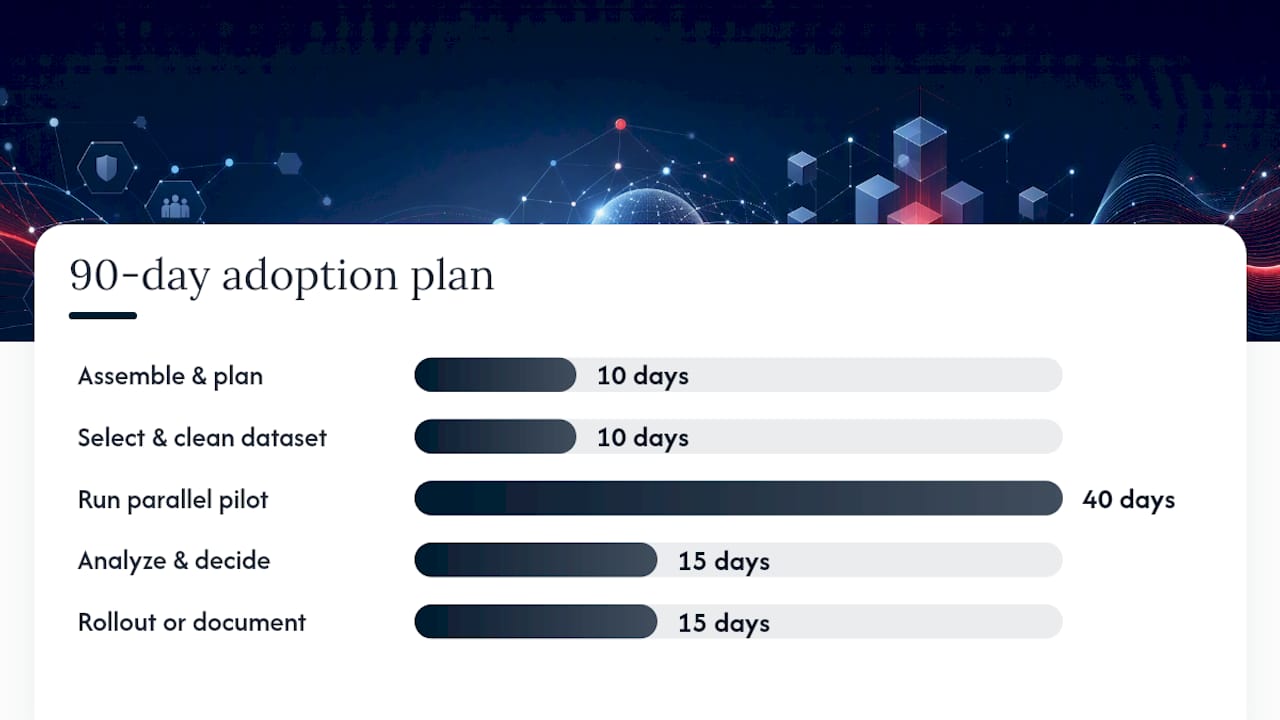
90-day adoption plan:
- Days 1–10: Assemble stakeholders (legal ops, IT security, one senior attorney, general counsel sponsor). Define the pilot contract type and success metrics. Identify the vendor shortlist and request SOC 2 reports and data processing agreements.
- Days 11–20: Select and clean the pilot dataset (50–100 contracts). Configure the playbook against your standard positions. Complete vendor security review.
- Days 21–60: Run the parallel pilot (AI-assisted and manual review on the same documents). Collect precision, recall, review time, and user acceptance data weekly.
- Days 61–75: Analyze results against success metrics. Identify false negative patterns. Adjust playbook. Make go/no-go decision on production rollout.
- Days 76–90: If go: sign the integration roadmap, assign governance roles, establish monthly KPI review cadence. If no-go: document root causes and define what needs to change before a second pilot.
Next-step options: Run this pilot internally using the framework above, or request a Mindpod Technologies assessment and pilot engagement. Mindpod's free technology assessment maps your current environment, identifies the highest-ROI starting point, and produces a plan you own before any contract is signed.
A few pragmatic notes from the field
The most common mistake legal teams make when evaluating AI contract review is treating it as a technology decision rather than a workflow decision. The tool is almost never the bottleneck. The bottleneck is the playbook, the change management, and the governance structure.
Three things teams consistently underestimate:
- Playbook quality determines output quality. A generic risk-flag model applied to your contracts will produce generic results. The teams that get the most value from AI review are the ones that invest two to four weeks building a real playbook before the pilot starts. That means written standard positions, acceptable language alternatives, and a list of the clauses that matter most for your specific contract mix.
- The easiest win is NDAs. High volume, relatively standard structure, low complexity. If your team reviews more than 20 NDAs per month, that is the place to start. The ROI is fast, the risk is low, and the success builds internal credibility for the next phase.
- The operational pitfall is false confidence. Teams that see high precision scores in the pilot sometimes reduce attorney review time more aggressively than the data supports. Precision of 90% means one in ten flags is wrong. On a 50-clause contract, that is five errors. Human review is not optional; it is the control that makes the system trustworthy.
Mindpod Technologies helps legal teams deploy contract-review AI
Most legal teams know they need better contract review tooling. The harder problem is knowing where to start without taking on unnecessary risk or locking into a platform before the workflow is proven.
Mindpod Technologies' legal intake and contract-review agent gives U.S. legal teams a production-ready path that does not require a CLM migration or a six-month implementation. The engagement starts with a free technology assessment that maps your current contract volume, document types, and security requirements, then delivers a prioritized plain-language plan you own. From there, Mindpod runs a structured 60–90 day pilot with monitoring, rollback, and attorney oversight built in from day one, not added as an afterthought.
The assessment costs nothing and commits you to nothing. Mindpodtech and get a clear picture of where AI contract review creates the most leverage for your team.
This article is general information, not a substitute for advice from a qualified lawyer. Consult a qualified legal professional about your own circumstances before acting on anything here.
Sources
- Buyer's guide: AI for legal contract review and analysis