

Use a stage-aligned AI ROI ladder, moving from adoption through efficiency, quality, and transformation, paired with CFO-ready benefit components and a one-page quarterly scorecard. That combination is what turns "the AI project seems to be helping" into a number a finance committee will sign off on. This guide gives you the ladder, the formulas, a baseline methodology, and a 90-day plan to get your first defensible scorecard on paper.
TL;DR:
- Most companies misapply a single metric, usually revenue, across all AI projects, ignoring the stage-specific expectations of adoption, optimization, enhancement, and transformation.
- Accurately calculating CFO-ready AI ROI requires breaking benefits into time savings, error reduction, and volume or revenue gains, using fully loaded labor costs and comprehensive cost accounting.
- A quarterly AI ROI scorecard should include baseline and current quarter data on cost reduction, revenue acceleration, quality, and strategic value to enable informed funding decisions.
- Common measurement errors, such as vanity metrics, missing baselines, undercounted costs, and premature expectations, cause the most inflated or unreliable ROI claims.
Table of Contents
- What Is an AI ROI Framework, and Why Does Stage Matter?
- How Do You Calculate CFO-Ready AI ROI?
- How Do You Baseline AI Performance Without Inflating the Numbers?
- What Belongs on a Quarterly AI ROI Scorecard?
- What Mistakes Make an AI ROI Claim Fall Apart?
- How Do You Run a 90-Day AI ROI Kickstart?
- How Does Mindpod Technologies Apply These Checkpoints?
- How Do You Measure Intangible AI Benefits Like Satisfaction or Brand Value?
- Why Most AI ROI Advice Skips the Hard Part
- How Mindpod Technologies Helps You Run This Framework
- Sources
- FAQ
What Is an AI ROI Framework, and Why Does Stage Matter?
An AI ROI framework is a structured method for tying AI spending to measurable business outcomes, using metrics that shift as a project matures. The mistake most companies make is applying one metric, usually a revenue number, to every AI initiative regardless of how new it is. A four-stage ladder fixes that by matching the type of value you should expect to the stage the initiative is actually in, an approach Atlassian's four-stage enterprise AI framework lays out clearly.
Here's how the stages break down:
- Exploring. Teams are testing whether a tool or agent fits the workflow at all. The primary signal is adoption: how many people opened it, how many sessions stuck, how many abandoned it after one try.
- Optimizing. The tool is in regular use and the question becomes efficiency. Track time saved per task and completion rate, not revenue.
- Enhancing. Quality becomes the story. Error rates, rework rates, and customer-facing accuracy scores tell you whether the AI is actually making the work better, not just faster.
- Transforming. Only here should you expect net-new revenue, new product lines, or headcount reallocation. This is the stage investors and boards usually want to hear about first, and it's the one most projects haven't reached.
Demanding transformation-stage numbers from an exploring-stage pilot is the single most common reason good AI initiatives get killed early. A chatbot that shaved four minutes off a support ticket in month two hasn't failed just because it didn't grow revenue, it's doing exactly what an optimizing-stage tool should do. Matching the metric to the maturity level protects a genuinely promising project from a premature "this isn't working" verdict, and it stops leadership from pouring budget into a stalled adoption-stage pilot because a vanity dashboard looked fine.
How Do You Calculate CFO-Ready AI ROI?
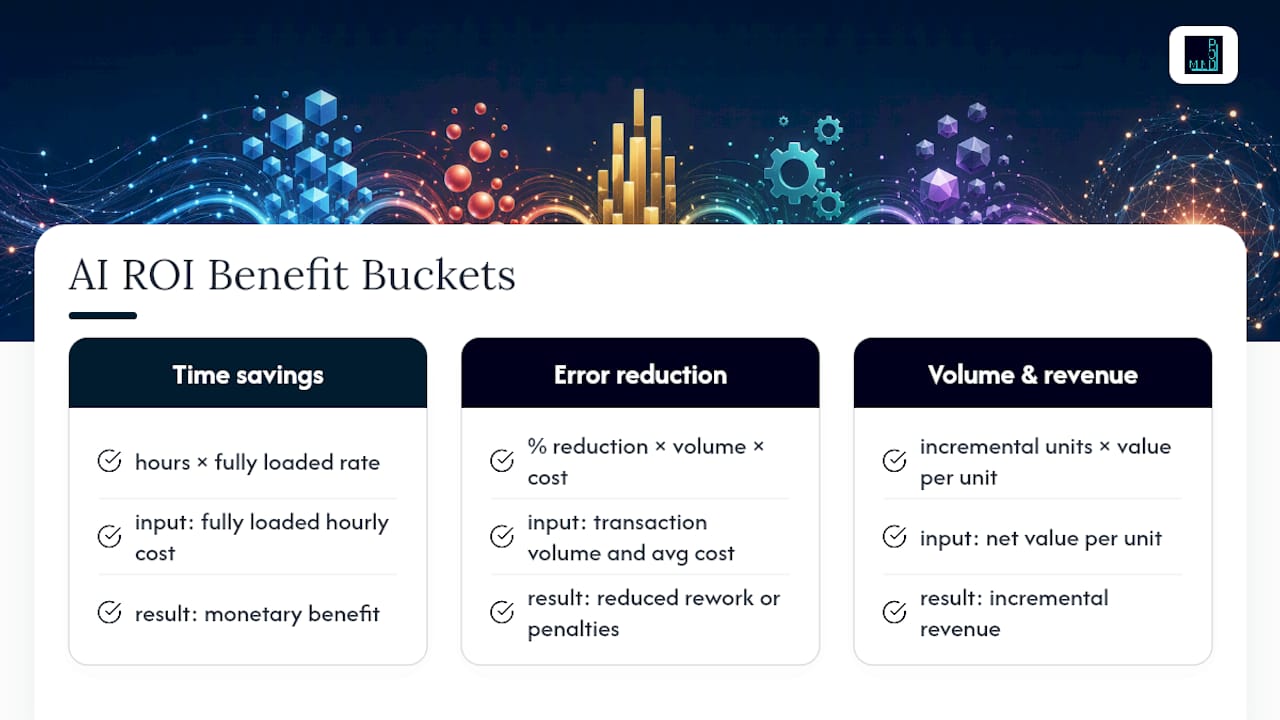
A CFO-ready calculation breaks benefits into three buckets, each with its own formula, rather than one blended "AI saved us money" claim — as explained in detail for practical small business use cases in AI Tools for Small Businesses: Real ROI. This structure comes straight from a CFO's framework for calculating AI ROI, and it's the version that survives scrutiny in a finance meeting.
Time savings: Hours saved per period × fully loaded hourly rate of the role performing the task.
Error reduction: Percentage reduction in error rate × transaction volume × average cost per error (rework, compliance penalty, or customer refund).
Volume and revenue gains: Incremental units processed or sold × value per unit, net of any added cost to generate that unit.
The fully loaded labor rate matters more than it sounds. A senior analyst's hour and a junior clerk's hour cost your business very different amounts once you add benefits, overhead, and management time, not just salary divided by 2,080 hours. Fully loaded cost calculations capture that difference, and skipping it is how companies both overstate and understate their actual savings.
Costs need the same rigor. Beyond the software license or API bill, count development time, integration work, ongoing operational support, training and change management, governance and human oversight, and the technical debt an AI shortcut can quietly create in your codebase.
Gartner projects worldwide spending on generative AI to reach hundreds of billions of dollars in 2025, a pace of investment that makes credible measurement, not enthusiasm, the deciding factor in which projects keep funding. Gartner's forecast
For financial framing, most operations leaders default to a simple payback period (total cost ÷ monthly net benefit = months to break even) for early-stage pilots, and reserve NPV or IRR for larger, multi-year platform investments where the timing of cash flows actually changes the decision. A $40,000 automation pilot with a nine-month payback doesn't need a discounted cash flow model. A three-year enterprise rollout does.
How Do You Baseline AI Performance Without Inflating the Numbers?
The single biggest source of inflated ROI claims is a missing or sloppy baseline. You can't credibly claim a 30% time reduction if you never measured how long the task took before AI touched it.
- Capture a real pre-AI baseline. Eight to twelve weeks is a reasonable default, but tie the window to the use case: a high-volume daily process (ticket triage, invoice coding) can baseline in a few weeks, while a seasonal or low-frequency workflow needs a full cycle.
- Log the four core data points during that baseline: time per task, error or rework rate, transaction volume, and the fully loaded cost of the people doing the work.
- Choose an attribution method before you launch, not after. A true A/B or cohort split, with one team using the tool and a matched team not, is the gold standard. Where randomization isn't feasible, a before/after comparison on the same team, or a difference-in-differences approach against a comparable unrelated team, is a workable substitute.
- Instrument logging with the lowest possible friction. Time-tracking add-ons, existing ticketing system fields, or a simple weekly form beat asking employees to fill out a new spreadsheet nobody will maintain past week three.
- Assign ownership explicitly. A data owner keeps the numbers clean, an implementation lead reports adoption and blockers, and a finance reviewer signs off on the cost and benefit math each quarter.
- Track adoption decay, not just initial uptake. A tool with 90% week-one usage that drops to 20% by week eight is not delivering the ROI its early numbers suggested.
- Watch model drift, error rate trends, and audit pass rate as trust signals. KPMG's guidance on AI ROI measurement treats these as leading indicators of whether realized value will hold up over time, not just whether it showed up once.
Pro Tip: Before comparing your results to any published industry benchmark, run the comparison against your own pre-AI baseline first. Benchmarks assume similar measurement methodology, and most companies aren't measuring the same way you are, a point Olakai's practical ROI framework makes explicitly.
What Belongs on a Quarterly AI ROI Scorecard?
A one-page scorecard, reviewed quarterly with data fed monthly, keeps AI spending decisions grounded instead of anecdotal. Influzer.ai's research on executive AI ROI reporting found this layered, annualized format to be the most effective way boards maintain funding discipline across multiple initiatives at once.
Structure it as four rows, each with a baseline column, a current-quarter column, and an annualized dollar value:
- Cost reduction: Labor hours and error costs eliminated, annualized using fully loaded rates.
- Revenue acceleration: Incremental throughput or sales enabled, net of added cost.
- Risk and quality: Compliance incidents avoided, audit pass rate, customer complaint trend.
- Strategic optionality: Capabilities the initiative unlocks for future projects, even if not yet monetized.
Total ROI is simply the sum of annualized dollar value across all four rows, divided by total AI investment for the period, expressed alongside payback in months as a second, easier-to-communicate metric. A populated row might read: accounts payable automation, baseline 6.2 minutes per invoice, current quarter 2.1 minutes, annualized value calculated from the time differential times invoice volume times the fully loaded processor rate. A related example on baselining and ROI in accounts payable automation walks through exactly this kind of calculation. No initiative needs a perfect number in every row every quarter, but leaving a row blank because "we didn't track it" is itself a finding worth flagging to the executive team.
What Mistakes Make an AI ROI Claim Fall Apart?
Most inflated AI ROI numbers don't come from dishonesty, they come from measurement shortcuts that felt reasonable at the time.
- Vanity metrics. Prompt counts, API calls, and pilot sign-ups measure activity, not outcomes. TechRadar Pro's reporting on AI vanity metrics calls this "activity theater," and it's the most common reason boards later ask why a well-adopted tool didn't move any real number. The fix: replace prompt counts with pre/post process-time comparisons on the same task.
- Missing baseline. No pre-AI number means no credible post-AI claim. Fix it by delaying rollout two weeks to capture a baseline if you have to.
- Undercounted total cost of ownership. Licensing is rarely the biggest line item once integration, training, and oversight are added. Fix it with a full cost worksheet before the first ROI report, not after.
- Poor adoption tracking. A tool nobody opens after month one can't deliver the efficiency gains modeled at launch. Fix it by monitoring weekly active use, not just initial rollout.
- Ignoring quality and regulatory costs. A faster process that generates more compliance exceptions isn't actually cheaper. Fix it by including error and audit metrics in every ROI calculation, not just speed.
- Measuring too early. Expecting transformation-stage revenue from a two-month exploring-stage pilot sets an unfair bar. Stage-gate your expectations and your funding decisions together.
How Do You Run a 90-Day AI ROI Kickstart?
You don't need a full enterprise measurement program to start. A focused 12-week sprint gets your first defensible scorecard on the table.
- Weeks 1 to 2: Pick one to three initiatives, no more. Name the single business metric each one is meant to move, and assign a named owner for each.
- Weeks 3 to 6: Capture your pre-AI baseline and stand up lightweight instrumentation. Assign a data owner to keep the numbers clean, an implementation lead to track rollout, and a finance reviewer to check the cost side.
- Weeks 7 to 10: Run your first controlled comparison, a cohort split or before/after test, and evaluate adoption alongside the outcome metric. Watch for early drop-off, not just early enthusiasm.
- Weeks 11 to 12: Produce your first quarterly scorecard and hold a formal stage-gate review: continue, adjust, or stop.
Set acceptance criteria before week 12 arrives, not during the meeting. A reasonable bar for continuing: adoption above 50% of the target user group, a measurable improvement over baseline on the named metric, and no new quality or compliance issue introduced. This mirrors the minimum-viable approach KPMG recommends for teams that can't run a full enterprise program on day one: one use case, clear success metrics, real instrumentation, reviewed on a schedule.
How Does Mindpod Technologies Apply These Checkpoints?
[brand_signal]
Agentic AI deployments can be built around four operational checkpoints, not just a launch date: a defined monitoring cadence, explicit rollback triggers if error or drift metrics cross a threshold, human-in-the-loop review at defined decision points, and acceptance gates before an initiative moves from pilot to production. These map directly onto the ladder above, an exploring-stage agent gets tighter human review than an enhancing-stage one that has already proven its error rate.
Engagements typically start with a free technology assessment that produces a prioritized, plain-language plan the client owns outright, whether it is delivered and run by the consultancy or executed internally. That structure exists because measurement discipline works best when it's built in from the first week, not retrofitted after a leadership team asks why the numbers don't add up. Our AI governance framework covers the control side of this in more depth, particularly around audit pass rates and monitoring cadence.
[author_bio]
How Do You Measure Intangible AI Benefits Like Satisfaction or Brand Value?
Not every AI benefit shows up as a line item, and pretending otherwise just pushes real value off the scorecard entirely. Customer satisfaction, brand perception, and employee experience move the business even when they resist a clean dollar figure.
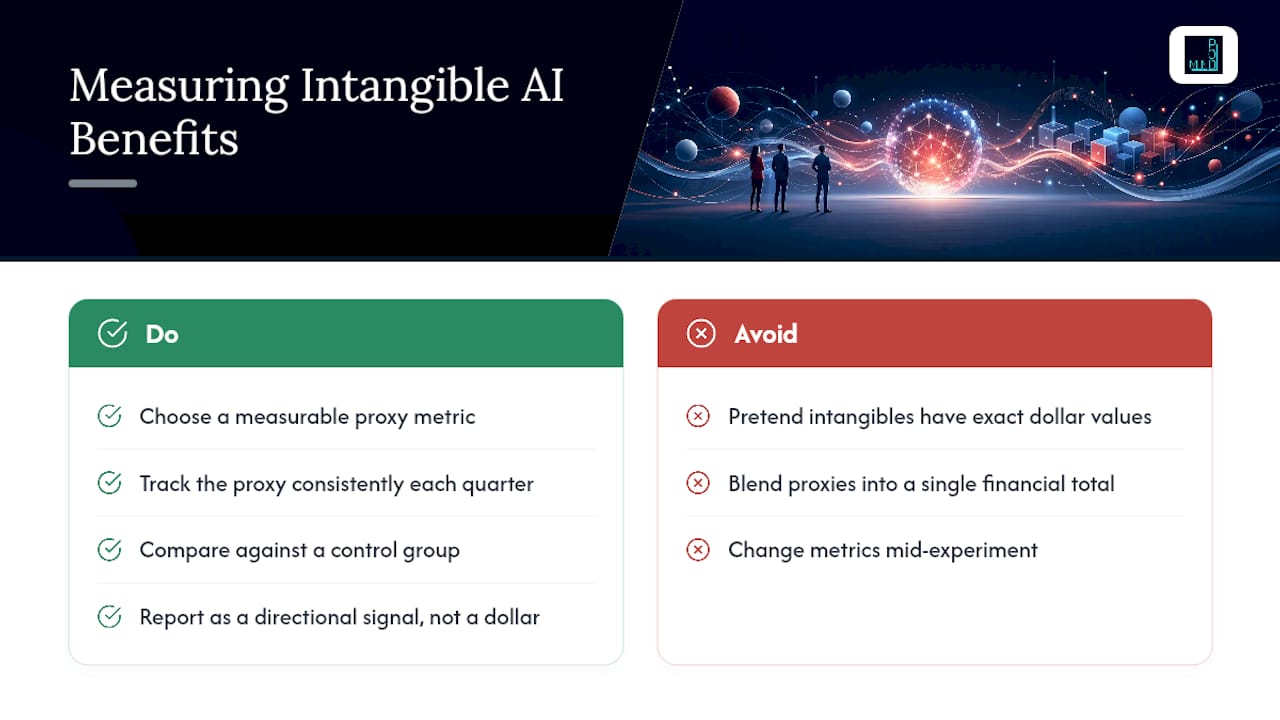
The practical approach is to proxy the intangible with something you can already measure, then track the trend rather than chase a precise dollar value. Customer satisfaction scores, Net Promoter Score movement, and support ticket sentiment before and after an AI-assisted process change all work as directional proxies. If AI-assisted support cuts average resolution time and satisfaction scores climb over the same quarter, you have a defensible, if not perfectly precise, signal that belongs on the risk and quality row of your scorecard.
Employee experience works the same way. Falling attrition on a team that adopted an AI copilot, tracked against a control team that didn't, tells you something about morale and retention costs that a pure efficiency number misses. Brand value is harder still, but proxies like reduced complaint volume, faster response times on social channels, or improved review scores give you a trend line worth watching even without a single authoritative valuation model.
The discipline here isn't precision, it's consistency: pick your proxy metric before launch, track it the same way every quarter, and report it as a directional signal alongside your harder financial numbers rather than blending the two into one misleading total.
Why Most AI ROI Advice Skips the Hard Part
Most AI ROI content stops at "measure before and after," which is true and nearly useless on its own. The harder, more valuable discipline is refusing to ask a two-month-old pilot to prove what only a mature deployment can prove. That single habit, staging your expectations to match your initiative's actual maturity, prevents more bad cancellations and bad renewals than any spreadsheet template.
The conventional advice also underweights cost. Companies get excited about the benefit side of the ledger and treat licensing as the whole cost story, then wonder why the "60% time savings" pilot never shows up in the P&L. Governance, oversight, and change management aren't overhead you tolerate, they're line items that belong in the same formula as the benefit.
If you take one thing from this framework, make it the scorecard cadence. A monthly data feed with a quarterly executive review forces the conversation to happen on schedule, before a project either gets killed on bad information or quietly limps along for two years because nobody had the numbers to challenge it.
— jaras
How Mindpod Technologies Helps You Run This Framework
Building the ladder, the formulas, and the scorecard is the easy part on paper. Instrumenting it inside real systems, with real data owners and real rollback triggers, is where most internal teams stall out for lack of bandwidth, not lack of understanding.

Mindpod Technologies starts every engagement with a free technology assessment that turns into a prioritized, plain-language plan you own, whether we deliver and run it or your own team executes it. That plan can apply this exact ladder to your top one to three AI initiatives, including baseline design, cost modeling with fully loaded labor rates, and the monitoring and human-in-the-loop checkpoints that keep an ROI claim credible past the first quarter. If you're weighing an agentic AI rollout for back-office, legal intake, clinic operations, or MSP ticket triage, our agentic AI solutions page outlines where this kind of measurement typically applies first. Book a free assessment through Mindpod Technologies and get a scorecard-ready plan built around your actual initiatives, not a generic template.
Sources
- Stop guessing at AI ROI: A four‑stage framework for real results
- Calculating AI ROI: A CFO's Framework | AI Report
- AI ROI measurement for scalable value, trust and performance
FAQ
What Is the Best Framework for Measuring AI ROI?
A stage-aligned ladder, moving from adoption to efficiency to quality to transformation, combined with CFO-ready benefit categories like time savings and error reduction, gives you a measurement approach finance teams can actually verify.
How Long Should an AI ROI Baseline Period Be?
Eight to twelve weeks is a reasonable default, though high-volume daily processes can baseline faster while seasonal or low-frequency workflows need a full cycle to capture accurately.
What's the Biggest Mistake Companies Make Measuring AI ROI?
Reporting activity metrics like prompt counts or API calls instead of economic outcomes tied to time, errors, or revenue is the most common reason AI projects fail to show credible ROI.
Should I Use Payback Period or NPV to Evaluate an AI Project?
Simple payback period works well for smaller, shorter pilots, while NPV or IRR is worth the added complexity only for larger, multi-year platform investments where cash flow timing changes the decision.
How Does Mindpod Technologies Support AI ROI Measurement?
Mindpod Technologies applies monitoring cadences, rollback triggers, and human-in-the-loop checkpoints during agentic AI deployments, starting with a free technology assessment that produces a prioritized plan the client owns.