

An AI risk assessment is a documented process that identifies where an AI system could fail, who gets hurt when it does, and what you're doing about it before it happens. It produces a risk register, an evidence trail, and a prioritized mitigation plan, not just a checklist you file away.
The fastest way to get oriented is to map your work to the NIST AI Risk Management Framework's four core functions: GOVERN (who owns this, what policies apply), MAP (what AI systems exist, what context they operate in), MEASURE (how risky each one actually is), and MANAGE (what you do about it). Most organizations skip straight to MEASURE and wonder why their risk scores don't hold up to an auditor's questions. They skipped GOVERN and MAP.
Here's what to do in the next 72 hours, before you read another framework document:
- Build an AI system inventory today. List every model, LLM integration, and third-party AI tool touching customer data, financial decisions, or employee records. Most SMBs find shadow AI tools nobody flagged.
- Name one risk owner. Not a committee. One person, even part time, who is accountable for the register and reports up to leadership or a fractional CTO.
- Pick your framework anchor now. Default to NIST AI RMF unless a client contract or regulator mandates otherwise. Deciding late costs you a rebuild later.
Key Takeaways
A defensible AI risk assessment requires a named owner, an inventory mapped to the NIST AI RMF, a scored risk register with evidence, and a fixed reassessment cadence.
| Point | Details |
|---|---|
| Anchor to NIST AI RMF | Map every assessment to GOVERN, MAP, MEASURE, and MANAGE from the start, not retroactively. |
| Build the inventory first | List every AI system and vendor integration before scoring anything, or your register will have blind spots. |
| Score, then document rationale | Likelihood × impact gives a starting number; a written rationale makes it audit-ready. |
| Reassess on a cadence | Quarterly for high-risk systems touching regulated data, longer intervals for lower tiers. |
| Get expert help operationalizing it | Mindpodtech's free technology assessment turns this checklist into a prioritized, owned plan. |
Table of Contents
- What Does an AI Risk Assessment Actually Cover?
- How Do You Conduct an AI Risk Assessment Step by Step?
- What Are the Common Types of AI Risk?
- How Do You Measure and Prioritize AI Risk?
- What Controls and Monitoring Practices Actually Reduce AI Risk?
- Where Can You Find Templates and Tools for AI Risk Assessment?
- What Does a Completed Risk Register Entry Look Like?
- What Practitioners Get Wrong About AI Risk Assessment
- How Mindpodtech Turns Risk Assessment Into an Operating Practice
- Primary Sources for Your Governance Binder
- Sources
- FAQ
What Does an AI Risk Assessment Actually Cover?
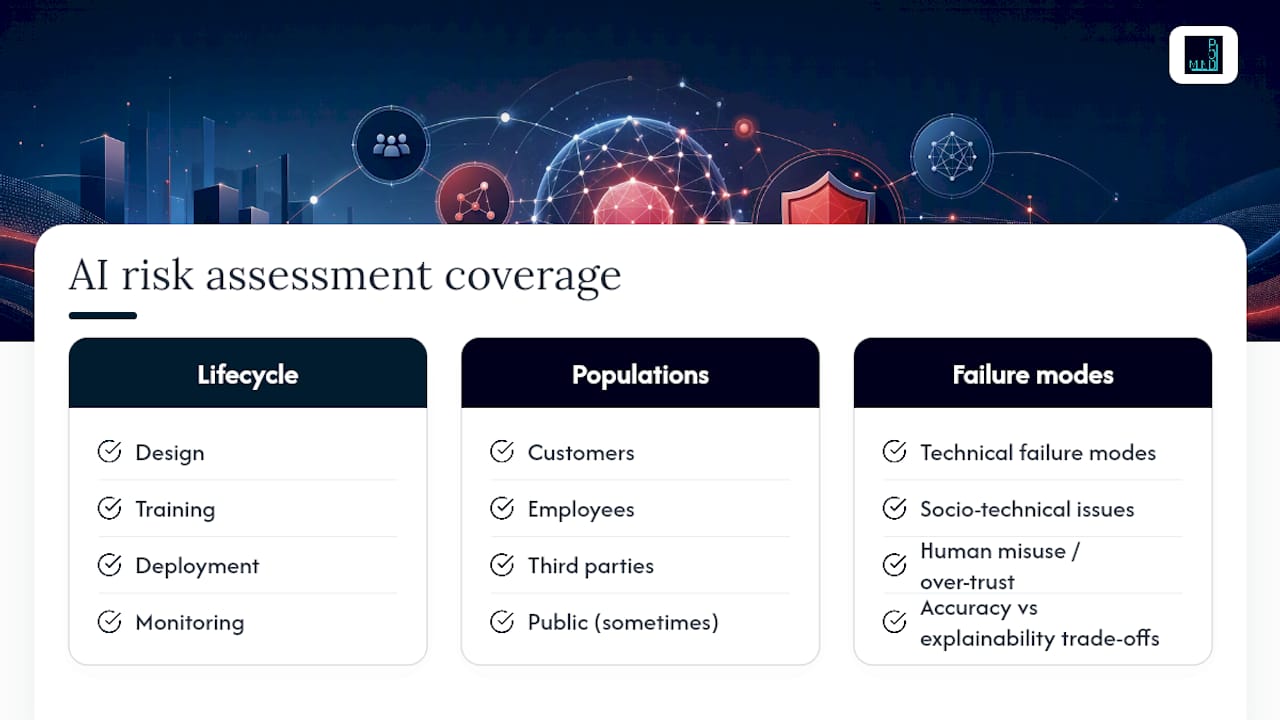
An AI risk assessment covers three things at once: the AI system's full lifecycle (design, training, deployment, monitoring, retirement), the populations it affects (customers, employees, third parties, and sometimes the public), and both the technical failure modes and the socio-technical ones, meaning how humans interact with, misuse, or over-trust the system.
That third piece trips up a lot of technically strong teams. A model can pass every accuracy benchmark and still cause harm because a call-center employee stopped double-checking its output, or because a customer never realized they were talking to an AI. The AI RMF 1.0 is explicit about this: trustworthy AI is a socio-technical problem, not a pure engineering one, and it names trade-offs between characteristics like accuracy and explainability that no purely technical fix resolves.
Four frameworks anchor most credible assessments right now:
NIST AI RMF and its Playbook. The RMF gives you the four functions and the trustworthiness taxonomy. The Playbook is the companion document with suggested actions, references, and tasks mapped to each subcategory, and it's the part practitioners actually keep open while doing the work.
NIST's Generative AI Profile. Published as NIST-AI-600-1, this profile calls out risks unique to or worsened by generative models, hallucination, prompt injection, training data memorization, and gives suggested actions mapped back to the core RMF subcategories. If any part of your stack touches an LLM, this document is not optional reading.
MIT's AI Risk Navigator. This is a living taxonomy and incident repository maintained by the MIT AI Risk Initiative, and it does something the NIST documents don't: it maps risk categories to real incidents and applicable laws, which is enormously useful when you're trying to convince a skeptical executive that a risk is real and not theoretical.
Institutional assessment processes, like Penn State's. Universities were early adopters of formal AI risk review because of research compliance requirements, and Penn State's AI Risk Assessment Process is a useful public reference for how a mid-sized institution structures intake, review, and sign-off, a template worth studying even if you're a 40-person company, not a university system.
The trustworthiness characteristics you'll assess against, per AI RMF 1.0, are valid and reliable, safe, secure and resilient, accountable and transparent, explainable and interpretable, privacy-enhanced, and fair with harmful bias managed. Each one deserves its own line in your risk register rather than being folded into a single vague "risk score."
How Do You Conduct an AI Risk Assessment Step by Step?
The process below runs in roughly this order, though steps 3 through 5 often loop more than once as new information surfaces.
- Scope the assessment. Define which system, which use case, which population is affected, and which regulations might apply (HIPAA if health data is involved, state privacy law if consumer data is involved). Output: a one-page intake form.
- Build or update the inventory. Every model, data source, vendor API, and prompt template feeding into the system gets logged. Output: an inventory entry with owner, purpose, and data classification.
- Identify specific risks. Walk through each trustworthiness characteristic and ask what could go wrong. Output: a draft list of candidate risks per system.
- Analyze likelihood and impact. Score each identified risk (more detail in the next section). Output: an impact assessment document.
- Prioritize. Rank risks by inherent score, then flag anything touching health data, financial decisions, or vulnerable populations for expedited review regardless of score. Output: a ranked risk register.
- Mitigate. Assign controls to each high and medium risk. Output: a mitigation plan with named owners and target dates.
- Monitor and document. Set a reassessment cadence and log evidence continuously, not just at review time. Output: an evidence log tied to each register entry.
A realistic timeline for a first pass on one moderate-complexity AI system: two to four weeks for a small team working part time on it, faster if you already have an inventory. Escalate to governance leadership (or your board, if you have one) whenever a risk touches regulated data, a customer-facing decision with legal consequence, or anything your legal counsel flags as novel.
Roles worth assigning explicitly, even in a company with no formal AI governance team yet:
- Product or business owner — accountable for whether the AI feature ships at all.
- Model owner — the person who understands the model's actual behavior, not just its intended behavior.
- Engineering lead — implements technical controls and monitoring.
- Legal or compliance — flags regulatory exposure before deployment, not after.
- Security — reviews adversarial and data exposure risk.
- Governance lead or fractional CTO — owns the overall process and signs off on residual risk.
What Are the Common Types of AI Risk?
Most practical taxonomies group AI risk into six categories, and nearly every real-world incident fits cleanly into one.
Technical or model risk covers things like hallucination, model drift, and poor generalization to edge cases. A customer service LLM that confidently invents a return policy that doesn't exist is a technical risk with a direct customer impact.
Misuse and malicious use covers people deliberately abusing a system, employees using an internal AI tool to generate fraudulent documents, or an external actor jailbreaking a chatbot into producing harmful content that gets screenshotted and posted publicly.
Privacy and data protection risk covers a model memorizing and later regurgitating training data, or a poorly scoped integration exposing customer PII to a third-party API. This is the single most common finding in early-stage assessments, according to practitioners who build automated scoring tools around exactly this problem, prompt and code scanning APIs that flag PII exposure as a top-tier risk factor.
Fairness and bias risk covers a hiring screening tool that systematically downgrades certain applicant groups, or a credit-scoring model trained on historically biased data that perpetuates the pattern at scale.
Security and adversarial risk covers prompt injection, data poisoning, and model extraction attacks, where a competitor or bad actor manipulates inputs to steal or corrupt the system's behavior.
Systemic or ecosystem risk covers concentration risk (your whole operation depends on one vendor's API staying up and unchanged) and cascading failures where one automated decision triggers downstream automated decisions with no human checkpoint.
| Risk category | Concrete example | Typically impacted |
|---|---|---|
| Technical/model | LLM hallucinates a false product spec in a support chat | Customers, brand trust |
| Misuse/malicious | Employee uses internal AI tool to draft fraudulent invoices | Employer, third parties |
| Privacy/data protection | Model exposes customer PII through an unscoped API call | Customers, regulators |
| Fairness/bias | Hiring tool downgrades resumes from a protected group | Job applicants, employer liability |
| Security/adversarial | Prompt injection extracts confidential system instructions | Company IP, security posture |
| Systemic/ecosystem | Single vendor outage halts all automated approvals | Operations, customers, revenue |
Tag every inventory item against this table during your intake step. A single AI system often carries risk in three or four of these categories simultaneously, which is exactly why a single overall risk score tends to hide more than it reveals.
How Do You Measure and Prioritize AI Risk?
The baseline model almost everyone starts with is likelihood × impact, scored on a simple scale (1 to 5 works fine for most SMBs) across metric categories like performance drift, data drift, security exposure, privacy exposure, and user impact severity. Multiply the two, and you get an inherent risk score you can rank against every other item in your register.
The honest limitation: this math looks precise and often isn't. Likelihood is genuinely hard to estimate for a novel AI failure mode with no incident history, and impact severity depends heavily on context a simple 1 to 5 scale can't capture (a hallucinated answer about store hours is not the same magnitude as a hallucinated answer about medication dosing). Metrics can also be gamed, quietly, when teams learn which numbers trigger escalation and start reporting around them. Group-level differences in fairness metrics can look fine in aggregate while hiding serious harm to a specific subpopulation. None of this means scoring is useless. It means a raw score is a starting conversation, not a final verdict, and every score needs a documented rationale a human can defend later.
The trend worth watching is a shift toward dynamic, ongoing risk scoring rather than a one-time assessment. Risk levels change as models drift, usage patterns shift, and regulations update, and continuous scoring approaches are increasingly expected under frameworks like ISO/IEC 42001 and the EU AI Act. Automated rules engines can flag a re-review the moment a model's output distribution shifts past a threshold, which beats waiting for the annual audit to notice.
Automated scoring earns its keep when it produces a reproducible, auditable trail, the same inputs generating the same score every time, with a documented rationale attached. It becomes a liability when a team treats the automated number as a substitute for judgment rather than an input to it. A score of "3" on an automated dashboard tells you nothing about whether the underlying harm is reputational embarrassment or a HIPAA violation.
Pro Tip: Run your automated or manual risk score past one question before finalizing it: "If a regulator asked us to defend this number in writing, could we?" If the honest answer is no, the score isn't ready, regardless of what the rubric says.
What Controls and Monitoring Practices Actually Reduce AI Risk?
Controls fall into five buckets, and a mature assessment assigns at least one control from each bucket to every medium or high risk item.
Design-time controls happen before the model ever runs: data minimization, choosing a less opaque model when explainability matters more than marginal accuracy, and building in guardrails at the prompt or architecture level.
Pre-deployment validation means testing against adversarial inputs, running bias audits on relevant subpopulations, and red-teaming the system before it touches a real customer.
Runtime monitoring means watching for drift, unusual output patterns, and rising error rates in production, not just at launch. This is where most organizations underinvest, treating the launch review as the whole job.

Human-in-the-loop checkpoints mean a person reviews or can override the AI's output before it takes effect on anything high-stakes, a loan denial, a medical scheduling decision, a legal document. Agentic AI systems raise the stakes here specifically, since an autonomous agent chaining multiple actions together can compound a small error into a large one before a human ever sees it; a dedicated look at agentic AI security is worth reading if any part of your stack runs agent-style automation.
Rollback and incident response means you can turn the system off or revert to a prior version fast, and you have a documented incident response plan specific to AI failures, not just your general IT outage playbook.
Every control you apply should reduce the inherent score to a documented residual score, with evidence attached: a test report, a monitoring dashboard screenshot, a sign-off email. That evidence is what turns a risk register from a spreadsheet into something defensible in an audit, and it's the difference auditors actually notice.
Monitoring signals worth tracking as ongoing KRIs include output error rate, flagged-content rate, drift metrics against a validation baseline, and time-to-resolution on flagged incidents. Reassessment cadence should scale with risk tier: quarterly for high-risk systems touching regulated data, semiannually for medium-risk, annually for low-risk internal tools. If your organization handles protected health information anywhere in the pipeline, layer in the specific requirements covered in guidance on HIPAA-aligned AI compliance rather than assuming general AI controls cover you.
Where Can You Find Templates and Tools for AI Risk Assessment?
Four primary references belong in every governance binder:
- NIST AI RMF and Playbook — the foundational framework and its action-oriented companion document, the core reference for governance mapping and subcategory-level tasks.
- NIST Generative AI Profile (NIST-AI-600-1) — required reading if any system in scope touches an LLM or generative model.
- MIT AI Risk Navigator — use it to map identified risks to real incidents and applicable laws, which strengthens your case when justifying priority to leadership.
- MIT AI Incident Database — a searchable repository of real-world AI failures, useful for stress-testing whether your risk list is actually comprehensive or missing known failure modes.
For templates, build your intake form around use case name, business owner, data sources, affected population, and regulatory flags. Your risk register needs, at minimum, an ID, owner, lifecycle stage, trustworthiness characteristics impacted, inherent score, applied mitigations, residual score, evidence links, and next reassessment date (the full example is in the next section). Your mitigation evidence checklist should force a yes/no on: was this tested, is there a rollback plan, is there a named human reviewer, and is monitoring live.
On the tooling side, expect three categories to matter increasingly: automated scoring and rules engines that assess prompts or code changes in real time (some risk-scoring APIs return factor-level breakdowns covering PII exposure, prompt clarity, and hallucination likelihood alongside an overall score), monitoring platforms that track drift and anomalies in production, and compliance mapping utilities that connect your controls back to specific regulatory requirements. If your organization operates under SOC 2 or a similar audit regime, review how SOC 2 requirements intersect with AI systems before you finalize your control set, since auditors increasingly ask AI-specific questions during standard SOC 2 review cycles.
What Does a Completed Risk Register Entry Look Like?
Nine fields make a risk register entry defensible instead of decorative:
| Field | Purpose |
|---|---|
| ID | Unique reference for tracking and audit trails |
| Owner | Named individual accountable for this risk |
| Lifecycle stage | Design, pre-deployment, production, or retirement |
| Trustworthiness characteristics impacted | Which of the NIST characteristics apply |
| Inherent score | Likelihood × impact before mitigation |
| Mitigations applied | Specific controls in place |
| Residual score | Score after mitigations, with rationale |
| Evidence links | Test reports, monitoring dashboards, sign-offs |
| Reassessment date | Next scheduled review, tied to risk tier |
A sample entry for a hypothetical customer-support LLM that can access order history:
ID: AI-2026-014. Owner: Head of Customer Operations. Lifecycle stage: Production. Trustworthiness characteristics impacted: Privacy, security, explainability. Risk description: The model can surface unredacted PII (full billing address, partial card number) in chat transcripts if a customer asks an ambiguously phrased question. Inherent score: 4 likelihood × 4 impact = 16 (high). Mitigations applied: PII redaction layer added before response generation, output filter blocking card-number patterns, quarterly red-team test of edge-case phrasing. Residual score: 4 likelihood × 2 impact = 8 (medium), rationale attached as a PDF test report. Evidence links: redaction test report (dated), red-team summary, engineering sign-off email. Reassessment date: 90 days out, tier flagged high due to PII exposure.
Use this exact structure for third-party and vendor AI components too. If a vendor won't share enough detail to fill in inherent score and mitigations, that gap itself is a risk finding worth escalating, not a reason to skip the entry.
What Practitioners Get Wrong About AI Risk Assessment
Most organizations treat their first AI risk assessment like a compliance exercise to finish and file. That's the first mistake, and it's the one that makes every subsequent effort harder.
Start small and prove the process on one or two high-impact use cases before rolling it out organization-wide. A perfect framework applied to nothing is worthless; a rough-but-real assessment on your riskiest customer-facing AI tool teaches you more in a month than a polished template sitting unused ever will. Prioritize by actual impact, not by what's easiest to assess. Teams gravitate toward scoring the internal tools first because they're simpler, while the customer-facing LLM handling PII sits unreviewed for months because it's harder.
The single most common failure I see in how organizations approach this: they assess once, at launch, and never come back. Models drift, vendors change their APIs without notice, and usage patterns shift as employees find new ways to use a tool nobody scoped for that use case. A risk register with a "last reviewed" date from eight months ago isn't a governance artifact anymore. It's a liability with a paper trail.
The second failure is letting a single automated score substitute for actual evidence. A dashboard showing "risk: medium" tells an auditor nothing about why, and it tells your leadership even less when they're deciding whether to greenlight the next AI feature. Every score needs a paragraph behind it: what was tested, who reviewed it, what the residual exposure actually looks like in plain language.
The third failure is treating this as a purely technical exercise and ignoring the socio-technical half entirely. A model can be statistically fair and still produce harm because the humans using its output don't understand its limitations, or because nobody told frontline staff what to do when the AI is obviously wrong. Governance cadence matters here as much as any technical control: set a fixed rhythm (monthly for high-risk systems, quarterly otherwise) where someone actually re-reads the register rather than assuming it's fine because nothing broke yet. Combine automated scoring with a standing human override path, because the moment a rules engine can't be overridden by a person with context, you've built a system that's rigid instead of resilient.
How Mindpodtech Turns Risk Assessment Into an Operating Practice
Most SMBs don't lack the will to run an AI risk assessment. They lack the bandwidth to build a NIST-aligned process, keep it current, and produce evidence an auditor will accept, on top of running the business. Mindpodtech closes that gap by pairing fractional technology leadership with hands-on governance design, so the framework above becomes a running practice instead of a document that goes stale after month one.

Engagements start the same way every time: a free technology assessment that maps your current AI footprint, flags where your risk register has gaps, and produces a prioritized, plain-language plan you own outright, whether or not you move forward with Mindpodtech afterward. From there, the work covers agentic AI strategy and governance, automated evidence capture so your residual scores hold up to review, and ongoing monitoring with human-in-the-loop checkpoints built in from day one rather than bolted on after an incident. Clients typically move from an unscoped AI footprint to a working risk register with a defensible evidence trail in weeks, not quarters, because the framework and templates already exist; the work is applying them to your systems. If your AI inventory is more guess than register right now, start with Mindpodtech's free assessment and get a plan you can act on immediately.
Primary Sources for Your Governance Binder
Keep these five references linked directly from your governance wiki and evidence folder, not buried in someone's email.
The NIST AI Risk Management Framework and its companion Playbook are your governance-mapping foundation, use them to structure the GOVERN, MAP, MEASURE, and MANAGE functions across your organization. The AI RMF 1.0 document itself is where the trustworthiness characteristics and socio-technical framing live in full detail. The Generative AI Profile is essential the moment any LLM or generative model enters scope. The MIT AI Risk Navigator is your tool for mapping a given risk to real precedent, incidents, and applicable law when you need to justify priority. And the Federal Register entry on the AI RMF gives useful context on the framework's public process and standing within US policy.
Sources
FAQ
What Are the Four Types of AI Risk?
Common taxonomies group AI risk into technical/model risk, misuse or malicious use, privacy and fairness risk, and security/systemic risk, though most working frameworks, including the six-category breakdown used in this guide, split these further for practical assessment purposes.
How Do You Do an AI Risk Assessment?
Scope the system, build an inventory, identify risks against trustworthiness characteristics, score likelihood and impact, prioritize, apply mitigations, and monitor on an ongoing cadence, all mapped to the NIST AI RMF's GOVERN, MAP, MEASURE, and MANAGE functions. Mindpodtech's free technology assessment can run this process for you if your team lacks the bandwidth to build it internally.
Can AI Write a Risk Assessment?
AI tools can draft parts of a risk assessment, summarizing known risks or generating first-pass register entries, but a credible assessment still requires human judgment on likelihood, impact, and residual risk, plus a documented rationale a person can defend to an auditor.
What Is the 30% Rule for AI?
There's no single, universally recognized "30% rule" in AI governance frameworks like NIST AI RMF; if you've seen this cited, it's likely a specific vendor's or industry's internal guideline rather than an established standard, so confirm the source before applying it.
How Often Should You Reassess AI Risk?
High-risk systems touching regulated data or customer PII should be reassessed quarterly, medium-risk systems semiannually, and low-risk internal tools annually, with immediate re-review triggered by any significant model, vendor, or usage change.