
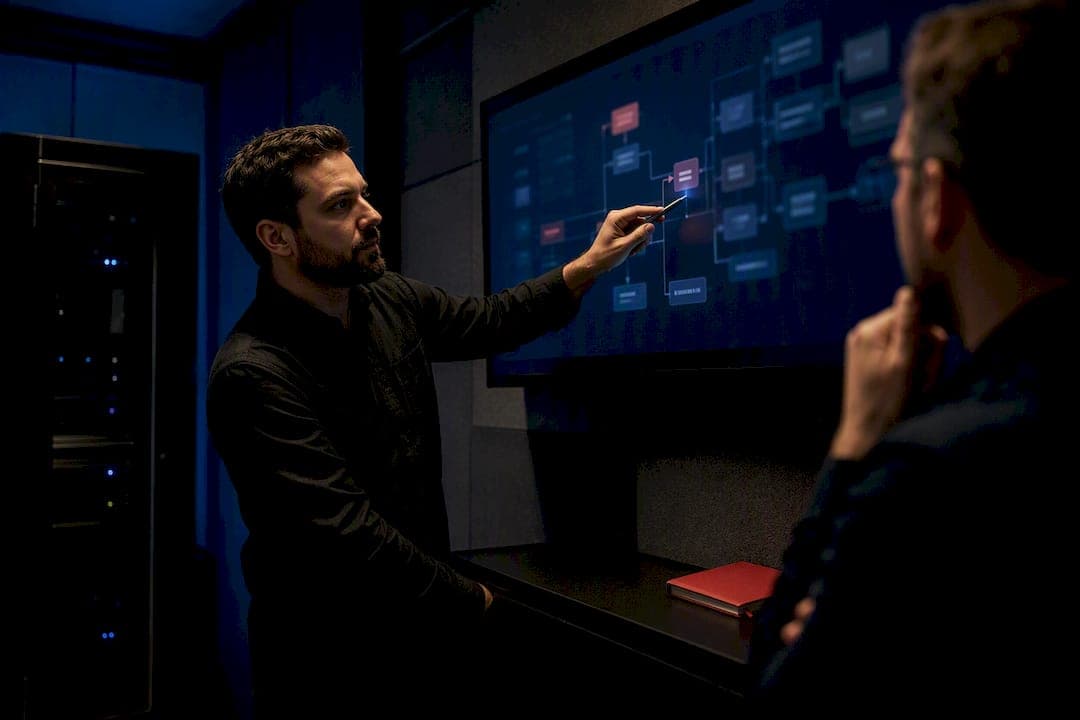
AI red teaming is a structured adversarial testing process that simulates real attacker strategies against machine learning systems to reveal safety, security, and trust failures before production. The goal is not a pass/fail score. It is a prioritized list of exploitable weaknesses, backed by reproducible test cases, that engineering teams can act on. Done right, it works alongside benchmarking and CI testing rather than replacing either.
TL;DR:
- Effective AI red teaming should start with impact-driven scenarios, focusing on real-world harms like data leaks and unsafe autonomous actions.
- Testing must cover the entire system stack, including models, pipelines, data stores, and APIs, not just isolated components.
- Automation excels at broad attack enumeration and scoring, but human oversight is essential for complex, multi-step breach chains.
- Red team findings should be prioritized by potential impact and exploitability, with clear, reproducible attack narratives driving fixes.
- Small teams benefit from a structured, impact-first approach, pairing automation with expert judgment to continually improve system resilience.
Table of Contents
- What Is AI Red Teaming and What Does It Cover?
- Why Do You Need AI Red Teaming?
- How Does AI Red Teaming Differ From Traditional Security Testing?
- How Do You Scope an AI Red Team Engagement?
- Running the Engagement: Planning to Remediation
- What Tools Actually Work, and Where They Fall Short?
- What Have Large-Scale Red Teaming Programs Actually Learned?
- How Do You Build a Repeatable Red Teaming Program?
- How Do Findings Turn Into Actual Fixes?
- How Mindpod Technologies Applies This for SMBs
- Building Red Teaming Into a Small IT Team: A Perspective
- Get Help Turning Red Team Findings Into Fixes
- Sources
- FAQ
What Is AI Red Teaming and What Does It Cover?
AI red teaming targets the full stack a model touches: the large language model itself, retrieval-augmented generation (RAG) pipelines, autonomous agents, the APIs connecting them, and the data stores they read from or write to. A red team probing a customer service chatbot isn't just testing the model. It's testing everything the model can reach.
The failure modes cluster into recognizable categories, mapped in taxonomies like the OWASP AI Testing Guide:
- Prompt injection that hijacks model behavior through crafted input
- Hallucination that produces confident, false outputs in high-stakes contexts
- Data leaks through training data extraction or RAG retrieval overreach
- Bias and fairness failures across protected classes or edge-case populations
- Unsafe agency, where an autonomous agent takes a harmful real-world action
A useful engagement doesn't end with a severity score. It produces attack narratives (the exact sequence of moves that triggered the failure), reproducible test cases engineering can rerun after a fix, and impact ratings tied to business consequences, not abstract risk categories.
Why Do You Need AI Red Teaming?
Traditional software either has a bug or it doesn't. AI systems are non-deterministic. The same prompt can succeed nine times and fail on the tenth, and benchmarks that run a fixed test suite once will miss that variance entirely. Red teaming closes that gap by testing the system the way an actual adversary would: repeatedly, creatively, and against the deployment context, not a leaderboard.
The real payoff isn't the exploit count. It's how fast findings move from discovery to fix. A red team engagement that surfaces 40 issues but sorts them by exploitability and business impact is worth more to a CISO than one that dumps 200 unranked findings on an engineering backlog.
Report to leadership on findings triaged by impact and exploitability, not raw counts. That framing, consistent with the risk-based approach in NIST's AI Risk Management Framework, is what turns a security exercise into a budget conversation leadership can actually act on.
How Does AI Red Teaming Differ From Traditional Security Testing?
Classic penetration testing hunts for reproducible, binary exploits: a SQL injection either works or it doesn't. AI red teaming operates in messier territory.
- Trustworthiness, not just security. You're testing for hallucination and bias alongside traditional exploits like injection and exfiltration.
- System-level attack chains. A single vulnerable RAG retrieval step combined with a weak system prompt can chain into full data exposure. No individual component looks broken in isolation.
- Multi-actor, probabilistic outcomes. The same attack can succeed or fail depending on model temperature, conversation history, or random seed.
- Different tooling and metrics. Traditional pentest tools assume deterministic state. AI red teaming needs evaluation harnesses that score subjective outputs across many runs.
Scoping an AI red team exercise like a standard pentest is the most common mistake IT leaders make. It produces a report that misses the failures that actually matter.
How Do You Scope an AI Red Team Engagement?
Start from the outcome you're afraid of, not the vulnerability you already know about. Microsoft's research team, after red teaming more than 100 generative AI products, found that beginning with downstream impact and mapping backward to attack chains produces findings that translate directly into fixes, instead of theoretical vulnerabilities nobody prioritizes.
- List the impacts that would actually hurt. Regulatory exposure, customer data leaked, an agent that takes an unauthorized financial action.
- Build a threat-model ontology tuned to your deployment. A customer-facing chatbot and an internal document-summarization agent don't share a threat model, and testing them identically wastes coverage.
- Map each impact to plausible attack chains. Work backward from the outcome to the specific prompt injection, retrieval manipulation, or tool-call abuse that could cause it.
- Score and prioritize. Rank scenarios by impact times likelihood times detectability, then test the top of that list first.
Pro Tip: Don't build a threat model in a vacuum. Pull your top three production incidents from the last six months, real or near-misses, and use them as your first three test scenarios. Ontology built from actual failure patterns beats one built from a generic checklist every time.
Running the Engagement: Planning to Remediation
A red team exercise breaks into six phases, each with its own exit criteria.
- Planning and rules of engagement (ROE). Define scope, systems in play, and boundaries in writing before anyone touches a keyboard. Acceptance criteria: a signed ROE document naming test environments, prohibited actions, and escalation contacts.
- Reconnaissance. Map the system architecture, data flows, and every point where user input reaches the model. Acceptance criteria: a system diagram identifying every attack surface.
- Attack design. Build specific test cases against the prioritized threat scenarios from your threat model.
- Execution. Run the attacks against a test environment, never live production data.
- Analysis. Score each finding by exploitability and impact, then write reproducible attack narratives.
- Remediation handoff. Convert findings into engineering tickets with clear reproduction steps.
Where to automate and where not to:
- Automate high-volume, repetitive tasks: payload enumeration, bulk prompt variation, initial triage scoring.
- Keep humans in the loop for anything requiring judgment about business context, subjective harm, or multi-step creative attack chaining.
- Never automate the ROE definition or the final severity call. Those need a human who understands the business consequences.
What Tools Actually Work, and Where They Fall Short?
Tool choice should follow your threat model, not the other way around. CSET's research on red-teaming design makes the point directly: a tool's implicit threat model constrains what it can find, and mismatched tools produce misleading results that look thorough but aren't.
Three broad categories cover most engagements:
- Benchmarks run fixed test suites for broad regression checks across model versions.
- Evaluation harnesses and orchestration frameworks, like Microsoft's open-source PyRIT, scale attack generation and scoring for bespoke, system-level testing.
- Agentic testing frameworks, including LLM-based penetration agents, automate enumeration and payload generation at a volume no human team can match manually.
Automation is genuinely strong at enumeration, payload variation, and bulk scoring. It's weaker at long-horizon planning. PentestGPT v2 research found that adding task-difficulty assessment improved end-to-end completion rates for agentic testers, but complex, multi-step attack chains still required human oversight to avoid context exhaustion and planning failures. Treat automated agents as force multipliers for coverage, not autonomous replacements for a skilled tester.
What Have Large-Scale Red Teaming Programs Actually Learned?
Public lessons from teams that have run this at scale converge on a few themes: scope from impact first, blend automated coverage with human creativity, and expect the most damaging findings to come from chained failures rather than single bugs.
Two example attack narratives illustrate the pattern:
- Prompt injection via document upload. A user uploads a PDF containing hidden instructions that override the system prompt when the model summarizes it, causing the assistant to leak internal instructions. Remediation: input sanitization plus a system-prompt hierarchy the model can't override, detailed in prompt injection defense practices.
- RAG data leak through retrieval overreach. A support bot's retrieval layer pulls from a document set that includes internal HR records, and a cleverly phrased query surfaces salary data. Remediation: retrieval-scope restrictions tied to user role, verified with a regression test.
The recurring pitfall is treating a single test pass as done. Automation catches breadth; human testers catch the chained, creative failures that matter most.
How Do You Build a Repeatable Red Teaming Program?
A one-time engagement finds today's vulnerabilities. A program catches tomorrow's. Effective teams typically include a security lead who owns scope and ROE, an ML engineer who understands the model's architecture, and a domain expert who can judge business impact.
- Rules of engagement should mandate synthetic data and isolated test tenants. Never run adversarial probes against production customer data.
- Report program metrics quarterly: findings by severity, mean time to remediate, and percentage of prior findings verified as fixed.
- Cadence matters more than intensity. A focused two-day sprint every quarter beats a single annual audit that goes stale within weeks of a model update.
Pro Tip: Tie your red team cadence to your model deployment cadence, not the calendar. If you ship a new model version or prompt update monthly, your highest-risk scenarios need a lightweight retest monthly too, even if the full program only runs quarterly.
How Do Findings Turn Into Actual Fixes?
An attack narrative is worthless sitting in a report. It has to become a ticket with reproduction steps, expected behavior, and a test case engineering can rerun.
- Prioritize the backlog by exploitability times impact, the same framing recommended in NIST's risk management framework.
- Attach the reproducible test case directly to the ticket so a fix can be verified against the exact scenario that triggered it.
- Build regression tests from confirmed findings and run them on every model or prompt update, closing the loop described in a structured AI incident response framework.
How Mindpod Technologies Applies This for SMBs
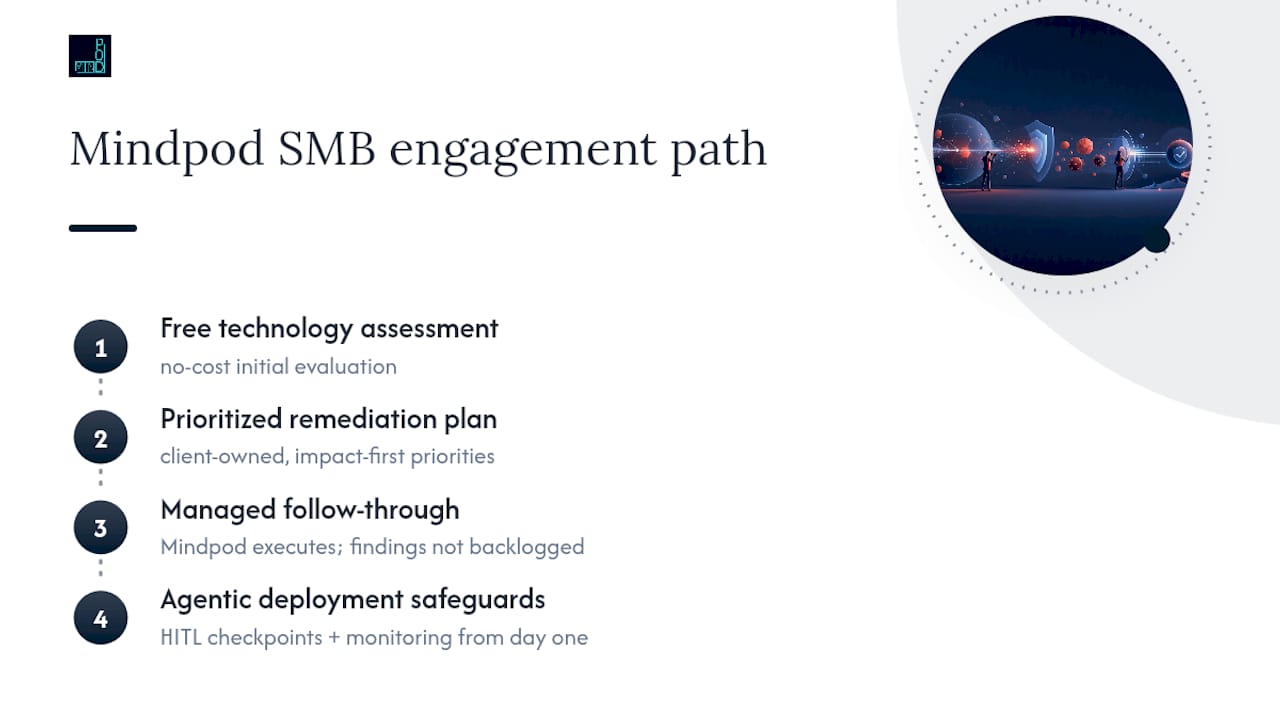
Most small and mid-sized teams can't staff a dedicated red team. Mindpod Technologies' agentic AI strategy work applies the same impact-first threat modeling enterprise teams use, scaled to a budget an SMB can actually carry. Every agentic deployment ships with human-in-the-loop checkpoints and monitoring built in from day one, not bolted on after an incident. The path runs through a free technology assessment, a prioritized remediation plan the client owns, and managed follow-through where Mindpod handles execution instead of leaving findings to sit in a backlog.
Building Red Teaming Into a Small IT Team: A Perspective
DIY testing works for narrow, low-stakes deployments where your team already understands the model's failure modes. Bring in a specialist once agents touch customer data or take real-world actions. Budget and speed pull against coverage. A 90-day starting checklist: build a threat model, run one impact-first test sprint, automate regression on confirmed findings, and set a quarterly cadence before scaling further.
— jaras
Get Help Turning Red Team Findings Into Fixes
Running the exercise is half the work. Translating attack narratives into prioritized engineering tickets, verified fixes, and monitored guardrails is where most SMB teams stall out with nobody left to close the loop.
Mindpod Technologies runs the security assessment and remediation work that turns red team findings into a plan your team can execute, without hiring a dedicated AI security function. The engagement starts with a free technology assessment that maps your current AI deployments against real threat scenarios, then produces a prioritized, plain-language plan you own outright. If your team is deploying agents with real-world permissions, the agentic AI strategy work builds human-in-the-loop checkpoints in from the start instead of retrofitting them after an incident. Book the free assessment and get a plan you can hand straight to engineering.
Sources
- OWASP AI Testing Guide | OWASP Foundation
- NIST AI Risk Management Framework
- Lessons From Red Teaming 100 Generative AI Products
- PentestGPT v2 (arXiv)
- AI Red-Teaming Design: Threat Models and Tools | CSET
FAQ
What Is Red Teaming in AI?
AI red teaming is adversarial testing where testers simulate real attacker behavior against a machine learning system to find safety, security, and trust failures before deployment, producing prioritized findings for remediation.
What Is an Example of Red Teaming in AI?
A common example is testing a customer-facing chatbot with a prompt injection hidden inside an uploaded document to see if it overrides the system's original instructions and leaks internal data or policies.
How Much Do AI Red Teamers Make?
Compensation varies widely by role, seniority, and region, and no single reliable industry-wide figure currently covers this specialized and fast-changing field; roles typically overlap with security research and ML engineering pay bands at a given employer.
Will AI Take Over Red Teaming?
Automation is already handling enumeration, payload generation, and bulk scoring, but research on agentic testers like PentestGPT v2 shows they still struggle with long-horizon planning, which means human testers remain necessary for complex, chained attacks for the foreseeable future.