

Use a risk-based AI governance framework organized around the NIST AI RMF's four functions — GOVERN, MAP, MEASURE, MANAGE — as your organizing backbone. Your immediate next step: build a model inventory and run a pilot on one high-value, manageable-scope model. Before you start, three things must be in place:
- A named senior sponsor with budget authority and accountability for AI risk outcomes
- A working model inventory that captures every AI system in production or development
- A basic risk taxonomy that classifies models by potential harm, data sensitivity, and business criticality
The bottom line: organizations that anchor AI governance to a risk-based framework from day one spend less time retrofitting controls later and more time deploying AI that actually holds up under scrutiny.
Key Takeaways
A risk-based AI governance framework anchored to NIST AI RMF's GOVERN, MAP, MEASURE, and MANAGE functions is the most practical and policy-aligned organizing structure available to US SMBs and enterprise teams today.
| Point | Details |
|---|---|
| Start with three prerequisites | Name a senior sponsor, complete a model inventory, and define a basic risk taxonomy before anything else. |
| Use NIST AI RMF as your backbone | Its four functions translate directly into organizational roles, artifacts, and measurable controls across all sectors. |
| Layer frameworks by obligation | Add EU AI Act compliance into MAP/MEASURE/MANAGE if you operate in the EU; use ISO/IEC 42001 if you need third-party certification. |
| Gate phases on evidence, not calendars | Move from pilot to scale only after zero unreviewed incidents, a tested incident playbook, and full monitoring coverage on the pilot model. |
| Mindpodtech accelerates the start | Mindpodtech's free technology assessment delivers a model inventory, prioritized risk register, and pilot plan the client owns from day one. |
Table of Contents
- What is an AI governance framework?
- Top global AI governance frameworks and when to use each
- Core organizational functions: GOVERN, MAP, MEASURE, MANAGE
- Step-by-step implementation roadmap
- Operational controls and tooling to support governance
- How to map governance frameworks to regulatory obligations
- How Mindpodtech implements AI governance for SMBs
- The tradeoffs leaders actually face during AI governance adoption
- Mindpodtech: AI governance without the enterprise overhead
- Sources
- FAQ
What is an AI governance framework?
AI governance is the set of organizational policies, roles, processes, and controls that manage how AI systems are developed, deployed, monitored, and retired. It is not a compliance checkbox. It is the operational layer that connects your AI ambitions to your risk appetite, your regulatory obligations, and your stakeholders' expectations.
The scope is broader than most teams initially assume. A complete AI governance program covers:
- Decisions: who approves model deployment, changes, and decommissioning
- Data: lineage, quality, access controls, and consent
- Models: versioning, validation, documentation, and performance baselines
- Monitoring: drift detection, fairness metrics, and operational alerts
- Human oversight: escalation paths and human-in-the-loop checkpoints
- Documentation: audit trails, risk registers, and validation reports
- Incident response: detection, triage, rollback, and stakeholder notification
Three frameworks anchor the field's shared vocabulary: the NIST AI Risk Management Framework, the OECD AI Principles, and ISO/IEC 42001:2023. Each approaches the problem from a different angle — risk management, ethical principles, and management system certification, respectively — but all three converge on the same core idea: AI risk is manageable when governance is systematic and embedded in operations, not bolted on afterward.
For SMBs specifically, governance matters for three concrete reasons. First, a single model failure in a customer-facing or financial process can trigger regulatory scrutiny, legal liability, or reputational damage that a small organization cannot easily absorb. Second, early governance investment makes compliance readiness far cheaper than retroactive remediation. Third, investors, enterprise customers, and insurers increasingly ask for evidence of AI controls before signing contracts.
Top global AI governance frameworks and when to use each
No single framework covers every organization's situation. The practical move is to pick one as your primary backbone and layer in others where your regulatory exposure or sector demands it.
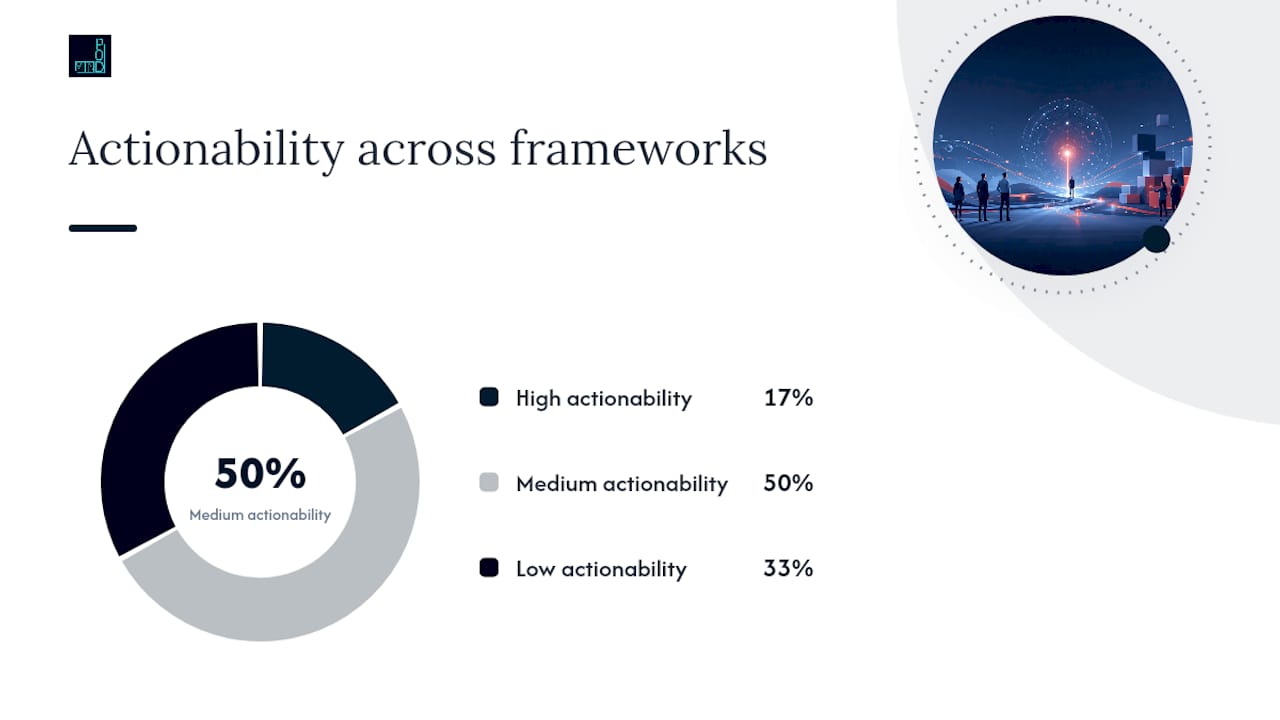
| Framework | Scope & intent | Best for | Core emphasis | Actionability | Geographic relevance |
|---|---|---|---|---|---|
| NIST AI RMF | Voluntary, risk-based management | All sizes, all sectors | GOVERN, MAP, MEASURE, MANAGE functions | High — Playbook, crosswalks, profiles | US-aligned; globally applicable |
| OECD AI Principles | Voluntary ethical principles | Policy alignment, multi-jurisdiction | Transparency, accountability, human rights | Low — principles only | Global (adherents) |
| ISO/IEC 42001:2023 | Certifiable management system | Enterprises seeking third-party audit | AI management system, continual improvement | Medium — requires implementation | Global |
| EU AI Act | Binding regulation by risk class | EU market operators, AI product vendors | Prohibited uses, high-risk obligations, transparency | Medium — compliance tasks defined | EU (binding) |
| UNESCO Recommendation | Voluntary ethical guidance | Public sector, policy teams | Human rights, sustainability, fairness | Low — principles and indicators | Global |
| IEEE standard | Engineering ethics standard | AI/software product developers | Value-based system design | Medium — design process guidance | Global |
| Singapore Model AI Governance | Voluntary practical guidance | SMBs, Asia-Pacific operators | Human oversight matrix, ops management | High — worked examples included | Singapore; regionally influential |
| GPAI | Multi-government research and guidance | Policy teams, researchers | Responsible AI, data governance, future of work | Low — research and recommendations | Global (member countries) |
Selecting your primary framework: For most US SMBs and operations leaders, NIST AI RMF is the right backbone. It is voluntary, sector-neutral, and maps directly to the NIST Playbook and profiles — including a Generative AI profile — that translate framework functions into concrete actions. If you operate in or sell into the EU, layer EU AI Act obligations into your MAP, MEASURE, and MANAGE functions as a compliance track running alongside the RMF. If you want third-party certification, ISO/IEC 42001:2023 builds on a management system structure your team likely already recognizes from ISO 9001 or ISO 27001.
Mini use cases:
- SMB pilot: NIST AI RMF + Singapore Model for human-oversight design
- Regulated financial services: NIST AI RMF + Federal Reserve model risk management expectations
- AI product vendors selling into EU: EU AI Act as primary compliance driver, NIST AI RMF for internal risk management
- Multi-jurisdiction enterprise: NIST AI RMF backbone with OECD Principles as the cross-border ethical layer and ISO/IEC 42001 for audit credibility
Pro Tip: The Singapore Model AI Governance Framework includes a human-oversight design matrix that plots required human involvement against probability and severity of harm. It takes about an hour to apply to each model in your inventory and produces a defensible, documented oversight decision — far more useful than a generic "human-in-the-loop" policy statement.
Core organizational functions: GOVERN, MAP, MEASURE, MANAGE
The NIST AI RMF is intentionally flexible — it is designed to be a translation layer between high-level principles and the concrete artifacts your teams actually produce. Here is how each function maps to organizational work.
GOVERN
GOVERN is the foundation. It establishes the organizational context, culture, and accountability structures that make the other three functions possible.
Practical activities:
- Assign a named AI governance lead and document their authority and escalation path to the C-suite
- Publish an AI use policy that defines acceptable use, prohibited applications, and accountability for model owners
- Stand up a governance review body (an AI ethics panel or risk committee) with cross-functional membership: legal, security, operations, and business owners
MAP
MAP is where you identify and contextualize AI risk before a model goes into production. It is the due-diligence phase.
Practical activities:
- Build and maintain a model inventory: every model in production or development, its purpose, data inputs, output type, and business owner
- Classify each model using your risk taxonomy (harm potential, data sensitivity, regulatory exposure)
- Apply the Singapore human-oversight matrix to set the required level of human involvement for each model's decision class
MEASURE
MEASURE turns risk identification into quantified, trackable signals. Without it, governance is opinion, not evidence.
Practical activities:
- Define performance baselines and fairness metrics at deployment; document them in the model card
- Run pre-deployment testing: adversarial inputs, edge cases, bias audits, and confidence calibration checks
- Set monitoring thresholds that trigger alerts for drift, accuracy degradation, or anomalous output patterns
MANAGE
MANAGE is the operational response layer — what happens when a model underperforms, drifts, or causes harm.
Practical activities:
- Maintain a risk register with open issues, owners, and remediation timelines
- Document rollback procedures for every production model; test them at least annually
- Run post-incident reviews and feed findings back into MAP and MEASURE to close the loop
Roles and RACI
| Role | GOVERN | MAP | MEASURE | MANAGE |
|---|---|---|---|---|
| Senior sponsor | Accountable | Informed | Informed | Accountable |
| AI governance lead | Responsible | Responsible | Responsible | Responsible |
| Model owner | Consulted | Responsible | Responsible | Responsible |
| Data steward | Consulted | Responsible | Consulted | Consulted |
| MRM/validation | Informed | Consulted | Responsible | Consulted |
| Security | Consulted | Consulted | Consulted | Responsible |
| Legal/compliance | Consulted | Consulted | Informed | Consulted |
| Business owner | Informed | Consulted | Informed | Informed |
Artifacts checklist: model inventory, risk register, model cards, validation reports, monitoring dashboards, AI use policy, incident runbooks, and NIST Playbook action logs.
As Databricks notes, AI governance works best when it extends existing enterprise risk and data management structures rather than running as a separate program. GOVERN is cross-cutting: it does not sit above MAP, MEASURE, and MANAGE in a hierarchy — it infuses all three with the authority, culture, and accountability that make them stick.
Governance without GOVERN is just documentation. The function most organizations skip — defining who is accountable and what decisions require sign-off — is the one that determines whether the other three functions ever get enforced.
Decision capability — the organizational ability to make sound, timely calls about AI outputs — is what separates governance programs that run on paper from ones that change behavior on the floor.
Step-by-step implementation roadmap
| Phase | Timeline | Key deliverables | Primary owners | Gating KPIs |
|---|---|---|---|---|
| Start | up to 3 months | Model inventory, risk taxonomy, AI use policy, senior sponsor named, governance lead appointed | AI governance lead, senior sponsor | Inventory complete; taxonomy approved; policy published |
| Pilot | 3 to 6 months | One model fully governed (MAP + MEASURE + MANAGE), human-oversight decisions documented, monitoring dashboard live | Model owner, AI governance lead, MRM | Zero unreviewed incidents; monitoring active on pilot model |
| Scale | 9 to 12 months | All production models in inventory with risk classification; validation reports for high-risk models; incident playbook tested | AI governance lead, security, legal | Audit-readiness score established; high-risk models validated; incident playbook exercised |
| Sustain | Ongoing | Quarterly governance reviews, annual policy refresh, continuous monitoring, NIST profile updates applied | Senior sponsor, AI governance lead | Reduction in operational incidents; compliance gap closure rate; model coverage percentage |
First a few months: minimum viable governance
- Assign a senior sponsor and an AI governance lead in writing — names, not titles.
- Complete a model inventory: every AI system in production or development, even vendor-supplied tools.
- Apply your risk taxonomy to classify each model; flag the top three by harm potential.
- Select one high-value, medium-risk model for the pilot.
- Document the human-oversight decision for the pilot model using the Singapore matrix.
- Set performance baselines and monitoring alerts before the pilot goes live.
Gating criteria to move from pilot to scale
Moving from pilot to scale is not a calendar decision. Gate it on evidence:
- The pilot model has run for at least one full business cycle with monitoring active
- Zero unreviewed incidents or anomalies from the pilot period
- The incident playbook has been tested at least once (tabletop exercise counts)
- The governance lead can produce a one-page audit summary on request
AI adoption stalls when organizations treat it as a technology problem rather than a capability problem. The pilot phase is where you build the organizational muscle — the habits, the escalation reflexes, the documentation discipline — that scale requires.
Operational controls and tooling to support governance
Governance policy without operational controls is a document that lives in a shared drive and gets ignored. The controls below translate framework functions into daily operational practice.
Core operational checklist
- Model inventory: every model registered with owner, version, data inputs, output type, and risk classification
- Versioning and change control: no model update goes to production without a version bump, a change log entry, and a re-validation sign-off
- Access controls: role-based access to model endpoints, training data, and configuration; reviewed quarterly
- Data lineage: documented path from source data to model input; updated when data sources change
- Testing suites: pre-deployment tests covering accuracy, fairness, adversarial robustness, and confidence calibration
- CI/CD gating: automated checks in the deployment pipeline that block promotion if test thresholds are not met
- Explainability features: output explanations or confidence scores surfaced to end users and reviewers where the model affects consequential decisions
- Confidence metadata: model outputs tagged with confidence levels so downstream systems and humans can apply appropriate skepticism
Tooling categories
Model registries (MLflow, Weights & Biases, or vendor-native registries in Azure ML or AWS SageMaker) give you the versioning and metadata layer that makes the inventory auditable. The tradeoff: open-source registries are flexible but require engineering effort to maintain; cloud-native registries are easier to operate but create vendor dependency.

Observability and monitoring platforms (Evidently AI, Arize, Fiddler AI) track drift, fairness metrics, and performance in production. Start with one metric per model that, if it crosses a threshold, triggers a human review — not an automated rollback. Automated rollbacks are powerful but require tested rollback targets; without them, they create more incidents than they prevent.
Policy-as-code tools (Open Policy Agent, Conftest) let you encode governance rules — "no model with a fairness score below X deploys to production" — directly into your CI/CD pipeline. This is the most underused control in SMB governance programs.
Pro Tip: Enforce a single minimal metadata schema across all models in your inventory — at minimum: model ID, owner, version, risk class, data sources, last validation date, and monitoring status. A consistent schema costs almost nothing to implement and makes enterprise-wide visibility possible without a dedicated governance platform.
Incident playbook outline
- Detection: monitoring alert or human report triggers an incident ticket
- Triage: governance lead and model owner assess severity within four hours; classify as P1 (immediate rollback), P2 (monitored), or P3 (tracked)
- Rollback: for P1, revert to last validated version; notify affected business owners within two hours
- Root cause analysis: within five business days, document what failed, why, and what the model's monitoring missed
- Remediation: update model, controls, or monitoring thresholds; re-validate before redeployment
- Stakeholder notification: for incidents affecting customers or regulated data, notify legal and compliance immediately; follow applicable breach notification timelines
How to map governance frameworks to regulatory obligations
Framework adoption and regulatory compliance are related but not the same thing. A framework gives you a risk management structure; a regulation gives you specific legal obligations with enforcement consequences. The mapping work connects them.
Four-step mapping process
- Identify applicable laws and regulations for your industry, geography, and data types. For US SMBs: sector-specific rules (HIPAA for health data, GLBA for financial data, state AI laws), plus White House federal AI policy direction for government-aligned work.
- Map legal requirements to NIST functions. Each regulatory obligation lands in one or more of MAP, MEASURE, or MANAGE. GOVERN covers the accountability and policy obligations that cut across all of them.
- Translate into controls and artifacts. A legal requirement like "document the basis for automated decisions affecting individuals" becomes a model card requirement in MAP and an audit log requirement in MANAGE.
- Set evidence collectors. Assign a system of record for each artifact (a model registry, a risk register, a ticketing system) so evidence is retrievable on demand, not assembled under audit pressure.
EU AI Act gap map example
| EU AI Act obligation | NIST function | Required control | Artifact |
|---|---|---|---|
| Conformity assessment for high-risk AI | MAP | Risk classification; third-party or internal audit | Risk register entry; audit report |
| Technical documentation | MAP + MEASURE | Model card; data lineage documentation | Model card; data sheet |
| Logging and record-keeping | MEASURE + MANAGE | Audit log; monitoring dashboard | Log archive; dashboard export |
| Human oversight measures | GOVERN + MANAGE | Human-in-the-loop checkpoints; escalation policy | Oversight policy; incident log |
| Transparency to users | GOVERN | Disclosure notices; explainability outputs | User-facing disclosures; explanation logs |
For GDPR-adjacent obligations when AI processes personal data, practical compliance steps for data protection map directly into your MAP function's data lineage and access control requirements.
What auditors typically request
When a regulator or internal auditor reviews your AI governance program, they usually ask for six things: the model inventory (complete and current), the risk register (with open items and owners), validation reports for high-risk models, monitoring dashboards with historical data, the incident log, and the AI use policy with evidence of training and acknowledgment. If you can produce all six on 48 hours' notice, you are audit-ready. If any one of them does not exist or is out of date, that is your highest-priority gap.
For regulated financial institutions, Federal Reserve supervisory guidance on model risk management sets expectations that map closely to NIST MAP and MEASURE functions — particularly around model validation, documentation, and ongoing monitoring.
How Mindpodtech implements AI governance for SMBs
Mindpodtech's engagement model is built around the reality that most SMBs do not have a dedicated AI governance team. The process starts with a free technology assessment that produces a prioritized, plain-language plan the client owns — not a vendor-locked roadmap.
A typical engagement delivers:
- A complete model inventory covering all AI systems in production or development
- A prioritized risk register with each model classified by harm potential and regulatory exposure
- A pilot plan for the highest-value, manageable-scope model, including human-in-the-loop checkpoints
- A monitoring dashboard configured to the pilot model's key performance and fairness metrics
- A governance runbook covering incident detection, triage, rollback, and stakeholder notification
Mindpodtech's agentic AI strategy and governance service line is designed to ship to production with monitoring, rollback, and human-in-the-loop controls from day one — not as an afterthought. The assessment is free; the plan is yours regardless of whether you engage further.
The tradeoffs leaders actually face during AI governance adoption
Most governance articles describe what to build. Few describe what it costs to build it, and what you give up while you do.
The first real tradeoff is between centralized and federated governance models. Centralized governance — one team owns all AI risk decisions — gives you audit consistency and a single source of truth. The cost is speed: every model change routes through a bottleneck. Federated governance pushes ownership to domain teams, which is faster and more contextually informed, but it produces inconsistent documentation and makes enterprise-wide risk visibility genuinely hard. A hybrid model aims to split the difference, but it requires coordination tooling and clear escalation rules to avoid becoming the worst of both worlds. For most SMBs, a lightweight centralized model with documented delegation to model owners is the right starting point.
The second tradeoff is audit-readiness versus time-to-market. Governance adds cycle time. A validation step, a model card, a risk register entry — none of these are free. The organizations that handle this well treat governance artifacts as part of the definition of done for any model deployment, not as a separate review gate. When documentation is built into the workflow rather than appended to it, the marginal cost drops significantly.
Change management is where most governance programs actually fail, and it rarely gets the attention it deserves. The technical controls are the easy part. Getting a product team to write a model card before deployment, or a business owner to escalate an anomalous output rather than ignore it, requires incentives, training, and visible senior sponsorship. Training priorities should focus first on model owners and business owners — the people closest to deployment decisions — before rolling out to the broader organization.
Senior sponsorship is not a formality. A governance program without a named executive who reviews the risk register quarterly and has authority to halt a deployment will drift toward theater within six months. The BLUF recommendation at the top of this guide names a senior sponsor as a prerequisite for a reason: without one, the rest of the framework is advisory at best.
Mindpodtech: AI governance without the enterprise overhead
Most SMBs do not need a 12-person governance team or a six-figure platform license. They need a clear inventory, a defensible risk classification, and controls that actually run in production. That is a different problem from what most enterprise consulting firms are set up to solve.

Mindpodtech closes that gap. The engagement starts with a free technology assessment that maps your current AI systems, flags your highest-risk exposures, and produces a prioritized plan you own outright. From there, Mindpodtech's agentic AI strategy and governance service delivers the model inventory, risk register, pilot plan, monitoring setup, and incident runbook your team needs to move from policy to practice — built into the tools you already use, with human-in-the-loop checkpoints and rollback procedures from the first deployment. No long-term lock-in, no governance theater.
Request your free technology assessment at Mindpodtech and get a plain-language plan within days, not months.
Sources
The sources below are the primary documents to reference when building governance materials or briefing leadership.
- Artificial Intelligence Risk Management Framework (AI RMF 1.0)
- AI Risk Management Framework | NIST
- ARTIFICIAL INTELLIGENCE GOVERNANCE FRAMEWORK
- National Policy Framework for Artificial Intelligence: Legislative Recommendations
How to use the NIST Playbook: The Playbook organizes suggested actions by function, category, and subcategory. Start by filtering to your highest-risk model and working through the MAP and MEASURE actions for that model only. Do not try to implement the full Playbook at once — it is a menu, not a checklist.
FAQ
What is an AI governance framework?
An AI governance framework is the set of organizational policies, roles, processes, and controls that manage how AI systems are built, deployed, monitored, and retired. The NIST AI RMF organizes this into four functions: GOVERN, MAP, MEASURE, and MANAGE.
Which AI governance framework should a US SMB start with?
Start with the NIST AI RMF as your primary backbone — it is voluntary, sector-neutral, and comes with a free Playbook and profiles that translate framework functions into concrete actions. Layer in EU AI Act obligations only if you operate in or sell into the EU market.
What are the minimum governance artifacts an organization needs?
At minimum: a model inventory, a risk register, model cards for each production model, a monitoring dashboard, an AI use policy, and an incident runbook. These six artifacts cover the most common audit requests.
How long does it take to implement an AI governance framework?
A minimum viable governance program — senior sponsor named, model inventory complete, one pilot model fully governed — is achievable in a few months. Scaling governance across all production models typically takes several months to over a year depending on the number of models and organizational complexity.
How does Mindpodtech help with AI governance implementation?
Mindpodtech's free technology assessment produces a model inventory, prioritized risk register, and pilot plan the client owns from day one. The agentic AI strategy and governance service then delivers monitoring, rollback procedures, and human-in-the-loop controls built into production deployments from the start.