

AI change succeeds when leaders focus on outcomes, trust, and manager-led enablement, not on rolling out more tools. Start this week: set a single North Star tied to business results, pick three to four pilot use cases instead of a dozen, and put your middle managers in charge of showing people how the work actually changes. Treat this as an ongoing capability, measured continuously, not a one-time rollout.
TL;DR:
- Focusing on three to four high-impact use cases with measurable outcomes yields better AI adoption than spreading efforts across many projects.
- Middle managers are crucial for successful AI integration because their direct involvement and modeling significantly influence team trust and usage.
- Building clear data governance, human oversight, and trust mechanisms early prevents common stalls and accelerates pilot progress.
- An 8 to 12-week pilot cycle with defined diagnose, align, measure, and iterate phases enables realistic evaluation and informed scaling decisions.
- Prioritizing business-impact metrics, not just adoption rates, ensures AI initiatives deliver tangible improvements in speed, cost, or accuracy.
Table of Contents
- What Is AI Change Management, and Why Does It Differ From Standard IT Rollouts?
- How Do You Set a North Star and Pick the Right AI Use Cases?
- How Do You Build Trust Through AI Governance and Human Oversight?
- How Should You Reimagine Workflows to Fit AI Into the Process?
- Why Are Middle Managers the Real Lever in AI Adoption?
- How Do You Sustain Adoption With Training and the Right Metrics?
- What Does an 8 to 12 Week AI Pilot Roadmap Actually Look Like?
- How Mindpod Technologies Helps: Pragmatic Advisory and Delivery for AI Change
- How Do You Manage Resistance and Cultural Pushback to AI Change?
- How Do You Communicate With Stakeholders and Keep Everyone Aligned?
- What Are the Real Risks and Ethical Considerations in AI Deployment?
- How Do You Scale AI Adoption Across Multiple Teams and Departments?
- What Are the Common Technology Integration Challenges in AI Projects?
- Author Perspective: Practical Cautions and Tradeoffs From a Fractional-Tech Leadership Lens
- Ready to Turn This Roadmap Into a Working Pilot?
- Sources
- FAQ
What Is AI Change Management, and Why Does It Differ From Standard IT Rollouts?
AI change management is the discipline of preparing people, processes, and governance structures to adopt AI tools in a way that produces measurable business results rather than stalled pilots. It borrows from classic change frameworks like Kotter's model and Prosci's ADKAR, but it adds layers those frameworks never anticipated: algorithmic trust, data governance, and the fact that the "system" being adopted keeps changing itself.
The distinction matters because most AI initiatives don't fail on the technology. A BCG survey of 1,000 CXOs found only about a quarter of organizations have achieved real value from their AI investments, and BCG traces the gap directly to how leaders manage the people side of the change rather than the model quality. That's a strategy problem before it's a software problem. If you're running a change management strategy with AI for the first time, expect the friction to show up in workflows, org charts, and manager habits long before it shows up in a technical bug ticket.
How Do You Set a North Star and Pick the Right AI Use Cases?
A North Star metric anchors every AI initiative to a business outcome, not a tool. Instead of "deploy generative AI in customer service," a workable North Star sounds like "cut average case resolution time by 20% while holding satisfaction scores steady." McKinsey's step framework for gen AI change starts exactly here: define outcomes before you touch workflows, trust, or org design.
Once the North Star is set, resist the urge to attack every process at once. BCG's research on AI-driven change strategies found that organizations prioritizing three to four use cases consistently outperform those spreading efforts across six or seven. Fragmentation kills momentum faster than any technical limitation does.
Use a simple checklist to prioritize candidates:
- Impact: Does this use case touch a metric your leadership team already tracks and cares about?
- Feasibility: Does the team have the skills, or is this asking people to learn a new tool and a new process simultaneously?
- Measurability: Can you establish a baseline before launch, so you can prove a delta afterward?
- Compliance risk: Does this use case touch regulated data, financial reporting, or protected health information where a mistake carries legal exposure?
A use case is genuinely ready when three signals line up: clean, accessible data; a named executive sponsor willing to defend the pilot when it hits friction; and a measurable baseline you can compare against 90 days later. Missing any one of the three usually means the pilot drags on for months without a clear verdict.
How Do You Build Trust Through AI Governance and Human Oversight?
Trust breaks down fastest when employees don't know where their data goes or who's accountable when an AI system makes a bad call. Treat data access as its own workstream from day one. Map which systems hold the data your priority use cases need, who owns each system, and what approval chain governs access. Skipping this step is the single most common reason pilots stall in month two.
Set up a small AI oversight group, even if it's three people meeting biweekly, to own acceptable-use guardrails and review edge cases as they surface. This group should publish a plain-language acceptable use policy before the first pilot goes live, not after.
Human-in-the-loop checkpoints are the practical mechanism for building algorithmic trust. Not every AI output needs a human sign-off, but some categories always should:
- Any decision affecting pay, hiring, or termination
- Any customer-facing communication involving a complaint, refund, or legal question
- Any output feeding a regulatory filing or financial statement
- Any action an agent takes autonomously that changes a system of record
IBM's research on AI-enabled change notes that predictive analytics can flag sentiment shifts and adoption stalls before they become full-blown resistance, giving leaders an early warning system rather than a postmortem. Building that kind of human-in-the-loop design into your governance model from the start also builds a real audit trail, which matters the day someone asks how a decision got made.
Pro Tip: Publish your human-in-the-loop rules as a one-page decision tree, not a policy document. Managers will actually use a flowchart taped to a monitor. They won't reread a 12-page governance PDF before every judgment call.
How Should You Reimagine Workflows to Fit AI Into the Process?
Bolting an AI tool onto an existing workflow rarely produces the ROI leaders expect. The workflow itself has to change, and that happens in phases.
- Task assist. AI helps with a single step inside a human-led process, drafting a first-pass email, summarizing a call, flagging an anomaly in a spreadsheet. Humans still own every decision.
- Agent teams. Multiple AI agents handle connected steps in a process (intake, triage, drafting) under a human supervisor who reviews outputs before they move downstream. This is where a legal intake workflow or an MSP ticket triage system typically lands.
- Supervised automation. The AI runs the end-to-end process with monitoring, exception handling, and rollback built in; a human reviews only flagged exceptions rather than every case.
Most organizations try to jump straight to phase three and then get surprised when trust and accuracy problems surface. Moving through all three phases, even quickly, gives your team time to calibrate what "good" looks like before autonomy increases.
"Two-in-the-box" design works well here: pair a business owner who understands the process with a technical lead who understands the AI's real capabilities, and have them co-design the workflow together rather than handing specs back and forth. This single practice prevents the most common failure mode, where the tech team builds something technically correct but operationally useless.
Pick your first end-to-end process trial carefully. The best early candidates have high transaction volume, a well-documented existing process, and low regulatory sensitivity, think expense report review or internal ticket routing before you attempt clinical scheduling or contract review.
Why Are Middle Managers the Real Lever in AI Adoption?
Every AI change program lives or dies on middle managers, not executives and not individual contributors. McKinsey's research identifies managers as simultaneously the biggest blocker and the biggest accelerator of adoption, depending entirely on how much support and authority they're given.
A manager who's never used the new AI tool himself has no credibility telling his team to trust it. Role-modeling isn't optional; it's the whole mechanism. Specific interventions that move the needle:
- Give managers decision rights over how AI fits their team's specific workflow, rather than mandating a single company-wide process.
- Protect two to four hours a week of "experiment time" where managers can test the tool on real work without a production deadline attached.
- Pair managers with a coach or peer group for the first 60 days, so questions get answered in real time instead of piling up in a support ticket queue.
- Set an explicit expectation that managers demonstrate use of the tool in team meetings, not just approve its use.
Measuring manager activation matters as much as measuring the tool itself. Track whether managers are logging into the tool weekly, whether they're referencing it in one-on-ones, and whether their teams report the manager as a source of guidance versus a source of confusion. A manager who avoids the tool almost guarantees his team avoids it too.
How Do You Sustain Adoption With Training and the Right Metrics?
Generic, one-size-fits-all training produces generic, low-adoption results; tools like Shortcut to the Right Person can help match talent and skills more effectively for capability building. Role-specific training, tailored to what a sales rep versus a claims processor versus an MSP technician actually does with the tool, cuts implementation time by 30 to 40% compared with broad training approaches, according to McKinsey's analysis. That gap is too large to ignore if you're trying to hit a quarterly ROI target.
Build a sandboxed environment where employees can experiment with real data patterns without touching production systems. This is where people build genuine comfort with the tool instead of a surface-level familiarity that evaporates the first time something goes wrong.
Your measurement stack needs four layers, not one:
- Pulse surveys measuring sentiment and confidence, run every two to three weeks during the pilot phase.
- Usage analytics tracking actual logins and feature use, not just license counts.
- A capability index scoring whether employees can independently complete a task with the tool versus needing help every time.
- Business-impact metrics tied directly to your North Star, cost per case, cycle time, error rate, revenue per rep.
The single biggest measurement mistake is stopping at adoption rate. A high login count tells you people opened the tool; it tells you nothing about whether the business actually got faster, cheaper, or more accurate. IBM's guidance on AI-enabled change management points out that predictive analytics can also flag disengagement patterns early enough for a manager to intervene before a team quietly reverts to the old process.
What Does an 8 to 12 Week AI Pilot Roadmap Actually Look Like?
A tight, time-boxed pilot beats an open-ended rollout every time, mainly because it forces a verdict instead of letting the initiative drift.
- Weeks 1 to 2: Diagnose. Map the target process, pull a data-readiness assessment, and identify your executive sponsor and pilot managers.
- Weeks 3 to 4: Align. Set the North Star metric, finalize the three to four use cases, and get the AI oversight group to sign off on guardrails.
- Weeks 5 to 8: Pilot. Run the tool in task-assist or agent-team mode with a small group, log every exception, and hold weekly manager check-ins.
- Weeks 9 to 10: Measure. Compare results against your baseline using the capability index and business-impact metrics, not just usage counts.
- Weeks 11 to 12: Iterate. Fix the two or three biggest friction points, then decide: scale, adjust, or kill.
Surface small wins publicly and specifically. "This process now takes 12 minutes instead of 40" lands better in an all-hands meeting than any slide about "AI transformation."
Watch for these red flags early: managers who quietly stop attending check-ins, a usage graph that spikes at launch and then flat lines, or a sponsor who stops showing up to defend the pilot when budget questions surface.
Pro Tip: If week 6 arrives and you still don't have a clean before/after baseline number, stop the pilot clock and fix measurement first. A pilot that "feels successful" but can't produce a number will lose its budget the moment a new priority shows up.
How Mindpod Technologies Helps: Pragmatic Advisory and Delivery for AI Change
Mindpod Technologies covers the range of services this roadmap requires, without asking a mid-market team to hire a full internal AI department. That includes fractional technology leadership, agentic AI strategy and deployment, cloud architecture and security hardening, and ongoing managed operations once a pilot moves to production.
Engagements often start with a free technology assessment that produces a prioritized, plain-language plan the client owns outright, not a vendor lock-in proposal. From there, delivery and ongoing operations can be handled with monitoring, rollback paths, and human-in-the-loop checkpoints built in from day one rather than bolted on after a problem surfaces.
This approach is designed to work at the budget level most SMBs and mid-market firms actually operate at: ranking use cases by ROI and risk instead of hype, and being honest when a use case doesn't clear the bar yet. If your leadership team is still narrowing down which three or four use cases deserve the first pilot slot, that ranking conversation is often where outside technology expertise adds the most value early.
How Do You Manage Resistance and Cultural Pushback to AI Change?
Resistance to AI change rarely announces itself directly. It shows up as slow adoption, quiet workarounds, or a team that technically complies while routing around the tool whenever possible. BCG's research points to "false alignment," where leadership believes everyone's on board while frontline teams have unresolved doubts that never get surfaced.
The fix starts with naming the trade-offs out loud instead of glossing over them. If a new AI-driven process means a role's day-to-day work changes significantly, say so directly rather than letting rumors fill the gap. Employees can handle a hard truth better than they can handle vague reassurance that turns out to be false.
Cultural adaptation also depends on who delivers the message. A companywide email from the CEO announcing an AI initiative carries far less weight than a direct manager demonstrating the tool in a team meeting and admitting where it still falls short. Credibility comes from proximity, not rank.
Give resistant employees a low-stakes way to test the tool without a public failure risk attached. A sandboxed practice environment, mentioned earlier for training, does double duty here: it turns "I don't trust this" into "let me try it privately first," which is a much easier position to shift. Sentiment surveys and usage data, tracked over the pilot period, will show you exactly which teams are stuck and why, long before a formal complaint reaches HR.
How Do You Communicate With Stakeholders and Keep Everyone Aligned?
Stakeholder communication for AI change needs to run on two tracks simultaneously: upward to sponsors and leadership, and outward to the teams actually doing the work. Collapsing these into one generic memo is a common mistake.
For leadership and sponsors, communication should center on the North Star metric and hard numbers, cost per case, cycle time, adoption trend, updated at a fixed cadence (biweekly during a pilot, monthly after scale). Leaders lose confidence fast when updates feel vague or inconsistent in timing.
For frontline teams, communication needs to be concrete and role-specific. A claims processor doesn't need to hear about "digital transformation AI tools" in the abstract; she needs to know exactly which three steps in her daily workflow change and what happens if the AI output looks wrong. Generic town halls rarely move behavior. Small team briefings led by a direct manager, paired with a clear point of contact for questions, do.
Build a simple communication map before launch: who needs to know what, by when, and through which channel. McKinsey's change framework treats this alignment step as a prerequisite to workflow redesign, not an afterthought bolted on after the tool ships. Skipping it is how you end up with an executive team convinced the rollout is going well while three departments are quietly ignoring the new process.
What Are the Real Risks and Ethical Considerations in AI Deployment?
Every AI deployment carries risk categories that traditional IT rollouts didn't have to account for as heavily: bias in model outputs, data privacy exposure, and accountability gaps when an autonomous action produces a bad outcome. Leaders need a risk framework before scale, not after an incident forces one.
Start with a straightforward risk assessment that scores each use case on data sensitivity, decision reversibility, and regulatory exposure. A use case that touches health records or financial reporting carries different obligations than one drafting internal meeting notes, and your governance group should apply proportionally stricter human review to the higher-risk category.
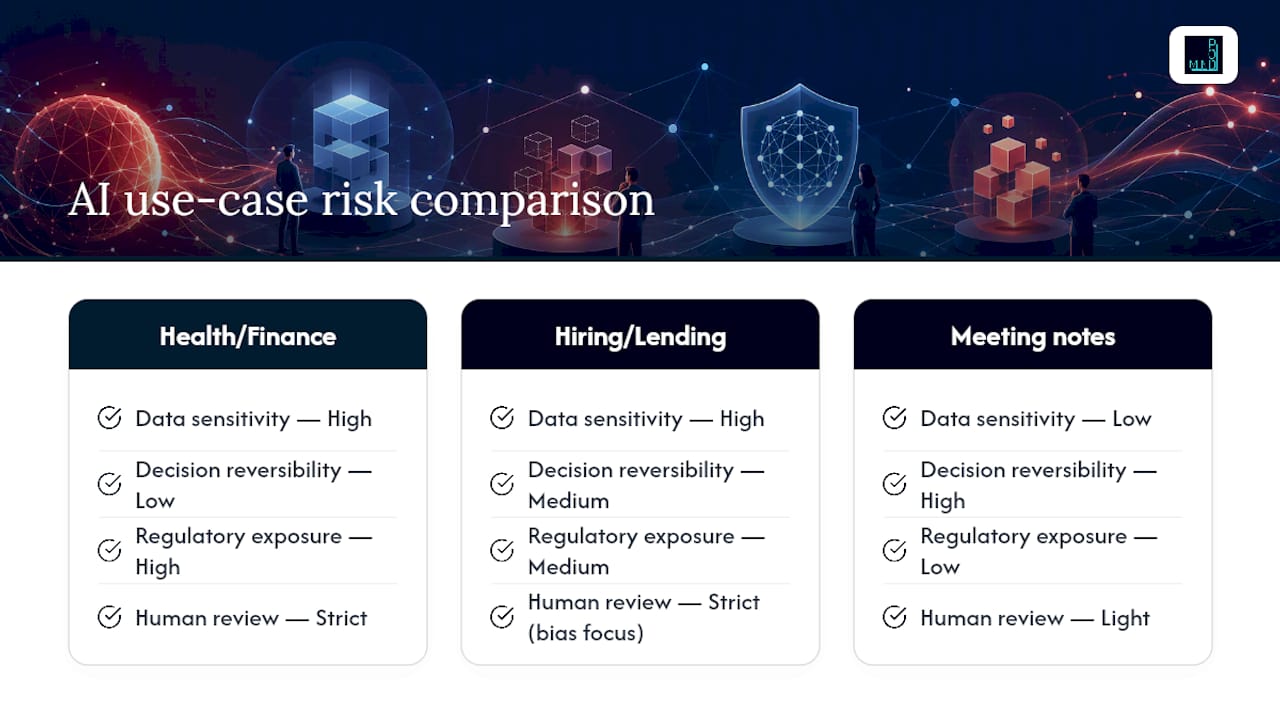
Bias risk deserves explicit attention, particularly for any use case touching hiring, lending, or performance evaluation. Test outputs against different employee or customer segments before launch, not after a pattern of complaints surfaces. Document what you tested and what you found; that record matters if a regulator or an internal audit ever asks.
Accountability has to be assigned by name, not by department. When an AI-assisted decision goes wrong, someone specific needs to own the response, review, and correction, and that person needs to be identified before the incident, not during it. Ambiguous ownership is how small mistakes turn into drawn-out disputes.
How Do You Scale AI Adoption Across Multiple Teams and Departments?
Scaling AI adoption is where most of the early discipline either pays off or falls apart. A pilot that worked in one department doesn't automatically transfer to another with different data quality, different regulatory exposure, and a completely different manager culture.
Resist copying the pilot configuration wholesale into a new department. Instead, rerun a compressed version of the diagnose and align phases for each new team, checking data readiness and sponsor commitment fresh each time. What made the first pilot succeed, often a highly engaged manager or unusually clean data, may not exist in the next department by default.
Sequence departments by readiness, not by size or visibility. A smaller team with clean data and an engaged manager will produce a faster, more convincing proof point than a flagship department with messy legacy systems. Early wins build the internal case for the harder rollouts later.
Keep the three-to-four use case discipline even as you scale horizontally. Adding a fifth or sixth use case per department, multiplied across five departments, creates a governance and support burden that quickly outpaces what a lean oversight group can actually monitor. Better to run the same tight use cases well across more teams than to let each department invent its own AI wish list.
What Are the Common Technology Integration Challenges in AI Projects?
AI projects rarely fail because the model underperforms; they fail because the surrounding systems weren't ready to feed it clean data or absorb its output. Legacy systems built for human data entry often lack the structured, accessible data AI tools need, forcing teams into manual data cleanup that quietly eats the pilot's timeline.
Integration with existing software, CRM systems, ticketing platforms, scheduling tools, is the second common friction point. An AI agent that can't write back to the system of record forces employees into a manual copy-paste step that defeats the entire purpose of the automation.
Security and access control add another layer. Giving an AI agent broad system access to move fast creates exposure; giving it narrow access to stay safe can cripple its usefulness. Getting this balance right usually requires input from whoever owns your cloud architecture and security posture, not just the team requesting the AI feature.
Plan integration testing as its own phase with its own timeline, separate from model performance testing. A model can perform flawlessly in a demo and still fail in production because a downstream system rejects its output format or a permission scope blocks a required write action.
Author Perspective: Practical Cautions and Tradeoffs From a Fractional-Tech Leadership Lens
Move fast on low-risk, high-visibility pilots. Slow down and add controls the moment a use case touches money, health data, or a legally binding decision. Those two speeds should never be confused with each other.
The broad-experimentation instinct is seductive because it feels like progress, but ROI comes from depth on three or four use cases, not breadth across a dozen. Before green-lighting a pilot, ask three questions: Is there a named sponsor who will defend this in month two? Is there a baseline number to compare against? Does a manager actually use this tool, or just approve it? If any answer is no, the pilot isn't ready, no matter how good the demo looked.
Ready to Turn This Roadmap Into a Working Pilot?
Reading a roadmap and running one are different problems, and most SMB teams get stuck between the two because nobody on staff has time to own both the strategy and the day-to-day delivery. Mindpod Technologies closes that specific gap: a free technology assessment scopes your data readiness, governance needs, and best-fit use cases, then hands you a prioritized, plain-language plan you keep regardless of what you decide next.
That assessment typically surfaces which three or four use cases actually clear the ROI and risk bar for your team, not a wish list of everything AI could theoretically do. If you move forward, Mindpod delivers the pilot and keeps running it, with monitoring and rollback built in from the start rather than added after something breaks. Explore the full advisory and managed services lineup, or head straight to the enterprise intelligence page to book the assessment and get your prioritized plan started.
Sources
- Why AI Change Is Actually a People Change | BCG
- A Guide to Building Change Resilience in the Age of AI | HBR
- Reconfiguring work: Change management in the age of gen AI | McKinsey
- How AI is used in change management | IBM
FAQ
What Is the Biggest Mistake Leaders Make in AI Change Management?
Trying to run too many use cases at once. Organizations that focus on three to four use cases consistently outperform those spreading efforts across six or seven, according to BCG's research on AI-driven change.
How Long Should an AI Pilot Run Before Scaling?
An 8 to 12 week pilot, following a diagnose, align, pilot, measure, and iterate sequence, gives enough time to establish a real baseline and produce a defensible scale-or-kill decision.
Who Should Own AI Adoption Inside a Company?
Middle managers, not executives alone, drive actual adoption because employees follow what their direct manager models and endorses day to day, a pattern McKinsey's research identifies as the central lever in gen AI change.
Can a Small or Mid-Sized Business Afford a Structured AI Change Program?
Yes, if the scope stays disciplined. Working with a fractional technology partner like Mindpod Technologies for the assessment and prioritization phase avoids the cost of a full internal AI department while still following the same North Star, governance, and manager-enablement framework larger enterprises use.
What Metrics Actually Prove AI Change Is Working?
Business-impact metrics tied to your North Star, cost per case, cycle time, error rate, matter more than adoption rate alone, since usage counts don't confirm the business actually got faster or cheaper.