

The minimum governance baseline for deploying autonomous AI agents comes down to six controls: a centralized control plane, a live agent registry, a single verifiable identity per agent, a runtime policy engine, documented data controls, and clear accountability mapped to a named human. Skip any one of these and you have a pilot project, not a production system.
Regulatory pressure is already forcing the issue. NIST's AI Risk Management Framework gives enterprises a structured way to measure and monitor agent risk, while regimes like the EU AI Act push high-stakes use cases toward mandatory impact assessments. Mindpodtech works with SMBs and mid-market firms to translate that pressure into a workable governance assessment and rollout plan rather than a compliance binder nobody reads.
Here's what to assign in the next hour:
- Pull a list of every AI agent currently running in production or pilot, including ones IT didn't approve.
- Assign one named owner to each agent, no exceptions.
- Flag any agent with write access to financial, customer, or legal systems for immediate runtime review.
Key Takeaways
Enterprise AI agent governance requires a centralized control plane, single agent identity, runtime policy enforcement, and named human accountability before any agent reaches production.
| Point | Details |
|---|---|
| Build the registry first | Catalog every agent's owner, scope, and autonomy level before adding other controls. |
| Enforce single identity | Bind each agent to one verifiable identity with least-privilege access, no shared credentials. |
| Use runtime, not static, policy checks | Path-dependent agent behavior requires per-step evaluation, not one-time prompt controls. |
| Map accountability explicitly | Assign owner, approver, custodian, and reviewer roles before an agent goes live. |
| Start with Mindpodtech's free assessment | A prioritized, plain-language governance plan the client owns, then Mindpodtech delivers and runs it. |
Table of Contents
- What Is AI Agent Governance and Why Does It Differ From Traditional AI Oversight?
- How Do You Build an Agent Control Plane?
- Who Is Accountable When an AI Agent Takes a Harmful Action?
- What Data Controls Do AI Agents Need Before Go-Live?
- What Runtime Guardrails and Red-Team Testing Do Agents Require?
- How Should Enterprises Manage the AI Agent Lifecycle?
- What Does a 10-Step AI Agent Governance Checklist Look Like?
- What Does an AI Agent Governance Rollout Actually Look Like?
- How We Advise CISO Clients to Start
- Get a Governance Assessment Before Your Next Agent Goes Live
- Sources
- FAQ
What Is AI Agent Governance and Why Does It Differ From Traditional AI Oversight?
AI agent governance is the set of controls, ownership rules, and monitoring systems that determine what an autonomous AI agent is allowed to do, who is accountable when it acts, and how its behavior gets audited over time. It is not the same discipline as governing a static machine learning model or a traditional software application, and treating it that way is where most enterprise programs break down.
Three distinctions matter. First, agents are path-dependent: an action that's safe in isolation can become dangerous depending on what the agent already did three steps earlier, which means static rule checks miss the risk entirely. Second, agents operate with delegated authority, often executing multi-step tasks (approving a refund, modifying a database record, sending external communications) without a human reviewing each step. Third, agents carry state and memory across a session or workflow, so their behavior shifts based on accumulated context rather than a single input.
That combination creates risk categories traditional software governance was never built for:
- Data exfiltration through tool calls or overly broad API scopes
- Unauthorized actions taken during multi-step delegated tasks
- Automation bias, where staff stop questioning agent output
- Accountability diffusion when no single person owns the outcome
- Regulatory triggers under high-risk classification schemes like the EU AI Act
The Model AI Governance Framework for Agentic AI from Singapore's IMDA captures this well: it recommends bounding risk before deployment, keeping humans meaningfully accountable (not just nominally listed), and applying technical controls across the full agent lifecycle. Mayer Brown's legal analysis frames this as a dual pressure problem: internal governance standards and external regulatory obligations both apply, and organizations that only satisfy one are exposed on the other.
How Do You Build an Agent Control Plane?
Every enterprise agent program needs four layers working together: a registry that inventories every agent, an identity and access layer that governs what each agent can touch, a policy engine that evaluates actions in real time, and an observability layer that captures what actually happened. Miss one layer and the other three become theater.
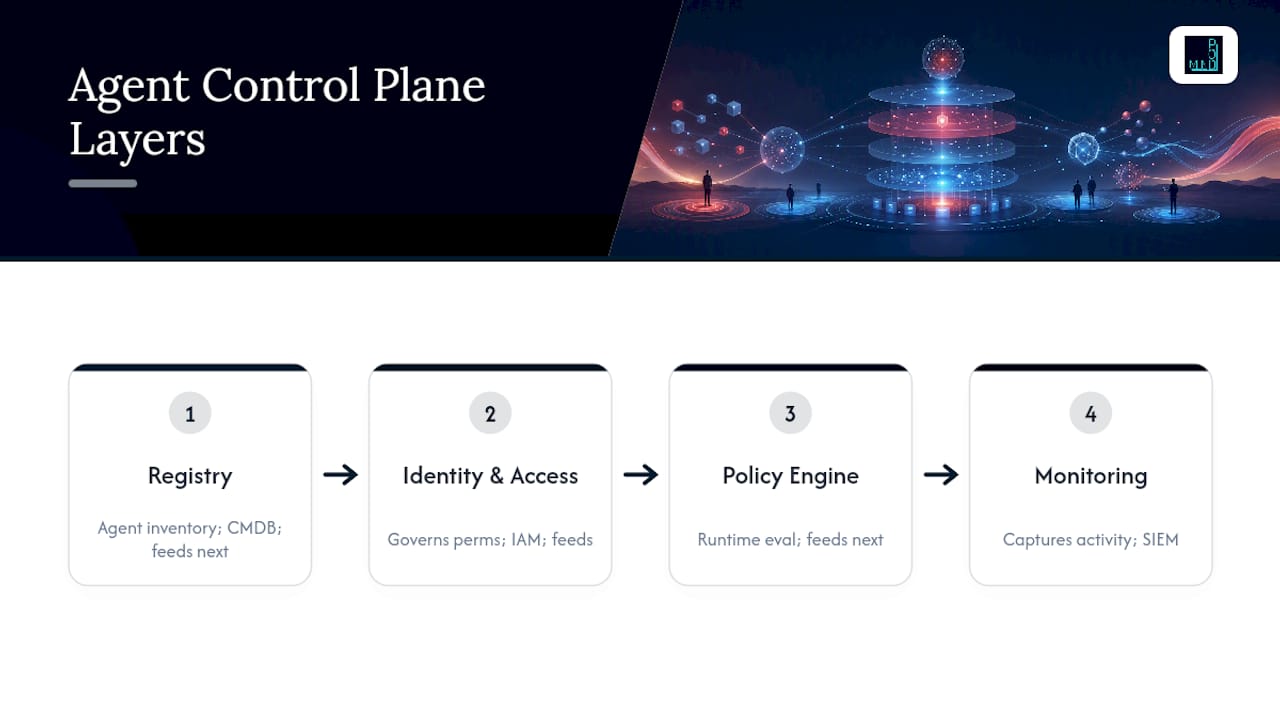
Think of the control plane as a diagram with these layers stacked vertically, each one feeding data to the next, with lateral connections into your existing IAM system, SIEM, and CMDB. If your security team can't see agent activity in the same dashboards they already use for everything else, you've built a parallel governance system nobody will maintain past quarter one.
What belongs in the agent registry
A registry entry isn't just a name and a description. At minimum, capture:
- Owner (the named human accountable for this agent)
- Purpose and business justification
- Platform and underlying model
- Access scope (systems, data, APIs it can touch)
- Autonomy level (advisory only, human-approved actions, or fully autonomous)
- Tools and functions the agent is permitted to call
- Retained state or memory duration
- Lifecycle stage (pilot, production, deprecated)
Microsoft's governance guidance for agents across an organization treats the registry as the foundation of the whole model, arguing that without it, shadow deployments proliferate faster than security teams can track them. That matches what we see in the field: the biggest governance gap at most SMBs isn't a bad agent, it's an agent nobody logged.
Identity, access, and the policy engine
Every agent needs a single, verifiable identity bound to your existing organizational identity policy, not a shared service account three different teams reuse. Credentials need a defined lifecycle (issuance, rotation, revocation), and access should follow least privilege by default, scoped to exactly what the agent's registered purpose requires.
The harder problem is runtime enforcement. Static access controls and carefully worded prompts cannot enforce policies that depend on what an agent already did. A runtime governance framework published on arXiv makes this case directly: because agent behavior is path-dependent, you need a policy engine that evaluates each proposed action against the agent's execution history and current governance state, not just against a fixed rule at the start of the session. Enforcement options at that decision point typically fall into three buckets: block the action outright, steer it toward a safer alternative, or route it to a human for approval.
Observability and the audit trail
Log API-level calls, but also capture decision-context logs, the reasoning trail behind why an agent took a specific action, not just that it did. Pair that with a compact governance state vector that tracks cumulative risk signals across a session. Retain these logs long enough to support both internal audits and any regulatory review your sector requires.

Pro Tip: Don't try to govern your entire agent fleet on day one. Start with a single high-value pilot: build the registry entry, enforce a single identity requirement, and get decision-context logging working for that one agent before you scale the pattern across the organization.
Who Is Accountable When an AI Agent Takes a Harmful Action?
Accountability has to be explicit and mapped to named roles before an agent goes live, not reconstructed after something goes wrong. Vague statements like "the AI team owns this" collapse the moment an incident review starts asking who actually approved the access scope.
A workable model assigns four roles per agent:
| Role | Responsibility | Example decision authority |
|---|---|---|
| Owner | Accountable for business outcome and risk of the agent | Approves the agent's purpose and scope at registration |
| Approver | Signs off on high-impact or irreversible actions | Authorizes actions above a defined dollar or risk threshold |
| Custodian | Maintains technical operation, credentials, and updates | Manages identity rotation and platform patching |
| Reviewer | Independently audits logs and decision-context records | Conducts periodic sampling of agent decisions |
For irreversible or high-impact actions, such as a financial transfer, a legal filing, or an external customer communication, the agent should route to the approver automatically, with a defined maximum wait time before the action either proceeds or fails safe. That escalation boundary needs to be written down before deployment, not improvised during an incident.
Governance failures tend to cluster into four categories:
- Technical: the agent takes an action outside its intended scope because of a policy gap
- Operational: nobody notices an agent has drifted from its approved behavior for weeks
- Compliance: an agent processes regulated data without the required consent or retention controls
- Reputational: a customer-facing agent produces an output that damages trust publicly
Every one of these traces back to an accountability failure somewhere upstream. Require an auditable approval record for every high-impact action and verify, on a recurring basis, that human-in-the-loop checkpoints are actually meaningful reviews. A pitfall worth naming directly: staff who rubber-stamp agent recommendations without reading them defeat the checkpoint entirely, and that pattern, often called automation bias, is one of the most common ways accountability structures fail in practice.
What Data Controls Do AI Agents Need Before Go-Live?
Data access and memory retention are the two biggest compliance exposures an agent creates, and both need controls in place before the agent ever touches production data, not after a review flags a problem.
Before go-live, run through this checklist:
- Apply data minimization: the agent gets access to only the fields and records its task requires
- Segment data by sensitivity so a customer-service agent can't reach financial or HR systems
- Mask or tokenize sensitive fields wherever the agent's task doesn't require the raw value
- Scope access at the API level, not the database level, so permissions are auditable
- Define retention and deletion policies, including how the agent honors a "forget" or erasure request
- Log the decision context behind every data access, not just the access itself
Regulatory obligations kick in earlier than most teams expect. Mayer Brown's analysis of agentic AI governance points out that organizations face both internal governance standards and external regulatory obligations simultaneously, and high-stakes use cases (credit decisions, hiring, health data, anything touching a regulated industry) can trigger classification requirements under frameworks like the EU AI Act even for U.S.-based companies serving international customers. When an agent's task touches regulated data or a high-risk category, loop in legal and compliance before deployment, not during the incident review.
For recordkeeping, keep decision-context logs and API-level activity logs together, tied to a governance state snapshot for each session. NIST's risk management framework recommends continuous monitoring rather than point-in-time review, which means your retention window should be long enough to reconstruct a full agent session months later if a regulator or auditor asks.
What Runtime Guardrails and Red-Team Testing Do Agents Require?
Static checks and well-written prompts cannot stop an agent from taking a harmful action mid-session, which is why runtime guardrails and adversarial testing are not optional extras. They're the layer that catches what the design phase missed.
Runtime guardrails that matter in practice:
- Per-step policy evaluation, not just a check at session start
- Least-privilege tool access scoped to the specific task, revoked when the task ends
- Session-scoped permissions that expire rather than persisting indefinitely
- Content safety filtering on both inputs and outputs
- Process isolation so a compromised agent can't reach adjacent systems
The OWASP State of Agentic AI Security and Governance report lays out a practical testing methodology worth adopting wholesale. A red-team and testing program should follow this sequence:
- Build a test matrix covering every tool and API the agent can call
- Run simulated adversarial inputs designed to trigger scope violations or prompt manipulation
- Execute integration tests against real (or staged) downstream systems, not mocks alone
- Roll out in stages: internal pilot, limited production, full production, with monitoring gates between each
- Re-test after every material update to the agent's model, tools, or permissions
When something does go wrong, the incident response sequence for an agent looks different from a typical software incident:
- Stop or roll back the agent's active session immediately
- Capture forensic decision-context logs before anything gets overwritten
- Revoke the agent's identity and credentials
- Patch the root cause and revalidate against the test matrix before restoring access
- Trigger regulatory notification if the incident involves regulated data or a high-risk classification
Pair your API-level logs with decision-context logs throughout this process. One without the other leaves you able to prove what the agent did but not why, and "why" is usually what an audit or legal review actually needs.
How Should Enterprises Manage the AI Agent Lifecycle?
Treat every agent as a first-class asset with a managed lifecycle: design, test, approve, deploy, monitor, update, and retire. An agent that skips formal retirement just becomes an unmonitored liability sitting in production.
Gate each stage with a clear checkpoint:
- Design: documented purpose, risk score, and approved access scope
- Pre-deploy testing: full test matrix passed, including adversarial cases
- Staging: run against real workflows with no external impact
- Canary: limited production rollout with tight monitoring thresholds
- Monitoring: defined thresholds that automatically flag drift or anomalous behavior
- Decommission: a checklist that revokes identity, archives logs, and confirms no dependent workflows remain
Version every agent update and keep rollback capability ready. State and memory persistence across updates is a common source of unpredictable behavior: an agent that "remembers" context from a prior version can behave inconsistently even when the underlying model change looks minor.
Pro Tip: Use feature flags to scope pilots to a small user group and set automatic rollback thresholds tied to your monitoring alerts, so a bad update reverts itself before a human even notices the problem.
What Does a 10-Step AI Agent Governance Checklist Look Like?
The goal for most organizations should be to establish a working governance baseline within a reasonable timeframe, prioritizing progress over perfection. Perfection is the enemy of getting the registry and identity controls live.
- Inventory every existing agent (quick win, security/platform, week 1)
- Assign a named owner to each agent (quick win, product, week 1)
- Stand up the agent registry (quick win, platform, month 1)
- Enforce single identity per agent (medium, security, month 1)
- Deploy a runtime policy engine (medium, security/platform)
- Apply data minimization and access scoping (medium, legal/security)
- Run initial red-team testing (medium, security)
- Define human-in-the-loop checkpoints (medium, product/legal)
- Map compliance obligations by use case (long-term, legal)
- Establish a recurring governance review forum (long-term, security/legal/product)
For the first three: early stages focus on inventory and ownership, which require no new tooling but discipline; subsequently, setting up the registry—even a basic one—is important for governance.
What Does an AI Agent Governance Rollout Actually Look Like?
The pattern that holds up across engagements is pilot, then a 90-day stabilization period, then a 6-month scale-out. Skipping the stabilization phase is the single most common reason governance programs stall.
The pilot phase targets one agent, one owner, one clearly bounded use case, with governance gates (registry entry, identity, basic logging) enforced from day one rather than retrofitted later. The 90-day phase adds runtime policy enforcement and starts tracking monitoring thresholds against real production data. By month six, the goal is a repeatable registry and identity process that a second and third team can adopt without rebuilding the framework from scratch.
The pitfalls that derail this pattern are consistent:
- Shadow deployments that never make it into the registry because a team moved fast
- Missing identity binding, where an agent shares credentials with a human user or another service
- Insufficient decision-context logging, which leaves teams unable to explain an incident after the fact
- Automation bias, where the human checkpoint becomes a formality instead of a real review
Mindpodtech's technology assessment is built to surface exactly these gaps before they become incidents, producing a prioritized plan the client owns rather than a vendor-locked recommendation.
How We Advise CISO Clients to Start
Start with the registry and identity layer before anything else. Every other control, policy engine, monitoring, incident response, depends on knowing which agents exist and who owns them.
A few tradeoffs worth deciding early:
- Centralize governance for regulated or high-risk use cases; federate for low-risk, team-owned pilots
- Weigh cost against control: a fully centralized policy engine costs more upfront but reduces incident response time later
- Measure success with risk reduction metrics, not adoption metrics, such as unauthorized action attempts blocked or time to detect drift
The harder tradeoffs sit between rollout speed and risk tolerance, and between observability depth and the storage cost of keeping years of decision-context logs. There's no universal right answer here. The wrong answer is not deciding at all and letting default settings make the call for you.
Get a Governance Assessment Before Your Next Agent Goes Live
Mindpodtech runs a free technology assessment that turns the governance baseline above into a prioritized, plain-language plan your team actually owns, then delivers and runs the implementation alongside you.
That assessment covers the specific gaps most SMBs hit first:
- Fractional CTO advisory for teams without a dedicated AI governance lead
- Agent registry and identity implementation scoped to your existing systems
- Pilot rollout with monitoring, rollback, and human-in-the-loop checkpoints built in from day one
- Ongoing monitoring and operations once the pilot moves to production
If you've got agents running today without a registry entry or a named owner, that's the gap to close first. Start with a free technology assessment and get a plan ranked by risk and return before your next agent deployment, not after an incident forces the conversation.
Sources
For legal and regulatory questions, technical implementation, and red-team methodology, these sources cover the ground this article draws from.
- Governance of Agentic Artificial Intelligence Systems | Insights | Mayer Brown
- Governance and security for AI agents across the organization | Microsoft Learn
- AI risk management framework | NIST
- Model AI Governance Framework for Agentic AI (IMDA)
- Runtime Governance for AI Agents: Policies on Paths (arXiv)
- State of Agentic AI Security and Governance 2.01 - OWASP Gen AI Security Project
This article is general information, not a substitute for advice from a qualified lawyer. Consult a qualified legal professional about your own circumstances before acting on anything here.
FAQ
What Is the Difference Between AI Governance and AI Agent Governance?
AI governance broadly covers models and data pipelines, while AI agent governance adds controls for autonomous, multi-step decision-making, including identity, runtime policy enforcement, and delegated authority.
Who Should Own AI Agent Governance Inside an Organization?
Ownership typically sits with security or a fractional CTO function, but each individual agent needs its own named business owner accountable for its outcomes.
How Long Does It Take to Build an Agent Governance Baseline?
Most organizations can establish a working baseline, registry, identity, and basic runtime policy, within 90 days, following a pilot then stabilization approach like the one Mindpodtech uses with clients.
Does the EU AI Act Apply to US Companies Using AI Agents?
It can, particularly for high-risk use cases or when a US company's agent interacts with EU customers or data, so legal review is warranted before deploying regulated-use agents.
What Is the Biggest Governance Gap Most Companies Have Today?
Missing agent registries and undefined ownership. Most incidents trace back to an agent nobody formally logged or assigned a human owner to before it reached production.