

An AI acceptable use policy is the employee-facing ruleset that defines which AI tools your team can use, how they must handle data inside those tools, and who signs off when something goes wrong. If you don't have one yet, the single next move is to identify the scope: list every AI tool already in use across your organization, then flag which workflows touch regulated or sensitive data. That inventory becomes the spine of everything else.
Three things separate a working policy from a document nobody reads: a data classification scheme that tells people what they can paste where, a human-in-the-loop requirement for anything customer-facing or high-stakes, and a named owner who reviews the policy on a schedule instead of letting it go stale. Skip any one of those and the policy becomes shelfware.
Before you draft a single clause, handle these four things:
- Inventory every AI tool in active use — including the ones employees adopted without asking, often called shadow AI.
- Flag regulated data flows — health records, financial account numbers, legal case files, student data — and mark them off-limits for public AI tools immediately.
- Require disclosure on high-stakes outputs — anything that touches a customer, a regulator, or a hiring decision needs a human sign-off and a disclosure note.
- Assign one owner — someone in IT, compliance, or operations who is accountable for the policy's next revision.
Pro Tip: Don't wait for a "perfect" policy draft before publishing interim rules. A one-page "do this, not that" memo covering your top three risks buys you six to eight weeks to build the full policy without leaving a gap for shadow AI to fill.
Key Takeaways
An AI acceptable use policy works only when it pairs clear, readable rules on tools and data with fast approval paths and real training, not just a published document.
| Point | Details |
|---|---|
| Inventory first | Map every AI tool in active use, including unapproved shadow AI, before drafting any rules. |
| Classify data before tools | Tie data classification tiers directly to which AI tools can touch which information. |
| Require human review on high-stakes outputs | Mandate sign-off for legal, financial, healthcare, and customer-facing AI content. |
| Speed beats restriction | Fast tool approval (five business days or less) reduces shadow AI more than strict bans do. |
| Review annually, log continuously | Set a yearly review cadence with logging on tool, user, and data classification for every use. |
| Get expert help if scope feels unclear | Mindpodtech's free technology assessment maps AI exposure and delivers a prioritized rollout plan. |
Table of Contents
- What Is an AI Acceptable Use Policy, and Who Does It Cover?
- Why Does Your Business Need an AI Acceptable Use Policy?
- What Core Components Belong in Every AI Policy?
- What Counts as Acceptable Versus Prohibited AI Use?
- How Do You Build, Approve, and Roll Out an AI AUP?
- Annotated AI Policy Template You Can Adapt Today
- When Do You Need Disclosure and Human Oversight?
- Who Owns AI Governance Decisions in Your Organization?
- How Do You Monitor, Enforce, and Audit AI Use?
- How Do You Get Employees to Actually Follow the Policy?
- What Legal and Privacy Rules Should Shape Your Policy?
- How Do You Respond to an AI Policy Violation or Failure?
- How Often Should You Review and Update the Policy?
- How Mindpodtech Approaches AI Policy Implementation
- What Usually Goes Wrong With These Policies
- If You Want Help Building or Rolling Out Your AI Policy
- 30/60/90 Day Plan and Immediate Next Steps
- Sources
- FAQ
What Is an AI Acceptable Use Policy, and Who Does It Cover?
An AI acceptable use policy is a governance document that tells people, in plain language, which AI tools they're allowed to use, what data they can put into those tools, and what happens if they don't follow the rules. It's narrower than a full AI governance framework, which usually covers model risk assessment, vendor due diligence, and technical architecture decisions that most employees never see. The AUP is the part employees actually read: the rules that apply the moment someone opens a chat window and starts typing.
Coverage typically extends beyond full-time staff. Contractors, temporary workers, interns, and any third-party vendor acting on your organization's behalf should fall under the same rules, especially if they touch your systems or customer data. A freelance copywriter who drafts marketing emails using a public AI tool is just as capable of leaking a customer list as a full-time employee.
The systems an AUP governs range wider than most people assume. It's not just standalone chat interfaces. Think about three categories: standalone assistants like OpenAI's ChatGPT, Google's Bard, and Anthropic's Claude; AI features embedded inside tools your team already uses, like Microsoft Copilot inside Word, Excel, and Teams; and increasingly, agentic tools that take multi-step actions on their own, like drafting and sending an email, or updating a record without a human clicking "send" each time.
Here's the practical dividing line that trips up a lot of first-time policy writers: the AUP covers behavior (what employees are permitted to do), while a technical security policy covers controls (firewalls, API restrictions, data loss prevention rules). Both matter. Only one of them is something a new hire reads on day one. A practical AI security framework treats the approved-tools list, data classification, and human review requirements as the backbone of the employee-facing layer, with technical enforcement sitting underneath it.
Why Does Your Business Need an AI Acceptable Use Policy?
The risk isn't hypothetical anymore, and it isn't limited to large enterprises. Small and mid-sized businesses face the same exposure with fewer resources to absorb a mistake. An employee who pastes a client's financial statement into a public chatbot to "clean up the formatting" has potentially handed that data to a third party outside any contract you control. Multiply that across a team of thirty, and the odds of it happening at least once this quarter are not small.
Five risks show up most often in practice:
- Data leakage — sensitive or regulated information entered into a public AI tool that retains or trains on inputs.
- Regulatory exposure — using AI in ways that violate sector rules (health, finance, education) without documented safeguards.
- Hallucination in customer communications — AI-generated text presented as fact when it's fabricated or wrong.
- Unintended automated decisions — agentic tools taking actions (approving a refund, sending a contract) without a human checkpoint.
- Intellectual property exposure — proprietary code, designs, or strategy documents fed into tools whose terms of service allow reuse.
The benefits run the other direction. A clear AUP gives you consistent risk handling instead of ad hoc judgment calls, faster adoption because employees know what's already approved, audit evidence you can hand to a customer or regulator, and a documented reason shadow AI usage drops once people have a fast, legitimate path to get new tools approved.
Regulatory momentum backs this up. New York State's own internal AI policy now requires executive approval for AI adoption in state agencies and mandates human oversight for decisions affecting the public, which signals where public-sector and, increasingly, private-sector expectations are heading. Microsoft's guidance on governing AI makes the same point from a different angle: an AUP works best when it enables safe use rather than blocking it outright, because overly restrictive policies just push usage underground.
If you're deciding where to start, rank your risks this way: data leakage first (it's the most common and hardest to reverse), disclosure gaps second (customer-facing hallucinations damage trust fast), and agentic automation third (lower current volume, but the failure mode is harder to detect).
What Core Components Belong in Every AI Policy?
A workable AUP needs nine components, and skipping any of them tends to create the exact gap that gets exploited or misunderstood later.
Purpose and scope. State why the policy exists and who it covers. Sample clause: "This policy applies to all employees, contractors, and third-party vendors accessing company systems or data, and governs the use of any artificial intelligence tool, whether company-provided or independently adopted."
Approved and prohibited tools. Name the tools people can use and the ones they can't, and update this list on a set cadence. Sample clause: "Employees may use only AI tools listed on the current Approved Tools Registry. Requests for new tools must go through the IT approval process outlined in Section 6."
Data classification and handling rules. This is the component that does the most work. Tie your classification tiers directly to tool permissions.
Human review and decision thresholds. Define what counts as a decision an AI can draft but never finalize alone. Sample clause: "AI-generated content used in customer communications, legal filings, or financial reporting must be reviewed and approved by a qualified human before release."
Disclosure and labeling requirements. Spell out when a customer or user must be told AI was involved.
Approval process for new tools. Set a realistic turnaround so shadow AI doesn't win by being faster than your process.
Incident reporting. Give employees one clear channel to report a mistake without fear of instant punishment for reporting it.
Enforcement and consequences. State graduated consequences, not a single "you're fired" clause that nobody believes will actually get used for a first offense.
Training and ownership. Name who owns the policy and how often it gets reviewed.
Microsoft's security guidance for governing AI frames these same core elements — approved tools, data classification, human review, and escalation paths — as the backbone of any workable policy, and a standalone employee AI policy guide reinforces the same structure with added emphasis on enforcement mechanics.
Here's how those components map to ownership in practice:
| Component | Essential elements | Typical owner |
|---|---|---|
| Approved tools list | Tier by risk (consumer vs. enterprise), review quarterly | IT / security lead |
| Data classification | Public, internal, confidential, restricted tiers mapped to tool access | Data/compliance owner |
| Human review threshold | Define which outputs require sign-off before release | Business unit manager |
| Incident reporting | Single intake channel, no-blame first-report policy | Security or compliance |
| Training and review cadence | Annual refresh, plus triggers for early updates | Policy owner (CTO/CISO) |
On the tool tiering question specifically: consumer-tier accounts for tools like ChatGPT, Copilot, Bard, or Claude often retain or train on input data differently than enterprise-tier accounts with data processing agreements in place. Your policy should state plainly that confidential or restricted data may only touch enterprise-tier tools with a signed agreement, never the free consumer version, even if it's technically "the same AI."
What Counts as Acceptable Versus Prohibited AI Use?
Ambiguity is where policies fail in practice, so concrete examples matter more than abstract principles. Here's how the line typically falls:
Generally acceptable: brainstorming marketing copy or headline variations; drafting a first pass of an internal memo; summarizing publicly available research; generating code snippets for non-production testing; using AI to outline a presentation structure.
Generally prohibited without explicit approval: entering customer personally identifiable information into a public AI tool; using AI to draft final legal or compliance language without attorney review; letting an agentic tool send external communications unsupervised; uploading proprietary source code to a consumer-tier chatbot; using AI outputs as the sole basis for a hiring, firing, or disciplinary decision.
Sector context changes the calculus. In healthcare, any AI interaction that touches protected health information needs a business associate agreement in place before the tool is used at all. In finance, AI-drafted content in anything resembling a disclosure or financial statement needs review under existing compliance sign-off procedures, not a new parallel process. In legal practice, AI-drafted research or filings need attorney review every time, not spot-checks. In education, several universities have already published explicit rules distinguishing AI-assisted drafting from AI-generated submissions, and UT Austin's policy on generative AI tools is a useful model for how to separate permitted brainstorming from prohibited final-work submission.
Agentic AI, tools that take multi-step actions without a human approving each step, deserves its own line in your policy. An agent that drafts an email is low risk. An agent that sends an email, updates a customer record, or issues a refund without review crosses into high-stakes territory the moment it touches something external or irreversible. A deeper look at agentic AI's implications for compliance and risk makes the case that these tools need tighter guardrails precisely because their actions compound faster than a human reviewer can catch them. Your annotated template (below) includes a clause stub for exactly this scenario.
How Do You Build, Approve, and Roll Out an AI AUP?
Building the policy is the easy part. Getting it adopted is where most organizations stumble. Here's a sequence that works for a small to mid-sized organization without a dedicated compliance department:
- Inventory and risk assessment (week 1-2). List every AI tool in use, sanctioned or not. Interview two or three people from each department, because what IT thinks people use and what people actually use rarely match.
- Draft the policy using a template (week 2-3). Start from the annotated template below rather than a blank page. Adapt clauses to your actual risk profile instead of copying generic language wholesale.
- Legal and compliance review (week 3-4). Route the draft to legal counsel, particularly for the data handling, disclosure, and enforcement sections. Budget five business days for a straightforward review; longer if you operate in a regulated sector.
- Pilot with one or two teams (week 4-6). Pick a team that uses AI heavily and one that barely touches it. Collect feedback on what's unclear or too restrictive before rolling out company-wide.
- Organization-wide rollout (week 6-8). Pair the policy launch with a short training session, not just an email with an attachment nobody opens.
- Monitoring and enforcement (ongoing). Set up logging and a review cadence from day one, not as an afterthought six months later.
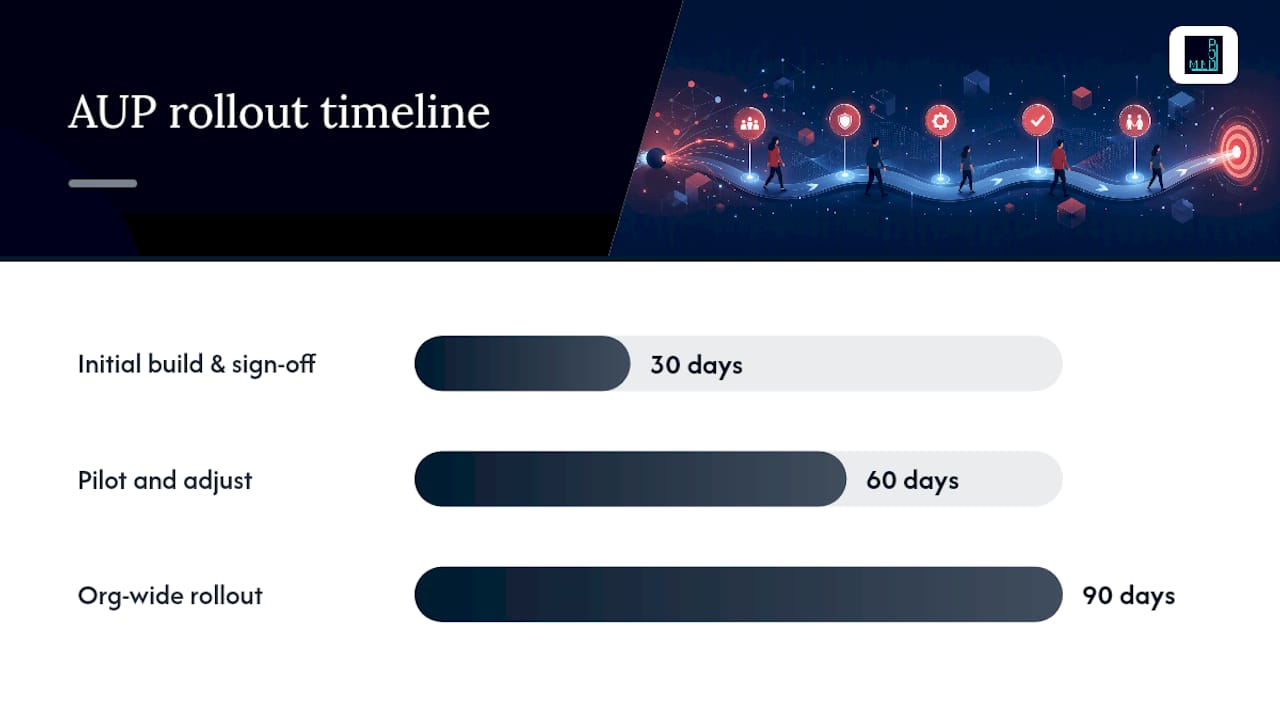
For a typical SMB, a realistic timeline looks like this: 30 days to complete the inventory, draft the policy, and get initial legal sign-off; 60 days to pilot and adjust based on real feedback; 90 days to complete organization-wide rollout with training documented. Internal hours run the bulk of the cost for most SMBs, roughly 20 to 40 hours split across IT, HR, and a department lead, unless the organization operates in a regulated sector where outside counsel review adds real dollars but reduces real risk.
Suggested turnaround targets keep the process from becoming a bottleneck: aim for five business days on standard new-tool approval requests, and 24 to 48 hours for anything flagged urgent by a business unit lead. Australia's National AI Centre guidance on creating an AI policy makes a point worth repeating here: start from a template, but tailor governance and approval points to your actual organization size rather than importing a Fortune 500 process into a 40-person company.
The fastest way to kill shadow AI isn't a stricter policy. It's a faster approval path than the one employees would otherwise take by just signing up for a tool themselves.
Annotated AI Policy Template You Can Adapt Today
What follows is a working skeleton. Each section includes a sample clause and a note on when to use the default language versus when to tighten it.
1. Purpose and Scope "This policy governs the use of artificial intelligence tools by all employees, contractors, and third-party vendors acting on behalf of [Organization Name]. It applies to standalone AI assistants, AI features embedded in existing software, and autonomous or agentic AI tools." Tighten this if you operate across multiple states or handle federally regulated data; add a line naming the specific regulatory frameworks that apply (HIPAA, GLBA, FERPA).
2. Approved and Prohibited Tools "Employees may use tools listed on the Approved Tools Registry, maintained by [IT/Compliance Owner] and reviewed quarterly. Use of unlisted tools for business purposes is prohibited without prior written approval." Default language works for most SMBs. Tighten by requiring enterprise-tier accounts only (not free consumer accounts) for any tool touching confidential data.
3. Data Classification and Handling "Data is classified as Public, Internal, Confidential, or Restricted. Confidential and Restricted data may only be used with AI tools under an active data processing agreement. Restricted data (health records, financial account details, government identifiers) may never be entered into a public or consumer-tier AI tool." This clause needs healthcare or financial-sector tightening almost every time; add explicit reference to your business associate agreement or data processing agreement obligations.
4. Human Review Requirements "AI-generated content used in customer-facing communications, legal documents, financial reports, hiring decisions, or code deployed to production must be reviewed and approved by a qualified human before use." Default language is broad by design. Narrow it further for legal and healthcare organizations by naming the specific reviewer role required (licensed attorney, compliance officer).
5. Disclosure Requirements "When AI-generated content is presented to a customer, client, or the public, [Organization Name] will disclose that AI was used in its creation, consistent with applicable disclosure laws." Pair this with the disclosure templates in the next section.
6. Tool Approval Process "Requests for new AI tools must be submitted to [Owner] and will receive a decision within five business days. Urgent requests may be escalated for a 48-hour turnaround."
7. Incident Reporting "Employees who suspect a policy violation, data exposure, or AI-related error must report it immediately to [Contact/Channel]. First-time good-faith reports made promptly will not result in disciplinary action."
8. Enforcement "Violations may result in retraining, temporary access restriction, or, for repeated or willful violations, formal disciplinary action up to termination."
9. Training and Review "This policy is reviewed annually by [Policy Owner] in coordination with Legal and IT, or sooner if triggered by a material vendor change, new regulation, or significant incident."
Where regulated data enters the picture, healthcare, finance, or any tool processing consumer personal data, insert a clause stub: "Vendor agreements involving Confidential or Restricted data require a signed Data Processing Agreement or Business Associate Agreement, subject to legal review before use." Leave that placeholder in the template rather than guessing at language; it forces the drafting team to actually route it to counsel instead of skipping the step.
When Do You Need Disclosure and Human Oversight?
"High-stakes" isn't a vague qualifier. Define it concretely so employees don't have to guess. High-stakes domains typically include legal filings and contracts, financial reporting and disclosures, safety-critical operational decisions, healthcare communications or documentation, regulatory submissions, and any final hiring, promotion, or disciplinary decision.
For internal reviewer sign-off, a short checklist works better than a paragraph of prose:
- Does the output touch a customer, regulator, or the public directly?
- Could an error cause financial, legal, or reputational harm?
- Is a licensed professional (attorney, clinician, accountant) required to validate this category of output?
- Has the reviewer confirmed the source data was appropriately classified before input?
For external, user-facing disclosure, keep the language short and honest: "This response was generated with the assistance of artificial intelligence and reviewed by a member of our team before being sent to you." That single sentence, placed consistently, satisfies the spirit of most current disclosure expectations without turning every customer email into a legal notice.
The regulatory direction here is not ambiguous. Disclosure laws governing AI use in commercial chatbot interactions are expanding, and companies that build disclosure into their process now avoid a scramble later when a state passes a new requirement. A partner guide on GDPR-compliant AI practices covers the transparency and consent angle in more depth if your organization handles data from EU residents alongside domestic customers.
The human oversight rule is simple to state and hard to skip: no AI output touching a high-stakes domain goes out the door without a named human, not just "a team," signing off on it.
Who Owns AI Governance Decisions in Your Organization?
Someone has to own this policy, and "IT will handle it" is not an answer that survives contact with an actual incident. A workable governance structure names a policy owner, typically your CISO, CTO, or a compliance lead, who holds final authority on updates. Information owners and data owners manage classification decisions for their specific domains. Business unit approvers sign off on tool requests relevant to their team. HR handles enforcement of violations. Legal reviews anything touching regulated data or high-stakes disclosure language.
Escalation needs to be fast for two different situations: urgent tool approval requests that can't wait for the next scheduled review, and incidents that may require legal or regulatory notification. Build both paths into the policy explicitly, not as an implied "figure it out."
Here's a RACI structure a small organization can adapt directly:
| Activity | Responsible | Accountable | Consulted | Informed |
|---|---|---|---|---|
| Approve new AI tool | IT lead | CTO/CISO | Legal (if regulated data) | Department heads |
| Approve high-risk use case | Business unit manager | Policy owner | Legal, Compliance | HR |
| Respond to AI incident | Security/IT | CISO or designated owner | Legal | Executive team |
| Update policy language | Policy owner | Policy owner | Legal, HR, IT | All employees |
Adjust the "Accountable" column down to a single named person even in a five-person company. Ambiguous accountability is how incidents sit unaddressed for weeks.
How Do You Monitor, Enforce, and Audit AI Use?
You can't manage what you don't log. At minimum, track which tool was used, the data classification level involved, the user, the stated purpose, and whether a disclosure flag applies. Retain these logs consistent with your existing data retention schedule, and where possible, feed them into whatever SIEM or IT service management system you already run rather than standing up a parallel tracking tool.
Enforcement should be graduated, not binary. A first-time, good-faith violation typically warrants retraining. Repeated or willful violations warrant access restriction. Only egregious or knowingly malicious violations, like deliberately feeding restricted data into an unapproved tool after being told not to, warrant formal disciplinary action. Technical enforcement layers, like data loss prevention rules or API proxies that block unapproved tools at the network level, back up the policy but shouldn't replace the human conversation entirely.
Four KPIs tell you whether the policy is actually working:
- Number of approved tools relative to tools requested, tracking approval speed.
- Number of high-risk use approvals granted per quarter, tracking how often edge cases arise.
- Incident count and time to remediate, tracking whether problems get caught and fixed quickly.
- Percent of employees trained, tracking whether the policy has actually reached people, not just been published.
Run a formal audit against these KPIs at minimum twice a year, and after any significant incident regardless of where you are in the normal cycle.
How Do You Get Employees to Actually Follow the Policy?
Publishing a policy and training people on it are two different projects, and skipping the second one is the single most common failure mode. One documented case found that despite a published AI policy, 71% of employees at one company were unaware it existed, even as 63% used AI tools daily. A policy nobody knows about protects nobody.
Use short scenario-based assessments rather than a wall of text followed by a checkbox, since scenario questions test whether people understood the "why," not just whether they clicked through slides.
Communications matter as much as the training module itself. Launch with a short, plain-language FAQ addressing the questions people actually ask ("Can I use ChatGPT to draft a client email?"). Name a few internal champions, people other employees already trust, who can answer quick questions without escalating to IT every time. Quick reference cards taped near a desk or pinned in a team channel beat a 40-page PDF that nobody reopens after week one.
Change management works best with a light touch at first: pilot with one or two teams, keep approval turnaround fast for common, low-risk cases, and give people an actual channel to flag when a rule feels wrong for their specific workflow. Measure success through training completion rate, a simple pulse survey on policy awareness, and whether incident reports trend down in the months after rollout. Educause research on generative AI adoption in higher education documents the same pattern institutions have learned the hard way: piloted, communicated rollouts stick; blanket mandates without training don't.
What Legal and Privacy Rules Should Shape Your Policy?
Certain sectors trigger an automatic need for legal or privacy review before you finalize any AUP language. Healthcare organizations need HIPAA-aligned data handling rules and a business associate agreement with any AI vendor touching protected health information. Financial services organizations need GLBA-consistent safeguards for customer financial data. Educational institutions need FERPA-compliant handling of student records. Public sector and government-adjacent organizations should look to models like New York State's AI policy, which requires executive approval for adoption and mandates human oversight anywhere a decision affects the public directly.
State-level AI disclosure and governance rules are moving fast, and what's optional guidance today tends to become a requirement within a couple of years. Building disclosure and human oversight into your policy now, ahead of a mandate, costs less than retrofitting it under a compliance deadline later.
Technical measures regulators tend to expect alongside policy language include data minimization (don't feed an AI tool more data than the task requires), encryption in transit and at rest, and signed data processing agreements or business associate agreements with any AI vendor handling regulated data. Your policy template should include a placeholder, literally the words "legal review required," anywhere the language touches a regulated data category. That placeholder is not a weakness in the draft. It's a signal to whoever finalizes the policy that a lawyer needs to look at this specific clause before publication.
This section provides general guidance, not legal advice specific to your situation. Confirm current requirements for your sector and state with qualified legal counsel before finalizing any policy language touching regulated data.
How Do You Respond to an AI Policy Violation or Failure?
When something goes wrong, whether it's a data exposure, a hallucinated output sent to a customer, or an agentic tool taking an unauthorized action, the first move is always containment, not blame assignment. Preserve the evidence before anything else: the exact input, the exact output, tool metadata (which tool, which account tier, timestamp), and the user context around what happened.
Containment differs depending on the failure type. A data exposure needs an assessment of what left the organization and whether the receiving tool retains or trains on that input; contact the vendor's support channel to request deletion where their terms allow it. An erroneous decision, like a hallucinated customer response, needs immediate correction communicated to the affected party and a review of whether the human review checkpoint was actually followed. An agentic automation failure, an agent that took an action nobody approved, needs the automation paused entirely until the root cause is understood, not just the specific instance patched.
Notification needs two tracks. Internally, alert the policy owner and, for anything touching regulated data, legal counsel, within the same business day. Externally, if the incident involves a regulatory notification requirement (a health data exposure, for example) or affects customers directly, follow your existing breach notification procedures rather than improvising new language under pressure.
Once the immediate incident is handled, run a short root cause review: was this a training gap, a policy ambiguity, or a willful violation? Update the policy language if the incident reveals a genuine gap, not just a one-off mistake, and track whether the same failure type recurs after the update.
How Often Should You Review and Update the Policy?
Review the policy at minimum once a year, and build in triggers for faster review: a major AI vendor changing its data handling terms, a new state or federal disclosure law, or any significant incident that reveals a gap in current language. Waiting for the annual cycle when a real trigger event has already occurred is how organizations end up defending an outdated policy after the fact.
Track four metrics to prioritize what actually needs updating: incident frequency and severity, the ratio of approved to requested tools (a growing backlog signals your approval process is too slow), training completion percentage, and findings from your periodic audit. If audits keep flagging the same gap, quarter after quarter, that's a policy problem, not a training problem.
Keep versioning simple: date every revision, note who approved it, and publish the current authoritative copy in one place employees actually check, an intranet page or shared drive folder, not buried in an email thread from eight months ago. Final signoff on any material update should involve the policy owner, legal counsel, and an operational sponsor from the business side, so the update reflects both the legal reality and how people actually work.
How Mindpodtech Approaches AI Policy Implementation
The approach that works for most SMBs isn't the most comprehensive policy possible on day one. It's a risk-ranked sequence: inventory first, protect regulated data second, put a human checkpoint on anything customer-facing third, then scale up with approved-tool automation once the guardrails are proven. Trying to solve every edge case before publishing anything just delays the protection you actually need immediately.
A 30-minute internal diagnostic can tell you where you stand. Ask these questions directly:
- Do we know every AI tool currently in use across departments, including tools nobody officially approved?
- Is any regulated data (health, financial, student, legal) currently touching a consumer-tier AI tool?
- Does anything customer-facing get sent without a named human reviewing it first?
- If an employee misused an AI tool tomorrow, is there a clear channel for someone to report it?
- Who owns this policy, by name, not by department?
If you can't answer all five confidently, that's your starting point, not a sign you need a six-month consulting engagement before making progress.
The real tradeoff most leadership teams face is speed versus control, and centralization versus delegated approval authority. Centralizing every tool approval decision with one person creates a bottleneck that pushes people toward shadow AI. Delegating too broadly creates inconsistent risk tolerance across departments. The workable middle ground: centralize the data classification rules and disclosure requirements (these need to be consistent everywhere), but delegate day-to-day tool approval to department leads who understand their own team's actual workflow, within guardrails set centrally.
Pro Tip: The organizations that get this right treat the approval process as a competitive tool, not a compliance chore. If getting an AI tool approved takes five business days through official channels versus five minutes signing up independently, people will take the five minutes. Make the sanctioned path close to as fast as the unsanctioned one, and adoption of shadow AI drops on its own.
What Usually Goes Wrong With These Policies
Most AI acceptable use policies fail for boring reasons, not dramatic ones. The document gets written in dense legal language nobody outside compliance can parse in under ten minutes. The tool approval process takes three weeks when an employee needs an answer today, so they just use the unapproved tool and don't mention it. Nobody logs anything, so when an incident does happen, there's no record of what tool touched what data, and the postmortem turns into guesswork.
The instinct to build a comprehensive policy covering every conceivable AI risk before publishing anything is, in practice, the wrong instinct. A simple, readable policy that covers the top three or four risks and gets communicated well beats a technically complete policy that sits in a shared drive folder unread. Perfection at launch isn't the goal. Coverage of the highest-probability failure modes is.
Where should leadership actually spend limited time and budget? Training and monitoring, not exhaustive model governance detail. Deep technical questions about how a specific AI model was trained, what its bias characteristics are, or how it performs under adversarial testing belong in a separate technical AI governance framework, reviewed by people with the expertise to evaluate that, not in the employee-facing AUP. Conflating the two documents is a common mistake that makes the employee-facing policy unreadable and the technical governance document too thin to be useful.
If there's one thing worth doing this week rather than next quarter, it's requesting a technology assessment that maps out exactly where your current AI exposure sits before you write a single clause.
If You Want Help Building or Rolling Out Your AI Policy
Writing a policy from a template gets you most of the way there, but knowing which clauses actually apply to your risk profile, and how tight to make the human review requirements, takes a closer look at how your team actually uses AI day to day. That's the gap Mindpodtech's advisory work is built to close.
Mindpodtech's agentic AI strategy and governance service covers exactly this ground: a fractional technology lead works through your tool inventory, drafts or reviews policy language against your actual regulatory exposure, and builds a rollout checklist your team can execute without a six-month consulting timeline. The engagement starts with a free technology assessment that maps your current AI usage and risk exposure, and produces a prioritized, plain-language plan you own outright, covering a draft policy, an approved-tools framework, and a rollout sequence built around what your business can realistically execute in 90 days. If you're ready to move past the template stage, start with a free assessment and get a concrete plan instead of another document sitting in a shared drive.
30/60/90 Day Plan and Immediate Next Steps
The most important actions to take before writing a full policy: complete a tool inventory, restrict regulated data from public AI tools immediately, and require disclosure on any high-stakes AI output already in production use.
- Days 1 to 30: Complete the tool inventory, draft the policy using the annotated template above, and route it to legal counsel for initial review.
- Days 31 to 60: Pilot the policy with one or two teams, adjust based on real feedback, and finalize the approved tools registry.
- Days 61 to 90: Roll out organization-wide with mandatory training, publish the authoritative policy copy in one accessible location, and set your first audit date.
Get legal review specifically for any clause touching regulated data (health, financial, student, or government records) before publishing, and log the policy's version history from day one so future updates have a clear paper trail.
Sources
For legal and regulatory grounding, New York State's acceptable use policy for AI technologies offers a real, currently enforced example of executive approval and human oversight requirements in a public-sector context. NYU's compliance blog on rising AI disclosure laws tracks the trend toward mandatory transparency in customer-facing AI interactions.
For implementation checklists and drafting structure, Microsoft's guide to creating an AI policy employees can follow and its companion AI security governance guide both offer practical, actionable frameworks rather than abstract principles. Sekurely's AI acceptable use policy template guide documents the real-world adoption gap between publishing a policy and getting employees to follow it.
For institutional policy examples, UT Austin's generative AI tools policy shows how a large organization separates acceptable from prohibited use in plain language, and Australia's National AI Centre guidance on creating an AI policy offers a template-first approach adaptable to organizations of any size.
This article is general information, not a substitute for advice from a qualified lawyer. Consult a qualified legal professional about your own circumstances before acting on anything here.
- AI disclosure laws on commercial chatbot interactions are on the rise (NYU compliance blog)
- Acceptable use of artificial intelligence technologies (NYS ITS)
FAQ
What Is the 30% Rule in AI?
If you've seen it referenced elsewhere, treat it as informal shorthand rather than a standard your policy needs to cite.
What Are Some Acceptable Uses of AI in the Workplace?
Acceptable uses typically include brainstorming marketing copy, drafting internal memos, summarizing publicly available research, and generating non-production code snippets, all without entering confidential or regulated data into the tool.
What Counts as Acceptable AI Usage Under a Company Policy?
Acceptable usage generally means using approved tools with appropriately classified data, keeping a human reviewer in the loop for high-stakes outputs, and disclosing AI involvement when required by policy or law.
What Are Five Common Elements of an AI Acceptable Use Policy?
Most policies include approved and prohibited tools, data classification and handling rules, human review requirements, disclosure obligations, and incident reporting procedures, the same core structure Microsoft's AI governance guidance recommends.
How Long Should It Take to Approve a New AI Tool Request?
Most organizations target five business days for standard requests and 24 to 48 hours for urgent ones; slower approval timelines tend to push employees toward unapproved shadow AI tools instead.
Can Mindpodtech Help Draft or Review Our AI Policy?
Yes. Mindpodtech's agentic AI strategy and governance service includes tool inventory, policy drafting or review, and a rollout checklist, starting with a free technology assessment.