

An agentic AI strategy means deploying software agents that plan, decide, and act across multi-step business processes with minimal human handling at each step, rather than just answering prompts. The immediate move for most leaders: pick one high-value process, name an executive champion, and pilot with governance built in from day one. Done right, this cuts cycle time and cost; done wrong, the risk is almost always organizational, not technical.
TL;DR:
- Agentic AI is most effective when applied to multi-step processes like invoice reconciliation, legal review, or supply chain monitoring, with measurable pain points.
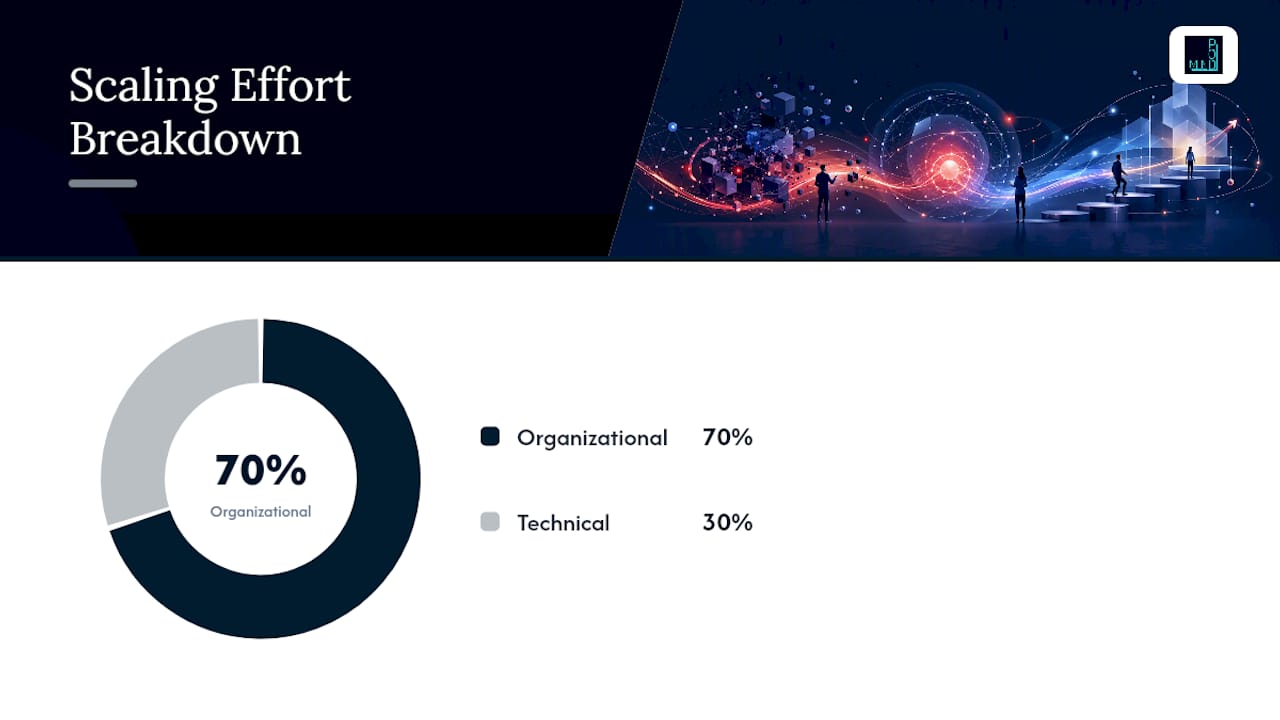
- Successful scaling depends heavily on organizational change management, with 70% of effort focused on people, ownership, and incentives rather than technology.
- Building a phased roadmap involves clear problem framing, detailed design, pilot testing, and governance controls, each requiring a tangible artifact to proceed.
- Multi-agent systems should use explicit state serialization, model routing, and containerized deployment to ensure scalability, auditability, and resilience.
- Governance frameworks involving role-based access, audit trails, approval gates, and safety thresholds are essential before handling real customer data or money.
Table of Contents
- What Is Agentic AI, and How Is It Different From a Chatbot?
- Where Does Agentic AI Actually Pay Off?
- How Do You Build a Phased Agentic AI Roadmap?
- What Architecture Do Multi-Agent Systems Actually Need?
- What Governance and Monitoring Does Agentic AI Need?
- Why Does Scaling Agentic AI Take So Much People Effort?
- What Does a Real Production Agentic AI System Look Like?
- Mindpod's Approach to Agentic AI Strategy
- What Should Leaders Prioritize This Year?
- Ready to Build Your Agentic AI Roadmap?
- Sources
- FAQ
What Is Agentic AI, and How Is It Different From a Chatbot?
Agentic AI orchestrates multiple specialized agents that coordinate toward a goal, rather than answering one prompt at a time. MIT Sloan describes it as agents that plan, call tools, check their own work, and hand off tasks to other agents, all with defined governance around the outcome.
A single-model chatbot answers a question. An agentic system might read an invoice, verify it against three systems, flag a discrepancy, draft an exception report, and route it to the right person, all without a human prompting each step. You need the agentic approach when a process has multiple decision points, touches several systems, or requires sequencing, not when a single lookup or summary will do.
Most enterprises should think in autonomy tiers rather than an all-or-nothing rollout:
- Shadow mode: the agent runs alongside humans and logs what it would have done, with zero live action.
- Supervised: the agent acts, but every output requires human sign-off before it executes.
- Guided: the agent acts autonomously within defined limits and escalates exceptions.
- Full autonomy: the agent operates independently within a bounded, well-tested process.
Most organizations should spend months in supervised and guided modes before granting anything full autonomy.
Where Does Agentic AI Actually Pay Off?
The business case has to start with a specific process, not a technology. Forbes' technology council notes that the right starting question is which process to reimagine first, based on measurable pain, not which agent sounds impressive in a demo.
Pro Tip: Score every candidate process on two axes only: business impact and technical complexity. Start with high-impact, low-complexity work. Save the ambitious, high-complexity projects for after you've proven the operating model once.
Here's where agentic approaches tend to show up first in practice:
- Customer service and intake — agents triage tickets, pull account context, and resolve routine requests, escalating only genuine exceptions.
- Finance operations — invoice matching, exception handling, and reconciliation across ERP and banking systems.
- MSP and internal IT operations — automated ticket triage, patch verification, and routine remediation across Microsoft and Azure environments.
- Legal intake and document review — agents extract key terms, flag risk clauses, and route matters to the right attorney.
- Supply chain and tariff risk — agents monitor supplier data and trade rules, then quantify exposure in dollars rather than a vague risk score.
Roughly 70% of the effort in scaling these systems is organizational, not technical, according to BCG's research on agentic AI strategy. That number should shape your budget before it shapes your architecture diagram.
BCG's own guidance also favors an ordering: speed first, growth second, cost third. Chasing cost savings before you've proven a working process usually backfires.
How Do You Build a Phased Agentic AI Roadmap?
A phase-gated roadmap keeps a pilot from becoming an expensive science project. Structuring the work into pilot, production, and scale stages, with a clear artifact required to exit each phase, is what separates teams that actually ship from teams that circle a demo for a year. Industry playbooks built around phase gates and design canvases consistently point to the same pattern.
Phase 0-1: Frame the problem
- Select one process with a measurable pain point and quantifiable current cost.
- Name an executive champion who owns the outcome, not just the budget line.
- Write service-level objectives (SLOs) before writing a line of code: target error rate, latency, and volume.
- Build the business case with a baseline metric you can measure against later.
Phase 2: Design
- Complete an Agent Design Canvas: inputs, tools, decision points, and escalation paths.
- Map every system integration point and data source the agent touches.
- Design governance controls up front: who approves what, and what gets logged.
- Model the cost architecture, including per-transaction inference cost and model routing.
Phase 3: Build
- Ship a level-one agent with automated tests before adding a second agent.
- Stand up retrieval-augmented generation (RAG) against a curated knowledge base, not your entire file share.
- Select models by task: a cheaper model for routine classification, a stronger model reserved for judgment calls.
Phase 4: Deploy and operate
- Launch with monitoring, a rollback plan, and a red team exercise before go-live.
- Run continuous evaluation, since model updates silently change agent behavior over time.
Each phase gate needs a real artifact to pass. No canvas, no SLO document, no exit. Skipping this step is the single most common reason pilots stall.
What Architecture Do Multi-Agent Systems Actually Need?
Most production agentic systems use a supervisor/worker pattern: one orchestrating agent breaks down a goal and delegates subtasks to specialized worker agents, communicating through defined contracts rather than free-form text. Frameworks like LangGraph, and protocols like MCP, formalize this handoff so agents don't silently drift out of sync.
A few architectural decisions determine whether the system survives contact with real traffic:
- State and memory: use a checkpointer to serialize conversation state explicitly, so any session is resumable and auditable rather than trapped in one agent's memory.
- Model routing: send routine classification to a cheaper model, and reserve larger, more expensive models for the steps that require real judgment.
- Knowledge grounding: back agents with vector-store retrieval against a curated, permissioned data set, not an open crawl of internal documents.
- Deployment: run agents as containerized services (ECS, Fargate, or an equivalent agent runtime) with standard CI/CD, so you can scale one agent independently of the others.
- Observability: trace every agent-to-agent handoff, not just the final output, or you'll have no idea which agent caused a bad result.
Academic work on multi-agent coordination protocols reinforces the same theme technical teams keep rediscovering in production: without explicit contracts between agents, coordination failures compound quietly until an incident forces a rewrite.
What Governance and Monitoring Does Agentic AI Need?
Governance is what lets you scale past one pilot, not a brake on getting started. Every production agent deployment needs a baseline of controls before it touches real customer data or real money:
- Role-based access control (RBAC) limiting which agents can read or write which systems.
- Audit trails logging every decision and action an agent takes, timestamped and attributable.
- Approval gates for any action above a defined risk or dollar threshold.
- Cost caps that hard-stop runaway inference spend before it hits your cloud bill.
- An acceptable-use policy spelling out what agents are and aren't permitted to do autonomously.
Set service-level objectives the same way you would for any production system: error rate under a defined ceiling, P95 latency within a target window, and throughput matched to expected volume, with alerts firing before customers notice a problem. Layer in human-in-the-loop checkpoints for exceptions, scheduled red-team exercises, and a tested rollback procedure you've actually rehearsed, not just documented.
The stakes for skipping this are real. Gartner projects that more than 40% of agentic AI projects will be canceled by the end of 2027, driven by escalating costs, unclear business value, and inadequate risk controls. Governance is the thing that prevents your project from becoming one of those cancellations.
Why Does Scaling Agentic AI Take So Much People Effort?
Scaling past a pilot is mostly a people problem, and the ratio backs that up plainly: BCG estimates 70% of the effort is people and change management, 20% is data and technology, and only 10% is the algorithms themselves. Budget and staff accordingly, or the technical work will finish while adoption stalls.
Four roles need clear owners before you scale beyond one team:
- Executive champion — owns the outcome and clears organizational roadblocks.
- Product owner — prioritizes the backlog of processes and defines success metrics.
- AI operations/SRE lead — owns uptime, monitoring, and incident response for the agents themselves.
- Compliance owner — signs off on data use, audit requirements, and acceptable-use enforcement.
Co-create the workflow with the domain experts who will actually use it, not just the engineering team, and tie adoption to real incentives rather than a mandate memo. The most common failure mode is treating an agent rollout like a software release instead of a change management project. A consultancy focused specifically on building AI-native organizations frames this as the real differentiator between firms that scale agentic AI and firms that stall at pilot number two.
What Does a Real Production Agentic AI System Look Like?
LendingTree built a production multi-agent mortgage assistant on Amazon Bedrock that illustrates the pattern well. The architecture uses a supervisor/worker structure, LangGraph orchestration, RAG-backed knowledge bases, model routing between task types, and containerized services on ECS with Fargate.
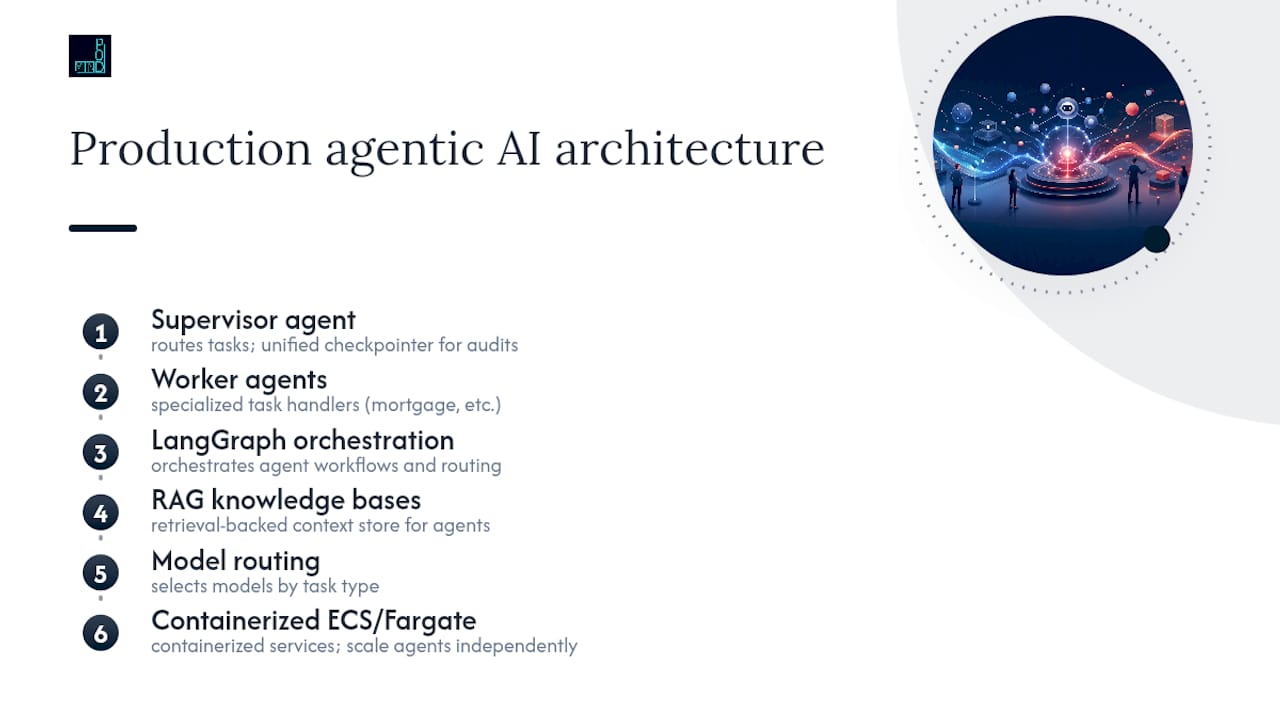
Two operational lessons carry over to almost any industry. First, they solved context-passing with a unified checkpointer, making multi-agent conversations auditable and resumable instead of trapped inside one agent's memory. Second, containerized deployment let them scale individual agents independently rather than scaling the whole system at once.
What to copy: the supervisor/worker split and explicit state serialization. What to adapt: your RAG knowledge base and compliance controls, since mortgage data rules aren't your industry's rules.
Mindpod's Approach to Agentic AI Strategy
Mindpod Technologies ranks opportunities by ROI and risk before building anything, then integrates agents into the tools your team already uses instead of forcing a new interface. Human-in-the-loop checkpoints and rollback plans ship with the pilot, not after an incident.
Readers can start with the Enterprise Intelligence Assessment, the AI Governance framework, MITB for autonomous IT operations, or SupplyMind.ei for tariff and supplier risk. The engagement model: a free assessment produces a prioritized, plain-language plan the client owns, then Mindpod delivers and operates it.
What Should Leaders Prioritize This Year?
The single biggest lever a leader has is picking the right first process and naming a real executive champion, not a committee. Build your governance and SLOs before you scale past one team; speed matters more than perfection, but only with safeguards already running.
Expect the people effort to dwarf the technical build. Training, ownership, and incentive redesign take longer than most teams plan for. Measure everything against your baseline metric, iterate hard on the first pilot, and resist the urge to launch three agents before you've proven one.
Ready to Build Your Agentic AI Roadmap?
Most agentic AI advice assumes you have an enterprise budget and a data science team standing by. Mindpodtech built its practice around the opposite problem: getting real agentic capability into a company that has neither, without the trial-and-error cost of learning governance the hard way. The Enterprise Intelligence Assessment starts free and produces a prioritized, plain-language plan you own outright, whether or not you ever hire Mindpod to build it.
For companies that need ongoing technical leadership rather than a one-time plan, Fractional CTO engagements put a senior technologist on your team part-time to run the roadmap, manage vendors, and keep the build honest against your budget. If governance is your bigger gap, the AI Governance service builds the RBAC, audit trail, and approval-gate framework this article describes, sized to your actual risk. Start with a technology assessment to identify potential pilot projects.
Sources
- Agentic AI strategy for CIOs and CTOs in 2026 | BCG
- Agentic AI, explained — MIT Sloan
- Gartner press release on agentic AI project cancellations
FAQ
What Is the 30% Rule in AI?
There's no single, universally recognized "30% rule" in agentic AI; the figure people cite most consistently is the inverse ratio from BCG's research: only about 10% of scaling effort goes into the algorithms themselves, while 70% is people and change management and 20% is data and technology. Treat any "30% rule" claim skeptically unless the source defines exactly what it's measuring.
What Are the Four Types of Agentic AI?
Most enterprise frameworks describe agentic AI in terms of autonomy tiers rather than fixed "types": shadow mode, supervised, guided, and full autonomy. Each tier defines how much a human checks before the agent acts, moving from zero live action in shadow mode to independent operation within bounded limits at full autonomy.
Is ChatGPT an Agentic AI?
A standard ChatGPT conversation is a single-model generative AI, not agentic, because it answers a prompt without independently planning multi-step actions or coordinating with other agents. Agentic AI becomes relevant when the model calls tools, checks its own work, and hands off tasks to other agents to complete a broader goal, which is the coordination MIT Sloan describes as defining the category.
What Are Good Examples of Agentic AI?
Strong enterprise examples include automated invoice matching and exception handling in finance, MSP ticket triage across Microsoft and Azure environments, legal document intake and risk-clause flagging, and supply chain agents that quantify tariff exposure in dollars. LendingTree's production mortgage assistant, built on a supervisor/worker pattern with RAG knowledge bases, is one of the clearest public examples of the architecture in live use.
What Does an Agentic AI Strategy Engagement With Mindpod Cost?
Pricing for Mindpod's Enterprise Intelligence Assessment and Fractional CTO engagements isn't published; current pricing is available directly through those pages. The initial assessment itself is free and produces a prioritized plan before any paid engagement begins.